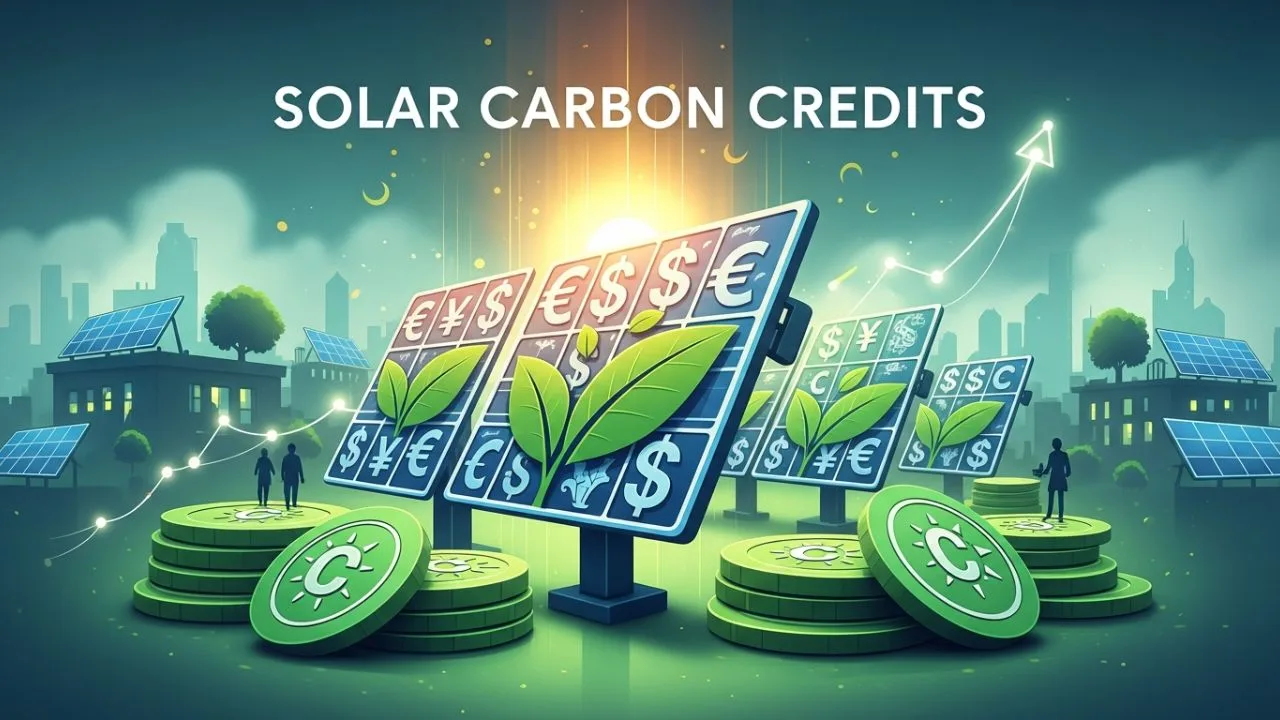
Solar investment has always been associated with stable returns, long-term asset value, and predictable energy production. But in recent years, investors have discovered an additional — and often overlooked — source of income that significantly boosts profitability: solar carbon credits.
This hidden income mechanism transforms the environmental impact of solar power into tradable financial assets, enabling investors to earn extra revenue by monetizing avoided carbon emissions. As global pressure intensifies on companies to meet sustainability targets, demand for high-quality carbon credits is soaring. For solar investors, that creates a unique opportunity.
This article provides a fully exploration of how solar carbon credits work, why they matter, and how investors can tap into this growing market.
Understanding Solar Carbon Credits
What exactly are carbon credits?
A carbon credit represents the reduction or avoidance of one metric tonne of CO₂ emissions. These credits can be traded, sold, or retired in two major markets:

• Compliance Carbon Markets
Mandatory markets where governments require certain industries to offset emissions.
• Voluntary Carbon Markets (VCM)
Buyers voluntarily purchase credits to fulfil corporate sustainability or ESG goals.
Solar projects primarily operate in the voluntary market, where they can claim carbon credits for each tonne of CO₂ they help prevent by replacing fossil-fuel-generated electricity.
How solar projects generate credits
When solar power feeds into the grid, it replaces electricity that would otherwise be produced by coal, gas, or oil. This prevents greenhouse gas pollution.
These avoided emissions are converted into solar carbon credits through a process of validation, verification, and certification according to global standards such as:
- Verra (VCS – Verified Carbon Standard)
- Gold Standard
- Global Carbon Council
- Regional government registries
These organizations approve solar projects and determine how many credits they can generate each year.
Read Also: Defence Solarisation Program 2025: How India’s Armed Forces Are Going Off-Grid
How Solar Carbon Credits Are Created: A Step-by-Step Process
Generating carbon credits from a solar project involves a structured, transparent workflow:
Step 1: Project Design & Baseline Assessment
Developers determine how much electricity the plant will produce yearly. Then, they calculate how much CO₂ would have been emitted if fossil fuels generated that electricity. This is known as the baseline.
Step 2: Choosing a Certification Standard
Registries such as Verra or Gold Standard dictate the rules and methodologies for measuring emission reductions.
Step 3: Validation by Independent Auditors
Third-party validators confirm the project’s technical feasibility, emission calculations, and compliance with carbon methodologies.
Step 4: Monitoring Power Generation
Once the plant is operational, real-time data is monitored and recorded.
Step 5: Verification & Certification
Verified emission reductions (VERs) are issued as carbon credits in the registry.
Step 6: Selling Credits in the Market
The project owner can sell these credits to buyers seeking to offset their carbon footprint.
Thus, every year a solar plant operates, it may produce thousands of carbon credits — each representing real financial value.
Why Solar Carbon Credits Matter for Investors
Solar projects typically earn revenue through:
- Electricity sales (primary income)
- Government incentives
- Net metering or feed-in tariffs
Carbon credits introduce an entirely new revenue layer:
Additional Passive Income
Solar plants consistently offset fossil-fuel emissions, which means credits can be generated and sold year after year — often for 10 to 15+ years depending on the certification standard.
Higher ROI and Shorter Payback Period
Carbon credit sales can increase annual project revenue by 5% to 25%, depending on:
- Market price of credits
- Volume of electricity produced
- Grid emission factors
- Certification quality
This can reduce payback time and make solar investments more attractive to banks and institutional investors.
Better Financial Stability
Carbon credits act as a revenue stabilizer, especially in regions where electricity tariffs fluctuate or government incentives decline.
The Types of Investors Who Can Earn from Solar Carbon Credits
Not all investors can participate in carbon markets directly, but many can do so through structured channels.
Utility-Scale Solar Investors
Large renewable energy companies and infrastructure investors can directly register their projects for carbon credits. For them, credits can significantly improve annual returns.
C&I (Commercial & Industrial) Solar Developers
Companies that install solar systems for factories, malls, industrial units, or commercial buildings can claim credits—depending on contract terms.
Some businesses choose to keep the credits to offset their own emissions, while others sell them for profit.
Retail & Small Investors
Individual investors can benefit through:
- Green energy funds
- Yieldcos
- Fractional solar ownership platforms
These entities handle the registration and management of carbon credits, distributing income proportionally to their investors.
How Solar Carbon Credits Enhance Returns
Multi-Layered Revenue Model
Solar investments now offer:
- Income from electricity generation
- Government subsidies (in certain regions)
- Additional profit from carbon credits
This diversified revenue structure makes solar one of the most stable renewable investments.
Boosting IRR (Internal Rate of Return)
Even a modest carbon credit price significantly elevates IRR, tipping borderline projects into strong profitability.
Advantage for Financing & Debt
Banks favor projects with carbon credit eligibility because it:
- Improves cash flow
- Reduces risk
- Strengthens project viability
This may result in better financing terms.
Risks and Limitations Investors Should Know
Carbon credits are powerful but not risk-free.
Market Price Volatility
Carbon credit prices fluctuate due to:
- Climate policy changes
- Corporate demand
- Supply of low-cost credits
- Global economic trends
This can affect year-to-year income.
Stricter Additionality Requirements
Some carbon standards may tighten rules and disqualify older projects if they no longer meet additionality criteria.
Administrative Costs
Issuing and maintaining carbon credits requires:
- Validation fees
- Verification audits
- Registry costs
- Consultant fees
Small projects may find these costs significant unless aggregated.
Changing Grid Emission Factors
As more clean energy enters the grid, emission factors decrease, leading to fewer credits per kWh of solar energy.
How Investors Can Access Solar Carbon Credits
Direct Ownership of Solar Assets
Large investors can register their own utility-scale solar farms for credit issuance.
Investing Through Funds
Green investment funds often include carbon credit income in their return structure.
Fractional Solar Investment Platforms
These platforms:
- Pool several solar plants
- Handle carbon credit certification
- Distribute revenue to investors
This is ideal for smaller investors.
Corporate Carbon Offsetting
Companies with sustainability goals often invest in solar projects to generate their own offsets instead of buying credits.
Key Questions to Ask Before Investing
Before counting carbon revenue into your ROI calculations, ask:
Which carbon standard certifies the project?
Is the project already registered or still in planning?
How many credits have been issued historically?
Who legally owns the carbon credits — developer or investor?
What is the expected issuance cycle — yearly or biannually?
How much revenue is lost to fees and audits?
Does the project have strong community and environmental co-benefits?
These answers help you evaluate whether the carbon revenue projections are realistic.
Beyond Profits: The Strategic Value of Carbon Credits
Boosting ESG Profiles
Investors and businesses can significantly strengthen their ESG scores through solar carbon credit involvement.
Securing Green Financing
Projects with credible carbon credit issuance may qualify for:
- Sustainability-linked loans
- Green bonds
- Climate finance programs
Environmental and Social Impact
High-quality solar projects contribute to:
- Cleaner air
- Rural electrification
- Local job creation
- Reduced dependence on fossil fuels
Investors benefit financially while helping accelerate the global transition to clean energy.
Read Also: Revolution Under the Roof: How Invisible Solar Tiles Are Changing Home Design Forever
The Future of Solar Carbon Credits
The carbon market is evolving rapidly. Here’s what the future may hold:
Increasing Demand for High-Quality Credits
Corporations worldwide are committing to net-zero targets, driving demand for solar-based offsets.
Digital Transformation
Blockchain, AI, and smart metering will streamline:
- Verification
- Transparency
- Fractional trading
This may open the space to millions of new investors.
Reduced Carbon Avoidance Over Time
As national grids become greener, avoided emissions per solar plant may decrease, reducing future credit issuance.
Conclusion: A Hidden Opportunity Worth Exploring
Solar carbon credits represent an underutilized yet increasingly lucrative revenue source for investors. By converting emissions avoided into tradable financial assets, solar owners can unlock significant additional income while supporting global climate goals.
For investors — whether institutional, corporate, or retail — understanding and leveraging carbon credits can transform a standard solar investment into a high-impact, high-return opportunity.
As the world accelerates toward cleaner energy, those who grasp this hidden income stream early will enjoy both financial rewards and long-term strategic benefits.
Related Posts