

Solar Farm Operations and Maintenance Plan : Learn how to build a future-ready solar farm O&M plan for 2026 with expert insights, India-focused strategies, and global best practices.
Introduction: Why Solar Farm O&M Is No Longer Optional
India’s solar capacity is moving rapidly toward the 500 GW clean energy target, and globally, utility-scale solar farms are becoming the backbone of energy security. In this evolving landscape, a Solar Farm Operations and Maintenance Plan is no longer just a technical document—it is a business survival strategy. As we approach 2026, solar plants that lack a structured O&M framework risk lower generation, higher downtime, and poor investor confidence.
This guide explains how to design a practical, future-ready O&M plan that improves performance, controls costs, and aligns with India’s regulatory and climatic realities—while remaining globally relevant.
Understanding the Purpose of a Solar O&M Strategy
Operations and Maintenance (O&M) covers all activities required to keep a solar power plant running efficiently throughout its lifecycle. From daily monitoring to long-term asset management, O&M directly impacts:
- Energy yield and PR (Performance Ratio)
- Equipment lifespan
- Safety and compliance
- Financial returns
By 2026, solar farms will increasingly depend on data-driven and preventive maintenance approaches rather than reactive fixes.
Read Also: Photovoltaic Systems in Hotels: Milleproroghe 2025 Opportunity for Italy’s Hospitality Sector
What Is a Solar Farm Operations and Maintenance Plan?
A Solar Farm Operations and Maintenance Plan is a structured roadmap that defines how a solar plant will be monitored, maintained, and optimized over 25–30 years. It sets clear procedures, responsibilities, and performance benchmarks for both on-site and remote teams.
A strong plan balances technical discipline with flexibility—especially important in India, where dust, heat, monsoons, and grid variability play a major role.
Core Components of an Effective Solar O&M Plan
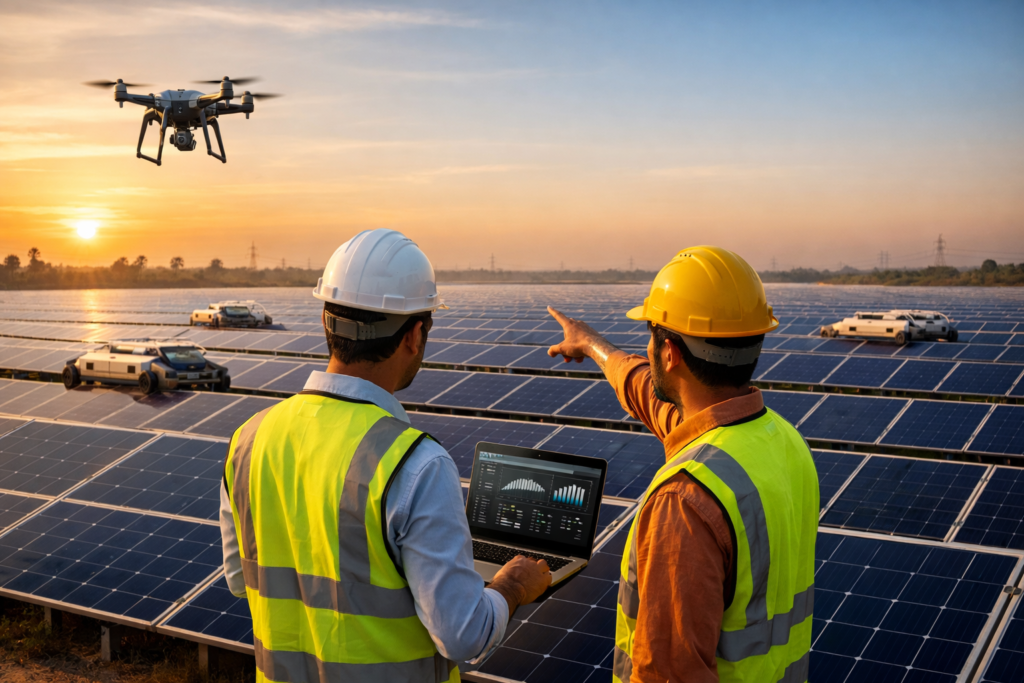
1. Asset Monitoring and Performance Tracking
By 2026, real-time monitoring will be standard, not optional.
Key elements include:
- SCADA systems for live data
- String-level or module-level monitoring
- AI-based anomaly detection
- Automated alerts for underperformance
Advanced analytics help identify issues like degradation, shading losses, or inverter inefficiencies before they impact revenue.
2. Preventive and Predictive Maintenance
Preventive maintenance reduces unexpected failures, while predictive maintenance uses data trends to forecast issues.
Typical preventive tasks:
- Scheduled inverter inspections
- Transformer oil testing
- Torque checks on mounting structures
- Thermal imaging inspections
Predictive maintenance is gaining ground in India as O&M providers adopt machine learning tools that analyze weather, load, and historical fault data.
3. Module Cleaning Strategy (India-Specific Focus)
Soiling losses can exceed 5–7% annually in dusty regions like Rajasthan, Gujarat, and Tamil Nadu.
An effective cleaning plan should define:
- Cleaning frequency by season
- Water-based vs. robotic cleaning
- Water consumption optimization
- Health and safety protocols
In 2026, waterless robotic cleaning systems are expected to become mainstream for utility-scale projects.
4. Inverter and Electrical System Management
Inverters remain the most failure-prone components of solar plants.
Best practices include:
- Maintaining critical spares inventory
- Firmware updates and remote diagnostics
- Clear SLA timelines for fault resolution
- Root cause analysis for repeated failures
A well-documented Solar Farm Operations and Maintenance Plan ensures inverter downtime stays within bankable limits.
Read Also: Cost of Installing Solar for Factories
Human Resource Planning and Training
Even with automation, skilled technicians remain essential.
Your plan should define:
- Roles and responsibilities
- Shift schedules and response times
- Safety training and certifications
- Vendor coordination procedures
By 2026, hybrid teams—combining on-ground staff with centralized remote monitoring centers—will dominate large solar portfolios.
Compliance, Safety, and Documentation
Regulatory compliance is becoming stricter in India and globally.
Include protocols for:
- Electrical safety and lockout-tagout
- Fire safety and emergency response
- Statutory inspections and reporting
- Environmental and ESG compliance
Well-maintained documentation not only avoids penalties but also improves asset valuation during refinancing or asset sales.
Cost Optimization Without Performance Compromise
O&M costs typically range between 1.5% and 2.5% of total project cost annually. The goal is not to cut costs blindly, but to optimize spending.
Smart cost strategies:
- Long-term AMC contracts with performance incentives
- Data-driven maintenance scheduling
- Standardized spare parts across portfolios
- Remote diagnostics to reduce site visits
A forward-looking Solar Farm Operations and Maintenance Plan aligns technical decisions with financial discipline.
Digital Tools Shaping Solar O&M in 2026
Technology trends redefining solar O&M include:
- AI-based fault prediction
- Digital twins of solar plants
- Drone-based thermography
- Blockchain for maintenance records
These tools improve transparency, reduce manual errors, and enhance investor confidence—especially for large IPPs and developers.
FAQ: Solar Farm O&M Planning
1. How often should a solar O&M plan be updated?
Ideally, it should be reviewed annually or whenever major upgrades or regulatory changes occur.
2. Is robotic cleaning suitable for all Indian solar farms?
Robotic cleaning works best for large, flat utility-scale plants but may not suit uneven terrains.
3. Can small solar developers afford advanced O&M tools?
Yes. Many tools are now available on subscription models, reducing upfront costs.
4. Does a good O&M plan improve financing options?
Absolutely. Banks and investors prefer projects with clear O&M frameworks and performance history.
Conclusion: Building Long-Term Value Beyond 2026
As solar energy matures from a growth sector into a stable infrastructure asset, disciplined operations will separate high-performing plants from underperforming ones. A well-designed Solar Farm Operations and Maintenance Plan is not just about fixing faults—it is about protecting energy yield, ensuring safety, and maximizing returns over decades.
For India and global markets alike, 2026 will reward solar projects that invest early in structured O&M planning. Those who treat O&M as a strategic function—not a cost center—will define the next phase of clean energy leadership.
Related Posts



1 thought on “How to Create a Solar Farm Operations and Maintenance Plan That Works in 2026”