
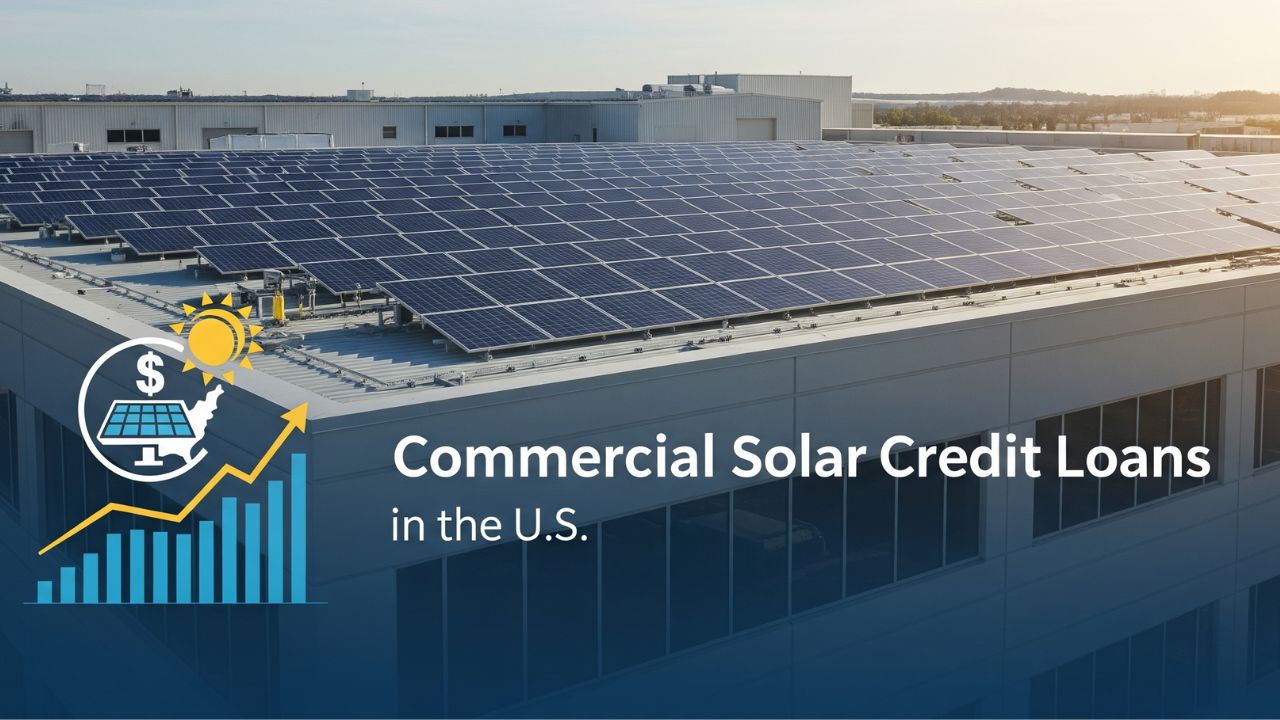
Businesses across the United States are rapidly adopting commercial solar systems, driven by powerful tax benefits, flexible loan structures, and long-term energy savings that make renewable energy both accessible and profitable for companies of all sizes.
In a landscape shaped by rising energy prices and sustainability expectations, commercial solar credit loans now offer U.S. businesses an unprecedented opportunity to reduce operating costs, unlock major tax incentives, and leverage innovative financing models tailored to the clean-energy transition.
The Expanding Role of Tax Incentives in Commercial Solar Adoption
The U.S. government is encouraging solar expansion more aggressively than ever before. Through federal programs and state-level incentives, businesses switching to solar can significantly reduce upfront investment costs. At the heart of these benefits is the Federal Investment Tax Credit (ITC), which allows companies to claim 30% of the total installation cost as a credit against federal taxes.
The Inflation Reduction Act (IRA) further strengthens the ITC by introducing bonus credits, enabling eligible commercial solar projects to secure up to 40–60% in total tax savings. These additional bonus credits apply to:
- Energy communities
- Low-income or underserved areas
- Domestic manufacturing-based projects
- Small-scale solar installations under specific caps
Another powerful tax-saving mechanism is the Modified Accelerated Cost Recovery System (MACRS). Through MACRS, businesses can depreciate most of the solar system’s value in the first year, dramatically improving cash flow and reducing tax liability.
For many companies, these tax advantages are the deciding factor that makes solar energy a financially compelling investment rather than simply an environmental choice.
Read Also: Global Solar Tax Credits: Country-by-Country Incentive Guide
How Commercial Solar Credit Loans Work in the U.S. Market
Commercial solar credit loans allow businesses to adopt solar with minimal upfront expense while enjoying full ownership benefits. These loans function much like traditional financing options, but with added flexibility to match renewable-energy goals.
With a solar credit loan, companies:
- Install the solar system immediately
- Pay monthly installments over 5–20 years
- Benefit from tax credits and depreciation
- Own the system outright once the loan is repaid
Ownership is a major advantage because it allows the business—not the lender or solar provider—to capture the full value of tax incentives. Additionally, companies gain from energy cost reductions that can begin the moment the system activates.
These loans are particularly beneficial for small and medium-sized businesses that want to move toward sustainability without jeopardizing their capital reserves.
Key Types of Commercial Solar Credit Loans Available
Commercial solar financing in the U.S. is diverse, offering multiple models tailored to different business sizes, risk levels, and financial strategies.
Secured Solar Loans
These loans use business assets—or the solar system itself—as collateral. They typically offer:
- Lower interest rates
- Longer repayment terms
- Increased borrowing amounts
Secured loans are well-suited for established companies with strong balance sheets seeking maximum cost-efficiency.
Unsecured Solar Loans
Unsecured loans rely primarily on the business’s credit rating. While interest rates may be slightly higher, they do not require collateral and offer a simpler approval process.
These are ideal for small businesses wanting a faster financing path.
PACE (Property-Assessed Clean Energy) Financing
PACE is one of the most innovative financing tools available today. It allows businesses to finance solar upgrades and repay the cost through property tax bills, often over 20–30 years.
Key benefits include:
- Long repayment terms
- Transferable to new property owners
- No major upfront investment
- Minimal impact on cash flow
PACE financing is gaining popularity in states like California, Florida, and Colorado.
Energy-as-a-Service (EaaS) Solar Loans
This model blends financing with ongoing maintenance and system monitoring. Companies pay a fixed service fee, while the provider ensures system performance.
This option is perfect for businesses lacking technical expertise or personnel to manage solar installations.
Green Business Loans & Credit Union Programs
Community-focused lenders and green banks offer specialized solar loans with:
- Lower interest rates
- Incentive-based reductions
- Flexible qualification criteria
These local programs help smaller businesses participate in the clean-energy shift.
Why Businesses Are Moving Toward Solar Credit Loans
Long-Term Energy Cost Stability
Solar credit loans help businesses lock in predictable electricity costs for decades. With utility prices rising, this stability provides a competitive advantage.
Fast Return on Investment
Thanks to tax credits, MACRS depreciation, and reduced utility bills, most commercial solar projects reach payback within 3–7 years, depending on system size and local incentives.
Full Ownership Benefits
Unlike solar leases or power purchase agreements (PPAs), loans provide ownership. This means companies retain:
- All tax benefits
- Depreciation advantages
- Energy savings
- Increased property value
Ownership also contributes positively to corporate sustainability reporting, strengthening trust with customers and investors.
Support for ESG and Net-Zero Goals
Corporate sustainability goals are becoming mandatory across industries. Solar systems help businesses:
- Lower carbon emissions
- Improve ESG scores
- Meet regulatory guidelines
- Build environmentally responsible brands
With climate accountability rising, solar adoption is increasingly linked to long-term brand performance.
The Strategic Value of Commercial Solar for U.S. Businesses
Commercial solar is now seen as a strategic investment rather than an operational upgrade. Companies adopting solar enjoy:
- Long-term operational savings
- Higher control over energy production
- Reduced dependence on public utilities
- Improved resilience during economic fluctuations
Many commercial buildings also experience increased property values, making solar a smart long-term asset.
Moreover, solar energy opens the possibility for battery storage integration. When paired with storage, businesses can mitigate outages, avoid peak-demand charges, and operate with enhanced energy independence.
Read Also: Low-Income Solar Loans in the U.S. – Hidden State Benefits 2025
Financing Models Shaping the Future of Commercial Solar
The future of commercial solar in the United States is shaped by modern financing models that prioritize flexibility, sustainability, and accessibility.
1. Traditional Bank Loans
Banks now view solar as a low-risk, high-value investment due to guaranteed energy savings and strong tax support. This results in competitive interest rates even for medium-sized firms.
2. Solar-Specific Lending Platforms
New fintech solutions offer fast approval and flexible repayment options tailored specifically to solar installation costs.
3. State and Local Incentive Programs
Numerous states are offering:
- Rebates
- Buy-down grants
- Loan-interest subsidies
These incentives dramatically reduce net installation costs.
4. Public-Private Partnerships
Municipalities and private lenders are collaborating to expand commercial solar access. These programs often target underserved regions to support economic and environmental growth.
Conclusion: The Future of Commercial Solar Credit Loans in America
The commercial solar industry in the United States is entering a period of accelerated expansion. As more businesses learn about robust tax incentives, affordable financing models, and long-term sustainability benefits, solar installations are expected to surge across warehouses, retail spaces, office buildings, factories, and data centers.
By 2030, analysts predict that commercial solar will be a standard feature of modern business infrastructure. Companies adopting solar today are positioning themselves ahead of regulatory shifts and consumer expectations.
With climate policies tightening globally, the demand for solar credit loans—especially those offering flexible terms—will rise sharply. This ensures that commercial solar will remain one of the most profitable energy investments for U.S. companies throughout the next decade.
Related Posts


1 thought on “Commercial Solar Credit Loans in the U.S. – Tax Benefits, Financing Models & Business Savings”