
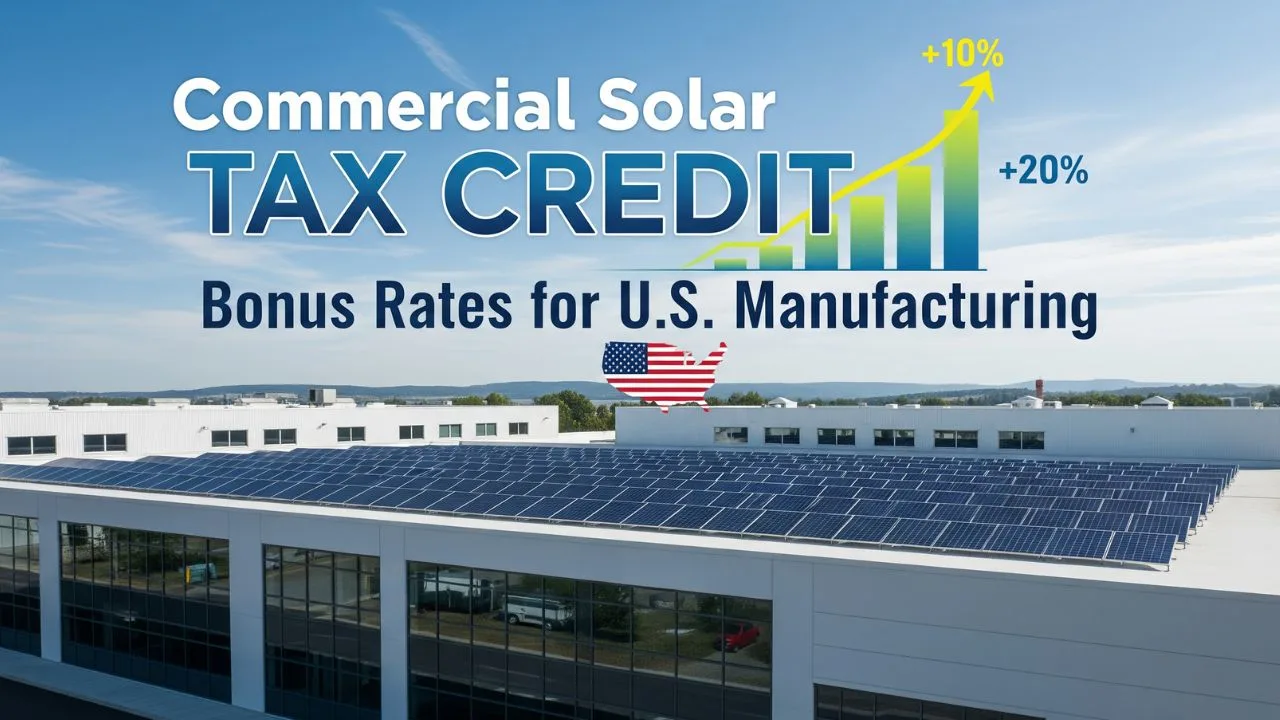
In a rapidly evolving clean-energy landscape, understanding commercial solar tax credit bonus rates tied to domestic manufacturing has become essential for companies aiming to secure financial advantages and accelerate their transition to renewable power.
The expansion of federal incentives supporting U.S.-based solar manufacturing has reshaped the commercial renewable-energy sector. These incentives not only fuel the growth of local supply chains but also open unprecedented financial opportunities for businesses committed to integrating domestically produced solar technology.
A New Era of Solar Incentives: What the Bonus Rates Mean for Businesses
Recent federal policies mark the beginning of a transformative era for American solar manufacturing. Through the introduction of enhanced bonus rates layered onto the existing Investment Tax Credit (ITC), the government aims to accelerate clean-energy deployment while strengthening national production capabilities.

These bonus tax credits reward developers who choose domestically manufactured solar components — from photovoltaic modules to inverters and structural materials. By supplementing the base ITC rate with additional percentage points, the incentives significantly improve project economics.
For commercial developers, this means that solar installations that previously hovered at the edge of financial feasibility may now become profitable megawatt-scale opportunities. Companies integrating domestic content will benefit from a combination of reduced capital expenditure, lower long-term operating costs, and substantial tax savings, all while supporting U.S. manufacturing growth.
What makes these incentives especially notable is their long-term impact: businesses are not only saving money but actively contributing to a resilient national supply chain less vulnerable to global disruptions.
Read Also: High-Efficiency Solar Panel Tax Credit 2025 New IRS Guidelines for Home Renovations
Why Domestic Manufacturing Matters: Stabilizing the Clean-Energy Supply Chain
In recent years, global renewable-energy markets have experienced volatility triggered by supply chain bottlenecks, fluctuating material prices, and international trade challenges. These issues have often led to delays and sudden cost overruns in commercial solar projects.
The new bonus credit structure serves as a strategic response to these vulnerabilities. By boosting demand for U.S.-produced solar components, policymakers aim to create a more predictable and stable foundation for future clean-energy expansion.
Domestic manufacturing delivers key advantages:
1. Reduced Dependence on Foreign Sources
Solar components have historically been sourced from overseas manufacturers, leaving developers exposed to unpredictable tariffs, shipping delays, and geopolitical tensions. The bonus credits help shift procurement toward American factories, where timelines and pricing are more stable and transparent.
2. Enhanced Quality Control
U.S.-based manufacturers must comply with strict quality and safety regulations, giving developers stronger assurances that components meet high-performance standards.
3. Economic Growth and Job Creation
These incentives stimulate domestic employment across engineering, production, research, logistics, and installation sectors. Companies leveraging the bonus rates effectively support the growth of a robust, nationally integrated clean-energy workforce.
4. Innovation Driven by Local Investment
As demand rises, American manufacturers are expected to expand R&D efforts, improving solar efficiency, durability, and integration technologies. This virtuous cycle of investment will continue to position the U.S. as a global leader in renewable innovation.
Financial Impacts: How Bonus Rates Transform Commercial Solar Economics
For commercial developers and corporate sustainability leaders, no factor is more influential than project cost and return on investment. The introduction of domestic content bonus incentives can dramatically reshape these financial dynamics.
Lower Upfront Capital Costs
By stacking bonus credit rates onto the standard ITC, companies can offset a significantly larger portion of installation costs. For megawatt-scale systems especially, the savings can reach millions of dollars.
Accelerated Project Payback Periods
Shorter payback timelines make solar installations more appealing to investors and lenders. This improved financial profile increases the likelihood of project approval and deployment.
Stronger Negotiating Position with Financiers
Financial institutions view incentive-qualified solar projects as lower risk due to predictable tax credit revenue. Projects that meet domestic manufacturing requirements often secure better financing terms, including:
- Lower interest rates
- Longer repayment periods
- Higher approval rates
Enhanced ESG and Corporate Sustainability Value
Businesses striving to meet environmental, social, and governance targets can leverage these incentives to demonstrate clear commitments to domestic economic growth, energy independence, and emissions reduction. This alignment strengthens brand reputation, investor confidence, and customer trust.
Compliance and Qualification: Meeting the Domestic Content Requirements
While the benefits are substantial, securing the bonus credit requires careful planning and documentation. The requirements vary based on factors such as project scale, component type, and manufacturing location.
Key Compliance Challenges Include:
- Verifying whether equipment meets domestic content thresholds
- Collecting certifications from manufacturers
- Ensuring proper record-keeping for future audits
- Coordinating procurement with suppliers that meet federal criteria
Currently, the availability of domestically manufactured solar components is still expanding. Some developers may face difficulty sourcing qualifying materials for specific system types — especially utility-scale installations with unique component needs.
However, federal and private investments into solar manufacturing facilities are accelerating rapidly. Over the next few years, analysts expect a significant increase in production capacity, reducing shortages and expanding the range of qualifying components available.
Industry Perspectives: How Developers Are Responding to the Incentives
Across the commercial solar industry, project developers are adjusting strategies to maximize the financial benefits of bonus credits. Common responses include:
1. Prioritizing Domestic Component Procurement Early in the Planning Phase
Developers are securing domestic materials months earlier than they traditionally would to ensure compliance and lock in supply.
2. Strengthening Supplier Relationships
Partnerships with U.S.-based manufacturers are becoming critical to long-term success. Developers who maintain these relationships gain priority access to limited-supply components.
3. Investing in In-House Compliance Expertise
Many firms are hiring specialists to oversee documentation, verification, and tax compliance, ensuring that every eligible project receives the bonus credit.
4. Emphasizing Domestic Content in Corporate Sustainability Reports
Companies are highlighting their integration of U.S.-manufactured materials as a symbol of responsible sourcing, reinforcing environmental and economic leadership.
Case Scenarios: Real-World Applications of the Bonus Rates
To understand the true impact of the bonus incentives, consider the following example scenarios:
Scenario 1: Large Commercial Facility Installation
A logistics company installs a 5-MW rooftop system. By using domestic modules and racking, the project qualifies for a layered bonus rate.
Outcome: The company reduces installation costs by several million dollars, shortens payback by nearly three years, and gains substantial federal tax offsets.
Scenario 2: Multi-Site Corporate Rollout
A national retail chain begins a multi-state solar rollout across 60 locations. After switching to domestic content suppliers, each installation qualifies for additional tax credits.
Outcome: The company saves enough capital to expand its rollout plan and accelerate its path to net-zero commitments.
Scenario 3: Industrial Manufacturing Facility
A heavy-manufacturing facility integrates solar to reduce operational costs. Bonus credits help offset the cost of solar-plus-battery systems.
Outcome: Annual utility savings combine with tax incentives to significantly strengthen profitability and operational resilience.
These examples illustrate how bonus credit rates can convert once-marginal investments into financially compelling opportunities.
Read Also: Solar Microgrid Tax Incentives 2025: New Funding Powering Schools & Public Infrastructure
The Bigger Picture: How Bonus Rates Shape the Future of U.S. Energy Independence
The commercial solar tax credit bonus for domestic manufacturing represents far more than a financial incentive. It is a strategic component of a national energy transformation.
Strengthening Energy Independence
By building a domestic solar supply chain, the U.S. gains greater control over its energy future — reducing vulnerabilities associated with imported technology.
Driving Long-Term Cost Reductions
As manufacturing scales, costs are expected to fall. The next decade may see the U.S. become a major global hub for high-efficiency and next-generation solar components.
Supporting the Transition to a Low-Carbon Economy
Widespread solar deployment contributes to lower emissions, improved air quality, and more resilient national infrastructure.
Empowering Businesses to Lead the Transition
Commercial enterprises that adopt domestic-content solar solutions become key drivers of the clean-energy future — gaining economic, environmental, and reputational advantages.
Conclusion: A Powerful Moment for Commercial Solar Investment
The introduction of commercial solar tax credit bonus rates linked to domestic manufacturing marks a pivotal point in the renewable-energy industry. For businesses, these incentives present an extraordinary chance to reduce capital costs, improve sustainability performance, and support the growth of American manufacturing.
Companies that take early action, secure domestic manufacturing partnerships, and align their solar strategies with these federal incentives will be positioned at the forefront of the clean-energy revolution. With strong financial backing and a growing ecosystem of U.S.-based solar suppliers, the future of commercial solar development has never been more promising.
Related Posts


1 thought on “Commercial Solar Tax Credit Bonus Rates for U.S. Manufacturing”