
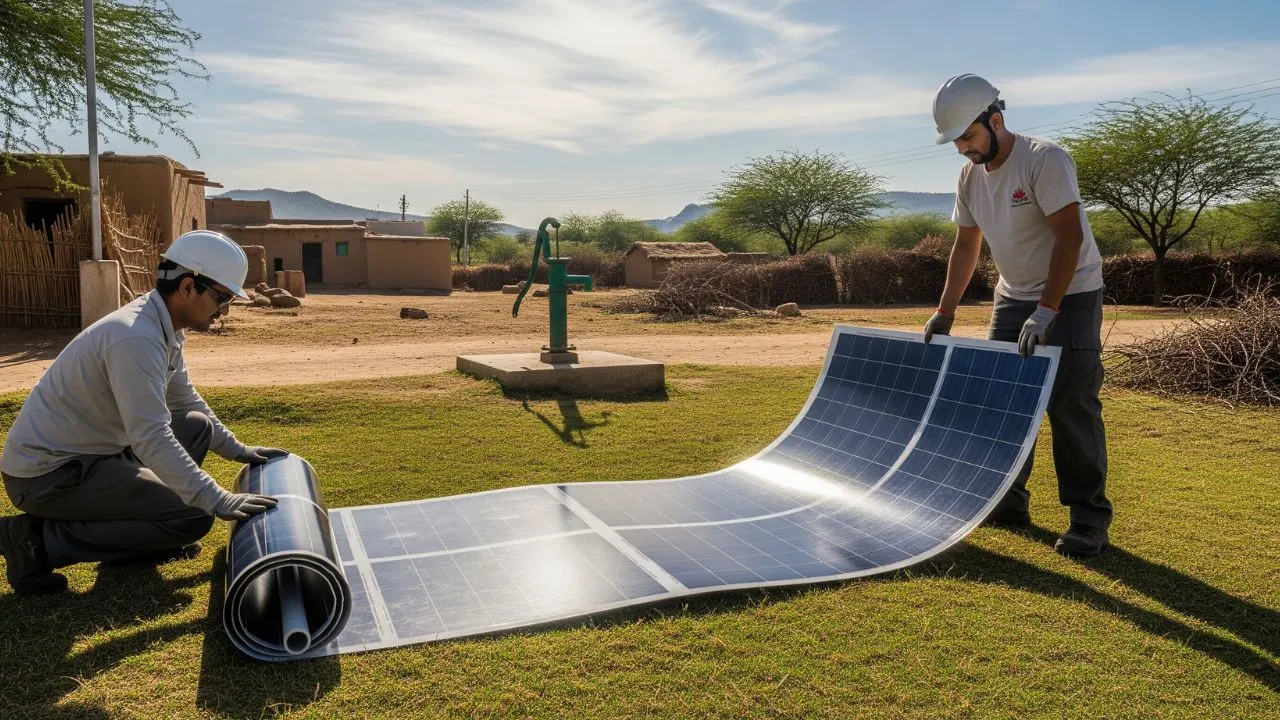
India introduces a breakthrough flexible solar panel designed for modern homes and industries, reshaping renewable energy possibilities.
India’s renewable energy landscape has taken a historic leap forward with the introduction of the nation’s first-ever flexible solar panel, a cutting-edge solution engineered to revolutionize how citizens and businesses harness solar power. This breakthrough technology promises higher efficiency, affordability, and unmatched versatility for diverse applications across the country.
A Game-Changer in India’s Renewable Energy Sector
The arrival of India’s first flexible solar panel marks a pivotal moment in the nation’s clean energy mission. Unlike traditional rigid systems, this pioneering panel is designed to bend, flex, and adapt to curved surfaces, making solar adoption easier and more accessible for millions.

The government’s push toward solar growth under initiatives like PM Surya Ghar and National Solar Mission set the stage for disruptive innovations. This new flexible panel fits seamlessly into that vision, offering a modern approach to fast-track India’s green transition.
Engineered using thin-film technology, the panel is lightweight, ultra-thin, and far easier to install than conventional modules, opening the door for use in areas previously unsuitable for solar installations.
Breakthrough Design: What Makes the Panel Truly “Flexible”?
At the heart of this innovation lies advanced CIGS (Copper Indium Gallium Selenide) or Perovskite-based thin-film solar technology, known globally for its flexibility and high-performance characteristics. These materials allow the solar panel to be rolled, bent, or curved without losing structural integrity.
Key advantages of this design include:
- Lightweight build, reducing structural load on rooftops and vehicles
- Ultra-thin construction, enabling portability and compact storage
- Impact resistance, making the panels durable in harsh weather
- Easy installation, even on unconventional or uneven surfaces
This flexible design represents a major step toward a future in which solar energy can power homes, vehicles, consumer gadgets, and temporary setups with ease.
Read Also: The Inflation Reduction Act (IRA) Solar Incentives: What Homeowners Must Know in 2025
Applications Across Industries: More Than Just Rooftops
One of the most compelling aspects of India’s first flexible solar panel is its immense adaptability across sectors. Its versatile build makes it suitable for environments where traditional panels cannot function efficiently.
1. Residential Spaces
Homeowners can now install panels on curved rooftops, balconies, and even exterior walls. The module’s lightweight nature helps eliminate structural concerns.
2. Electric Vehicles & Mobility
Flexible panels can be fitted on EV roofs, caravans, buses, and delivery vans—allowing vehicles to generate supplementary power on the go. This lowers grid dependency and improves battery health.
3. Farming & Rural Electrification
Portable flexible panels provide affordable micro-power solutions for farmers, powering water pumps, fencing, and farm lighting even in remote areas.
4. Commercial Buildings
Glass facades, curved structures, and temporary setups can all benefit from this adaptable solar technology.
5. Disaster Relief & Military Use
With the ability to roll and transport easily, flexible solar panels offer reliable power solutions in emergency zones, border areas, and isolated terrains.
The broad range of applications underscores the enormous impact this innovation could have on India’s long-term energy independence.
Efficiency & Performance: How Strong Is the New Technology?
A major question is how flexible solar panels match up against conventional silicon modules in terms of efficiency. While typical rigid systems deliver around 18–22% efficiency, India’s new-generation flexible panels achieve a competitive range of 14–20%, depending on the underlying thin-film material.
Key Performance Highlights:
- High performance in low light, making them ideal for cloudy regions
- Better heat tolerance, offering stable output in hot climates
- Lower degradation rate, ensuring long service life
- Minimal maintenance, suitable for rural and industrial users
For a country like India, with diverse weather conditions across states, this performance profile can help maximize renewable power generation in multiple environments.
Affordability: A Cost-Effective Solar Solution for All
One of the biggest advantages of the new flexible panel is its affordability. Thin-film technology typically requires less raw material, making production costs lower compared to crystalline solar panels.
Cost benefits include:
- Lower manufacturing costs
- Reduced installation charges due to lightweight design
- Minimal maintenance expenses
- Potential subsidies under government schemes
These factors make flexible solar technology an attractive option for homeowners, start-ups, and large enterprises alike.
Driving Make in India: The Manufacturing Revolution
The launch of India’s flexible solar panel is not just a technological milestone—it also strengthens India’s push for domestic manufacturing. Leading Indian companies in the renewable sector have started establishing large-scale production lines dedicated to thin-film and flexible solar panels.
This step aligns with India’s Atmanirbhar Bharat mission and aims to reduce reliance on imported solar cells and modules. Local manufacturing promises:
- Job creation across assembly, R&D, and distribution
- Boost to Indian solar exports
- More competitive pricing for domestic adopters
This innovation could position India as a global leader in next-generation solar solutions.
Environmental Impact: A Cleaner, Greener Future
By adopting flexible solar panels, India can significantly accelerate its renewable energy goals. These panels contribute to reduced carbon emissions, decreased dependence on fossil fuels, and more sustainable infrastructure development.
Furthermore, the lightweight and low-material design reduces waste and minimizes environmental footprint during production.
India’s energy transition will benefit immensely from scalable and eco-conscious technologies like this one.
Challenges Ahead: What Needs Improvement?
Despite its groundbreaking potential, the technology faces a few hurdles:
- Slightly lower efficiency compared to high-end silicon panels
- Shorter lifespan for certain thin-film materials
- Limited awareness among consumers
- Need for more field testing in extreme conditions
However, ongoing research and scaling of production are expected to rapidly improve efficiency and durability over the coming years.
Read Also: California Solar Tax Credits and Incentives 2025 – The Most Powerful Savings Programs Explained
Future of Flexible Solar in India: What to Expect?
The introduction of India’s first flexible solar panel is likely to spark massive innovation in the coming decade. Experts predict fast growth in:
- Solar-powered mobility
- Solar wearables and gadgets
- Building-integrated photovoltaics (BIPV)
- Portable solar solutions for travellers and military
As manufacturers ramp up production, the technology will become more advanced, affordable, and widespread across the country.
Ultimately, flexible solar could transform India into a global clean energy superpower.
Related Posts

1 thought on “India Launches Its First Flexible Solar Panel: A New Era for Clean Energy Innovation”