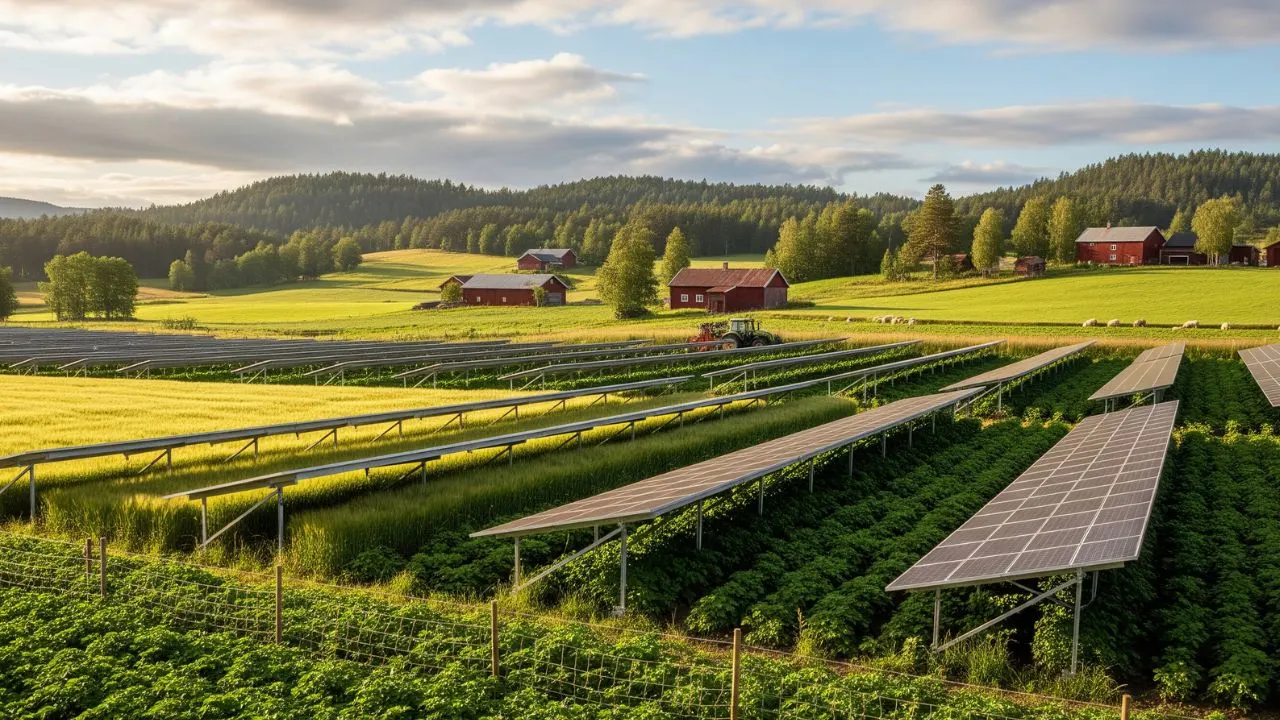
A ground breaking renewable energy initiative is set to reshape Norway’s energy future, integrating solar technology with agricultural land use across an expansive eastern Norwegian landscape.
The launch of the country’s largest agrivoltaic installation marks a decisive step forward for a nation historically rooted in hydropower. As Norway navigates a rapidly evolving energy landscape, the newly approved project stands as a bold signal of the country’s willingness to expand its renewable portfolio through innovative, land-efficient methods.
Energeia AS Secures Historic Approval for a Solar Milestone
Norwegian solar developer Energeia AS has received an official concession from the Norwegian Water Resources and Energy Directorate (NVE) to build, own, and operate a 46 MW agrivoltaic power station—the largest solar project allocated in Norway to date. Known as the Seval Skog project, the development will occupy 72 hectares in the municipality of Gjovik in eastern Norway and will operate under a 30-year authorization through a public–private arrangement with the municipality.
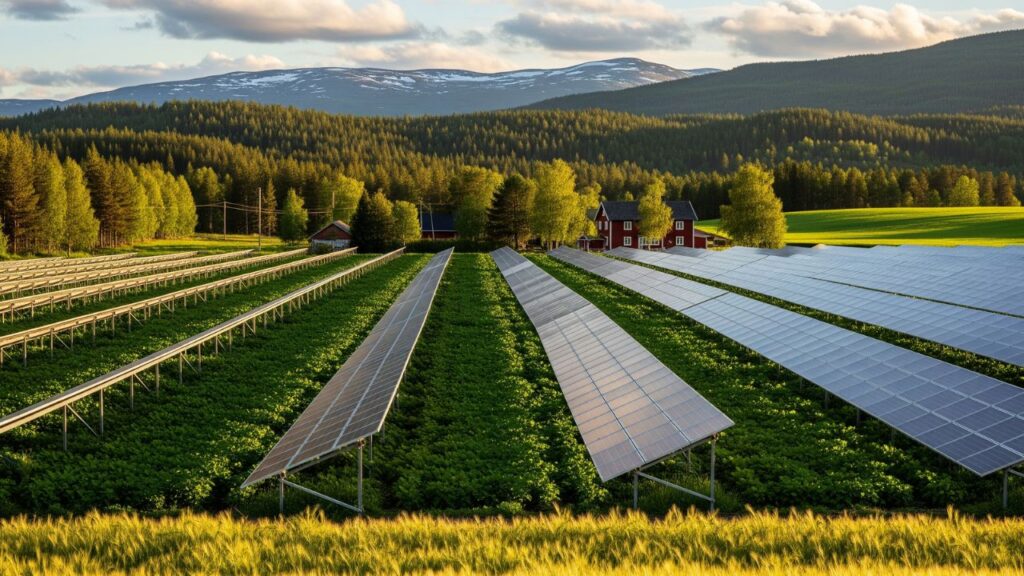
This project is a significant leap in scale. According to Energeia advisor Per Storberget, the solar plant will be “approximately four times larger than any other concession previously awarded in Norway,” highlighting its importance in setting new national benchmarks.
Designed with a single-axis tracker system, the project is expected to generate approximately 53 GWh of electricity per year, enough to power thousands of Norwegian homes. The plant will also integrate a 6 MW/12 MWh energy storage system, improving grid stability by storing excess energy during peak production times and releasing it when demand rises or sunlight dips. This hybrid approach demonstrates Energeia’s intention to support Norway’s energy reliability as the country expands its renewable footprint.
Read Also: Extended Solar Warranty vs. Home Insurance: Essential Guide for U.S. Homeowners 2025
A New Model for Agricultural and Energy Synergy
While the project’s energy capacity is remarkable, its agrivoltaic framework adds another layer of significance. Agrivoltaics—dual land use that pairs solar infrastructure with agricultural activity—has been gaining global momentum in countries seeking to balance food production, land protection, and clean energy generation. Norway, known for its rugged terrain and limited arable land, stands to benefit tremendously from such a model.
Energeia’s current plans include grass cultivation beneath and around the solar arrays, with the landscape also serving as pasture for grazing animals in the autumn. This dual-use approach ensures that the land remains productive and maintains agricultural value, even as it hosts advanced photovoltaic technology.
By adopting this model, the Seval Skog project aligns with growing EU and Nordic regional strategies that promote efficient land use and rural sustainability. The project will serve as a working demonstration of how Norway can integrate renewable energy expansion with local agricultural ecosystems, allowing municipalities and farmers to benefit jointly from technological progress.
Notably, agrivoltaics can also enhance crop performance by providing partial shading, reducing water loss, and creating microclimates that perform better under certain seasonal conditions. While Norway’s agricultural output differs from warmer climates where agrivoltaics originally gained popularity, this project will help determine how these benefits translate to Nordic farming environments.
The Road to Approval: A Multi-Year Development Process
Although Energeia only recently obtained its final license, the groundwork for the Seval Skog project began years earlier. Development officially commenced in 2021, when the company signed a long-term land lease agreement with the municipality of Gjovik. This early step established the foundation for cooperation and ensured that the project aligned with local land-use priorities.
Energeia submitted its full licensing application last year, which the NVE accepted for review before granting approval earlier this year. In parallel, the municipality issued a deforestation permit to clear the designated land area in preparation for infrastructure deployment. Though deforestation is a sensitive topic in Norway, the environmental assessment concluded that the long-term renewable energy benefits—and agrivoltaic land reuse—offset potential impacts.
Energeia is currently finalizing its preliminary investment decision, expected before the end of this year. A final investment decision (FID) is anticipated in the first quarter of next year, after which full-scale procurement and construction planning will move forward.
With all approvals and decisions aligned, construction is slated to begin next year. The project’s first grid connection is scheduled for 2027, with full operational activity anticipated in 2028. This timeline places the Seval Skog development among the fastest-moving large-scale solar initiatives in Norway’s history.
Expanding Norway’s Renewable Energy Landscape
The Seval Skog installation is part of a broader strategic expansion by Energeia AS, which has been aggressively advancing new solar projects throughout the country. Since September 2024, the company has submitted applications for three additional solar plants with projected capacities of 32 MW, 6 MW, and 24 MW, respectively. Beyond these immediate proposals, Energeia is also progressing on three early-stage developments aimed at much larger scales, with planned capacities of 103 MW, 117 MW, and 97 MW.
If approved and completed, these projects could transform Norway’s solar generation capacity over the coming decade. They signal a shift from small and medium-sized rooftop installations toward large, utility-scale solar farms, expanding renewable diversity and complementing Norway’s famous hydroelectric grid.
This momentum coincides with national installation trends. In the first half of 2025 alone, Norway deployed 49 MW of new solar capacity, bringing total national capacity to 763 MW. The commercial and industrial (C&I) segment represented more than half of this growth, showing a strong shift in business investment toward renewable energy infrastructure.
While Norway still ranks far behind solar-heavy countries like Germany or Spain, the country’s adoption curve is steepening. As technology becomes more efficient and as hydropower faces seasonal variation challenges due to climate change, solar energy is emerging as a crucial complement to the national grid.
Strategic Importance for Norway’s Energy Future
The approval of the Seval Skog agrivoltaic project highlights several key trends that are shaping Norway’s long-term energy evolution:
1. Diversification Beyond Hydropower
Hydropower remains Norway’s dominant energy source, but changing precipitation patterns and seasonal water levels create new pressures. Solar provides a complementary resource that performs well during drier periods—especially in summer when electricity demand increases.
Read Also: Solar Panel Recycling Tax Benefits: New Federal Incentives
2. Land-Use Efficiency Through Agrivoltaics
By integrating agricultural activity, Energeia is addressing common land-use criticisms associated with solar expansion. Dual-use systems ensure that solar farms contribute to food security as well as energy security, making them more socially and politically palatable.
3. Grid Stability Through Energy Storage
With the addition of a 6 MW/12 MWh battery system, the project supports Norway’s broader shift toward flexible, smart grid technologies. Storage helps balance intermittent supply and improves resilience during peak consumption hours.
4. Local Economic Growth and Rural Revitalization
Large renewable projects bring benefits to municipalities through new tax revenue, community partnerships, job creation, and infrastructure growth. Gjovik’s decision to collaborate with Energeia indicates a growing interest among Norwegian municipalities in adopting sustainable economic development models.
5. Renewable Innovation on Northern Latitude Terrain
Norway faces unique geographical challenges for solar production due to seasonal daylight variations. The use of single-axis trackers helps maximize energy yield during periods of lower sun angles, proving that Norway’s northern latitude is no longer a barrier to utility-scale solar deployment.
A Model for Future Nordic Energy Projects
The Seval Skog project represents far more than an incremental addition to Norway’s energy grid. It signals a strategic pivot toward large-scale solar adoption, innovative land use, and energy diversification.
Beyond its immediate impact, the project could serve as a blueprint for future Nordic agrivoltaic installations. As climate goals intensify and renewable infrastructure evolves, the combination of solar energy and productive agricultural land may become one of the most effective pathways for sustainable development across the region.
If Energeia’s broader pipeline moves forward, Norway may see exponential growth in solar capacity throughout the next decade, bringing the country closer to achieving its net-zero commitments while strengthening its energy resilience.
Related Posts

1 thought on “Large-Scale Agrivoltaics Arrive in Norway with Record 46 MW Solar Project”