
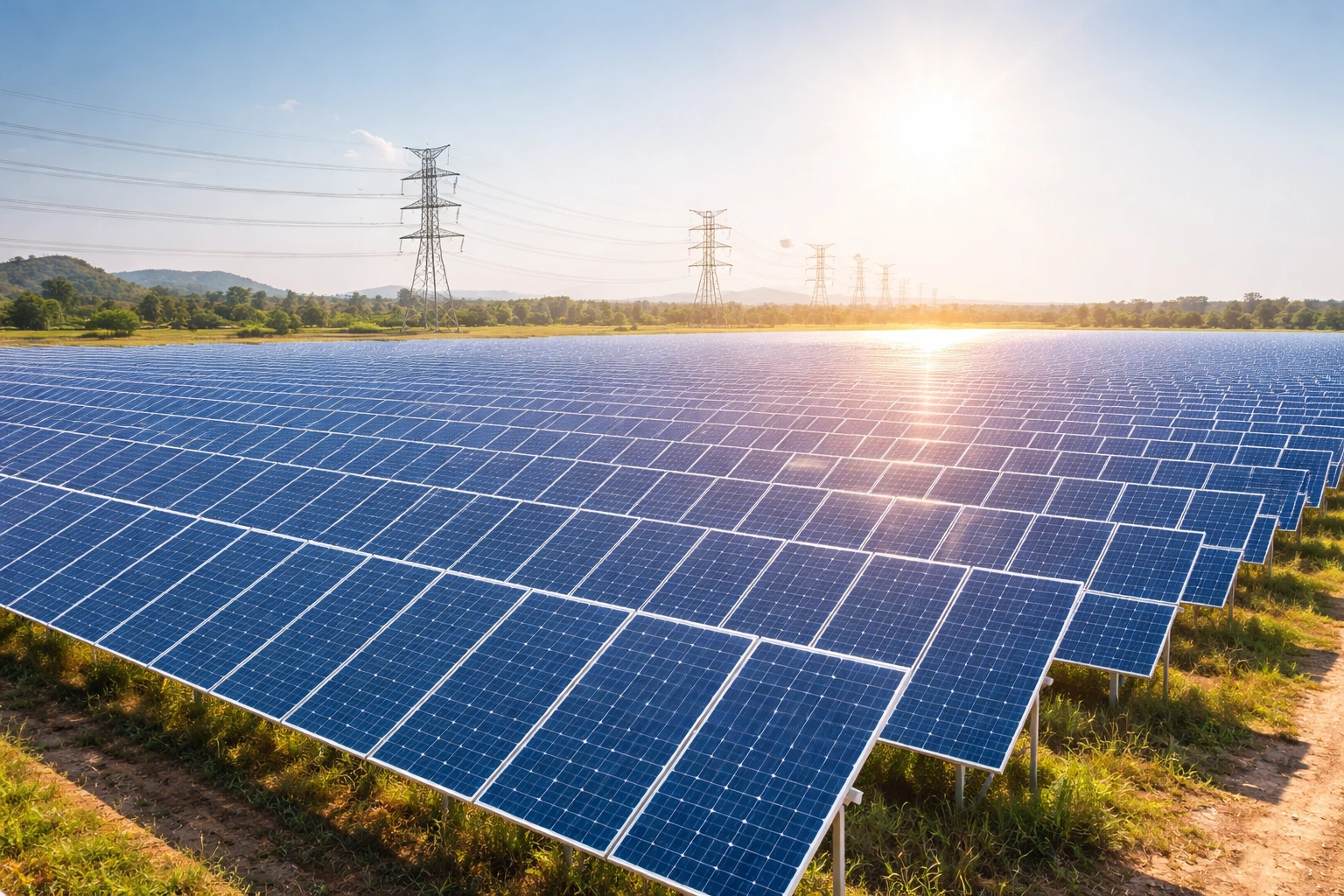
Tamil Nadu solar power record: The solar energy sector is at a pivotal moment as 2025 nears its end. While countries around the world continue to expand renewable capacity, new market realities are emerging that test the resilience of solar economics. Simultaneously, regional success stories, such as Tamil Nadu’s record solar power absorption, demonstrate how strategic deployment and favorable conditions can unlock unprecedented clean-energy performance at the subnational level.
This article explores the clash between oversupply and profitability in leading markets, policy and regulatory responses, and India’s burgeoning solar landscape with Tamil Nadu at the forefront.
1. Oversupply in Europe: Spain’s Solar “Discount Season”
Spain has been widely recognized over the past decade as a solar champion in Europe, driven by abundant sunshine, attractive policies, and strong investor interest. However, 2025 has exposed vulnerabilities in the economics of solar power that challenge the conventional narrative of uninterrupted growth.
Solar Oversupply Weakens Asset Values
According to recent reports, solar electricity generation in Spain has surged so dramatically that electricity supply now often exceeds local demand — even during shoulder hours outside peak sunshine. This glut depressed wholesale electricity prices, with prolonged periods of negative pricing where generators effectively pay consumers to take power during midday oversupply.
This imbalance has had a striking effect on the value of solar assets. Valuations for ready-to-operate solar plants have collapsed from ~€916,000 per megawatt down to ~€648,000 per megawatt in just one year. In some cases, developers are literally selling solar projects for €1 just to exit unprofitable positions. (Financial Times)
Why This Matters
The Spanish case is not just a local phenomenon — it reveals broader challenges:
- Wholesale markets were designed for fossil generation, not mass exported renewables.
- Lack of adequate storage means excess production must be dumped or curtailed.
- Power Purchase Agreements (PPAs) are weakening because low spot prices drag down contract terms.
Shifts in Strategy
In response, many producers are exploring battery storage integration to shift midday peaks into evening demand, when prices are higher and traditional generation falls off. Regulatory changes in Spain — such as exempting existing solar plants that add batteries from fresh environmental assessments — aim to accelerate the deployment of hybrid solar + battery systems.
2. China’s Market Power and Policy Challenges
While Europe confronts oversupply pains, China’s solar industry grapples with a different set of structural stresses.
Market Competition Risks
On 26 December 2025, China’s State Administration for Market Regulation issued a strong warning to domestic solar manufacturers to avoid price collusion, fraudulent pricing, and unsustainable price wars. The regulator underscored its intention to intensify oversight of product quality and penalize illegal behaviour in the solar sector. (Reuters)
This caution comes amid cutthroat competition among manufacturers, likely driven by global oversupply of panels, strained margins, and downward pressure on module prices. Excessive competition — if not carefully managed — can lead to compromised product quality, market volatility, and weakened domestic capacity to invest in future technologies.
China’s Solar Expansion Is Vast — But Complex
China has led global solar installations in recent years. Reports indicate the country achieved record solar capacity additions in H1 2025, helping push its total installed photovoltaic capacity beyond the 1,000 GW (1 TW) milestone — far more than any other nation. (renewable-energy-industry.com)
However, extremely rapid deployment has been accompanied by policy adjustments and market corrections:
- BloombergNEF (BNEF) projects solar installations may slightly decline in 2026 as China rebalances its deployment pace — the first potential global slowdown in decades.
- Domestic pricing pressures and the regulator’s recent warnings highlight tensions between scale ambitions and sustainable market dynamics.
China’s experience illustrates an evolving solar ecosystem where mass manufacturing, export strategy, domestic policy goals, and global market signals must align to support long-term industry health.
3. India’s Renewable Ascent with Tamil Nadu at the Forefront
Amid these global contrasts, India’s solar narrative offers a compelling success story. The nation has already surpassed record renewable capacity additions, propelled by strategic policy initiatives, investor confidence, and competitive tendering. Data from 2025 shows India’s renewable sector leapt forward with around 25 GW of capacity added in the first half of the fiscal year, with solar contributing nearly 22 GW alone.
Tamil Nadu’s Solar Breakthrough
On 26 December 2025, the Tamil Nadu Power Distribution Corporation Ltd (TNPDCL) reported a new solar power milestone — absorbing 50.8 million units (Mu) of solar energy into the state grid on a single day. Peak solar power generation hit a record 7,276 megawatts (MW), surpassing previous highs.
This achievement is noteworthy for several reasons:
- It represents significant grid absorption capability, demonstrating that solar can supply a large fraction of a region’s daily demand.
- It highlights how climate and weather patterns (clear skies after monsoon) can materially enhance solar output.
- The performance reflects continued capacity expansions, as Tamil Nadu’s installed solar portfolio now exceeds 10,000 MW — up by about 2,000 MW compared to 2024.
Regional and National Significance
Tamil Nadu’s record is not isolated — it is part of India’s broader renewable success:
- India’s solar strategy includes ambitious rooftop solar targets, utility-scale installations, and robust manufacturing incentives.
- The state now ranks fourth in India for solar capacity, behind Rajasthan, Gujarat, and Maharashtra.
- Solar power consistently meets roughly one-sixth of Tamil Nadu’s total electricity consumption on clear days, reducing reliance on fossil fuel plants and cutting emissions.
These outcomes align with India’s renewable goals — including the national target of 500 GW of non-fossil fuel capacity by 2030 — and underscore the critical role of state-level implementation in achieving larger climate objectives.
4. Contrasts and Convergence: Lessons from Global Solar
Spain vs India: Oversupply vs Optimized Integration
Spain’s oversupply issue and Tamil Nadu’s record absorption reveal a central truth: solar’s value depends on how well supply and grid integration are balanced.
- In Spain, too much production relative to demand has pressured prices and asset valuations.
- In Tamil Nadu, strong grid infrastructure, clear weather, and growing demand have allowed solar generation to be consumed effectively, demonstrating optimized utilization.
China’s Industrial Scale vs Market Stability
China’s unparalleled scale of solar deployment is both a strength and a challenge. The government’s regulatory warnings about fair pricing underscore the need to balance rapid industrial expansion with market health and quality assurance.
Meanwhile, projections for a potential global slowdown in 2026 suggest markets will need to find new demand drivers, storage solutions, and policy frameworks that prevent boom-and-bust cycles.
5. What Lies Ahead for Solar Energy
Solar power’s trajectory through 2025 and into 2026 is likely to be shaped by several key forces:
1) Storage Integration
Battery storage will be essential in smoothing supply curves, preventing negative pricing episodes, and improving profitability for solar generators — particularly in oversupplied markets like Spain.
2) Policy and Market Design
Governments must adapt energy market frameworks to accommodate renewables — including capacity markets, time-of-day pricing, and incentives that support investment beyond subsidized tariffs.
3) Balanced Manufacturing Strategy
Industrial powerhouses like China will need to balance scale with fair competition and quality control to sustain healthy global supply chains.
4) Local Implementation Matters
States like Tamil Nadu show that localized planning, responsive grid operations, and optimal conditions can unlock solar’s potential even amidst global market shifts.
Conclusion
Solar energy stands at a critical inflection point. Oversupply and pricing pressures in developed markets, regulatory recalibrations in manufacturing hubs, and record-setting achievements in emerging economies all paint a complex picture. Yet, the sector’s fundamental renaissance continues — fuelled by relentless deployment, technological improvements, and policy support.
As markets adjust, the future of solar will be written not just by gigawatts installed, but by how well systems are integrated, markets are regulated, and clean energy is valued in every region.
Related Posts



1 thought on “Tamil Nadu’s Solar Breakthrough Shows How India Can Lead the Global Clean Energy Transition”