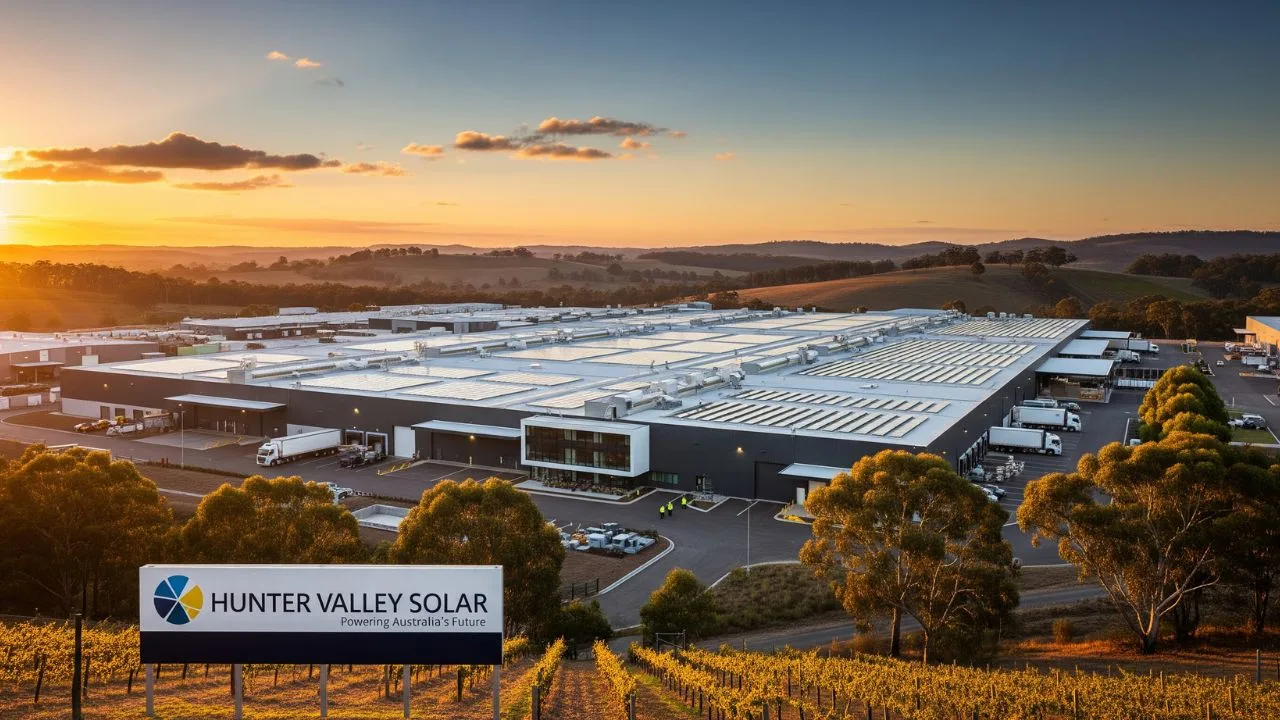
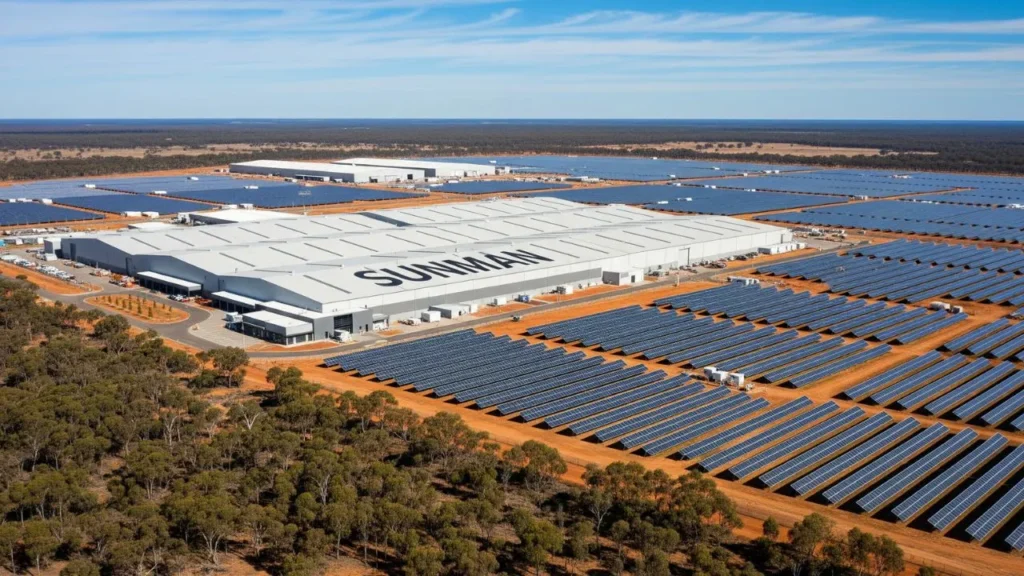
Sunman 500 MW solar factory Australia: In a move set to transform Australia’s renewable energy landscape, Chinese-founded solar innovator Sunman has unveiled plans to build a 500 MW per year solar module manufacturing facility in the Hunter Valley region of New South Wales. Backed by historic federal and state government funding, the new plant will become Australia’s largest solar module manufacturing site, significantly boosting local production capacity and strengthening the nation’s clean-energy future.
The announcement marks a strategic milestone in Australia’s journey toward energy independence, local manufacturing revival, and global leadership in solar innovation.
Massive AUD 171 Million Public Funding Secured
Sunman’s ambitious project has received a powerful financial push from both state and federal governments:
- AUD 151 million in conditional funding from the Australian Renewable Energy Agency (ARENA) under the federal government’s AUD 1 billion Solar Sunshot program
- AUD 20 million from the New South Wales government
This combined AUD 171 million funding package signals one of Australia’s most significant public investments in solar manufacturing to date. The funding aims to accelerate domestic production capacity, reduce import dependence, and create a resilient supply chain for Australia’s rapidly growing solar market.
A Vision Led by Solar Pioneer Zhengrong Shi
The Sunman Group was founded by Dr. Zhengrong Shi, a University of New South Wales alumnus often recognized as one of the world’s most influential solar pioneers.
Shi, who has dedicated decades to pushing the boundaries of photovoltaic innovation, described the project as the realization of a long-standing ambition:
“Once established, the Hunter Valley Solar Foundry will be the largest manufacturer of solar photovoltaic modules in Australia, and the only one in NSW. It will deliver world-leading products to residential, commercial, and utility customers nationwide,” Shi said.
His vision goes beyond production; the plant aims to inspire a fully integrated solar supply chain within Australia, reducing the country’s reliance on imported technology.
Read Also: South Korea Solar Inverter Industry Raises Cybersecurity Alarms
Sunman’s Growing Global Footprint: China, USA, and Now Australia
The Hunter Valley plant will join Sunman’s expanding global manufacturing network:
- 1 GW plant operating in China
- 500 MW plant under construction in the United States
- Now a 500 MW plant planned for Australia
This strategic distribution of factories ensures Sunman remains competitive in multiple key markets while supporting regional clean-energy goals.
Location Selection: Why the Hunter Valley?
The new facility will be built at Black Hill near Maitland, a location chosen for its industrial infrastructure, skilled workforce, and proximity to logistics networks.
The Hunter Valley, traditionally associated with coal mining, is now emerging as a powerhouse in Australia’s clean-energy future. Establishing a large-scale solar manufacturing facility in this region is symbolic: a transformation from fossil fuels to renewables is actively underway.
Manufacturing Capacity: From 300 MW to 500 MW
The plant will be launched in phases:
- Phase 1: Production of 300 MW of solar panels per year
- Phase 2: Expansion to a full 500 MW annual capacity
This staged approach allows Sunman to start manufacturing quickly while gradually scaling technology, workforce, and production lines.
A Huge Boost to Australia’s Solar Industry
Currently, Tindo Solar in South Australia is recognized as the country’s only major domestic module manufacturer. Tindo’s Mawson Lakes facility is undergoing expansion—from 20 MW to 180 MW—with the company exploring plans for a 1 GW future manufacturing plant.
Sunman’s new 500 MW plant, however, will instantly dwarf existing production volumes, giving Australia a competitive foothold in the global solar market.
What Will the Hunter Valley Solar Foundry Produce?
The facility will produce a diverse range of next-generation solar modules, including:
1. Sunman’s Signature eArc Modules
A breakthrough innovation in solar engineering, the eArc (enhanced Architecture Ready Composite) modules:
- Replace traditional glass with durable polymer materials
- Weigh 70% less than conventional panels
- Are extremely flexible and can be curved, moulded, or glued to surfaces
- Suit rooftops unable to support heavy glass panels
- Ideal for commercial structures, off-grid applications, and architectural integration
These ultra-lightweight panels have already gained international recognition for expanding the possibilities of solar installation.
2. Traditional Glass Solar Modules
To meet broader customer needs, Sunman also plans to manufacture high-performance glass modules.
3. OEM Manufacturing Capacity
The plant will act as a solar manufacturing foundry, offering its production capabilities to:
- Other solar brands
- Energy companies
- OEM (Original Equipment Manufacturer) partners
This helps build a robust and diversified solar supply chain in Australia.
4. A Solar Innovation Hub
Beyond production, the facility will house an innovation hub dedicated to:
- Commercializing new solar technologies
- Testing next-gen solar materials
- Supporting academic and industry collaboration
- Developing Australian-designed solar solutions
Strengthening Domestic Supply Chains
ARENA CEO Darren Miller emphasized the strategic importance of this new manufacturing facility:
“Building our solar manufacturing capabilities will help ensure that our supply chains are resilient and that Australian innovations are supported as we accelerate the rollout of solar PV.”
Australia has long relied heavily on imported panels, primarily from China. With solar energy central to national emissions reduction targets, building a secure domestic supply chain is essential.
Sunman’s entry into Australia marks a major step toward:
- Enhancing energy independence
- Ensuring stable supply for rooftop and utility markets
- Creating competitive manufacturing jobs
- Reducing project costs over time
Job Creation: 300 New Roles for the Hunter Valley
The project is expected to deliver significant employment benefits:
- Up to 200 construction jobs during the building phase
- Around 100 ongoing roles once the factory becomes operational
These roles will span across manufacturing, engineering, R&D, administration, supply chain logistics, and management, contributing to long-term economic growth in the region.
A Major Milestone in Australia’s Clean-Energy Transition
Australia’s solar demand continues to rise at record levels.
The nation leads the world in rooftop solar penetration, with more than 3.7 million homes now equipped with PV systems.
However, most of these panels are imported.
The Sunman facility aims to reverse that trend, giving Australians greater access to locally made technology—while strengthening national capabilities in an industry critical to reducing emissions.
Shi described the project as a “long-held ambition” finally becoming reality. The hope is that this foundry will spark a fully integrated solar ecosystem in Australia, from polysilicon production to panel assembly.
Australia’s Emerging Solar Supply Chain: Polysilicon Feasibility Study
Earlier this year, Sunman’s Australian subsidiary Energus received AUD 1.3 million through the Solar Sunshot program to explore building a 50,000-tonne per year solar-grade polysilicon plant in the Hunter Valley.
The feasibility study aims to assess:
- Technical challenges
- Commercial viability
- Environmental impact
- Market demand for Australian-made polysilicon
If successful, Australia could one day manufacture not just solar panels, but critical upstream materials, further boosting domestic independence.
The Bigger Picture: Australia’s Solar Manufacturing Revival
The Hunter Valley project aligns with a broader national strategy to rebuild advanced manufacturing capabilities in Australia, particularly in industries tied to:
- Renewable energy
- Battery production
- Green hydrogen
- Critical minerals
A strong local solar manufacturing industry also supports:
- Long-term job creation
- Export potential
- Innovation leadership
- National energy security
With global supply chains becoming increasingly fragile, countries worldwide are racing to localize essential clean-energy industries. Australia’s move is well-timed and strategically crucial.
Why the Solar SunShot Program Matters
The federal government’s AUD 1 billion Solar Sunshot program is designed to support:
- Solar PV manufacturing
- Panel assembly
- Inverter and component production
- Raw material processing
- Technological innovation
- Export opportunities
Sunman’s Hunter Valley Foundry is among the first major beneficiaries, signalling the government’s seriousness about rebuilding domestic clean-energy sectors.
Future Impact: What Can Australia Expect?
With Sunman’s 500 MW plant, Australia can anticipate several long-term benefits:
1. Reduced Dependence on Imported Solar Panels
Local manufacturing boosts supply chain resilience and shields the market from global disruptions.
2. More Affordable Panels Over Time
Local production can lower transportation costs and create competitive pricing.
3. Innovation-Led Manufacturing Growth
The facility’s solar innovation hub will enable Australian researchers and startups to commercialize breakthroughs.
4. Stronger Renewable Energy Targets
Locally made panels accelerate solar deployment as Australia pushes toward its 2030 and 2050 climate goals.
5. Job Creation and Regional Development
The Hunter Valley gains new economic direction as it transitions from fossil fuels to renewable industries.
Read Also: France Adds 1.5 GW Solar in Q3, Nears 30 GW Total PV Capacity in 2025
Conclusion: A Landmark Project for Australia’s Solar Future
Sunman’s decision to build a 500 MW solar module manufacturing plant in the Hunter Valley marks one of the most significant renewable energy announcements in Australia’s recent history.
With a combination of advanced technology, major government funding, and a vision led by one of the world’s foremost solar innovators, the Hunter Valley Solar Foundry has the potential to:
- Transform Australia’s solar supply chain
- Strengthen national manufacturing
- Support climate goals
- Boost regional jobs
- Position Australia as a global leader in solar innovation
This project isn’t just about producing solar panels—it’s about reshaping Australia’s clean-energy identity and securing a renewable-powered future.
Related Posts