
Solar Power in Tunisia is no longer just about sustainability—it is increasingly treated as a strategic investment vehicle reshaping the country’s economic and energy future.
Tunisia’s solar sector is undergoing a profound transformation. What was once viewed mainly as an environmental solution is now being positioned as a bankable, revenue-generating asset, comparable to traditional financial products. This shift is redefining how businesses, investors, policymakers, and households approach renewable energy, placing solar power at the heart of Tunisia’s economic modernization.
A Turning Point for Solar Energy in Tunisia
Over the past decade, Tunisia has faced mounting pressure to reduce its dependence on imported fossil fuels. Rising energy costs, currency pressures, and geopolitical uncertainties have highlighted the vulnerability of relying heavily on external energy sources. Against this backdrop, solar power has emerged as both an energy solution and a financial opportunity.
Unlike earlier phases, where solar installations were primarily donor-funded or driven by public policy incentives, today’s Tunisian solar market is increasingly shaped by investment logic. Returns, risk profiles, financing structures, and long-term yields are now central to decision-making. Solar energy is being evaluated not just in kilowatt-hours, but in internal rates of return, payback periods, and asset valuation.
This evolution mirrors global trends but carries unique significance in Tunisia, where capital scarcity has traditionally limited infrastructure investment.
Solar as a Financial Product, Not Just an Energy Source
One of the most striking developments is the perception of solar installations as financial products comparable to real estate or bonds. Investors are attracted by predictable cash flows, long-term power purchase agreements, and declining technology costs.
In many cases, photovoltaic projects in Tunisia now offer returns that outperform traditional savings instruments, particularly in an environment of inflation and fluctuating interest rates. For landowners, installing solar panels can generate steady income over decades, transforming unused land into productive assets.
For companies, solar installations are increasingly treated as balance-sheet assets, reducing operational costs while enhancing financial resilience. Electricity savings translate directly into improved margins, making solar an attractive hedge against volatile energy prices.
The Rise of Autoconsumption and Distributed Solar
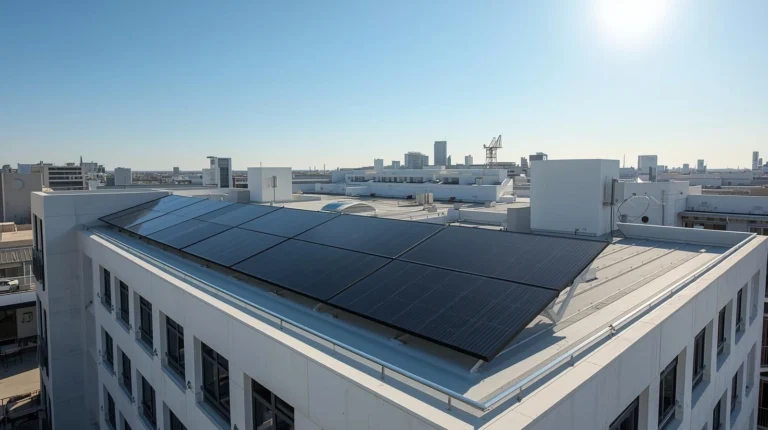
At the consumer and commercial level, autoconsumption has become a major driver of solar adoption. Rooftop installations on homes, factories, warehouses, and office buildings are now common across urban and industrial zones.
These systems allow users to produce electricity for their own needs, significantly lowering dependence on the national grid. In many cases, excess electricity can be injected back into the grid under regulated frameworks, further enhancing project profitability.
Tunisia has already connected hundreds of megawatts of solar capacity to low- and medium-voltage networks. This distributed approach reduces transmission losses, eases pressure on national infrastructure, and empowers local energy production.
For export-oriented companies, solar adoption also plays a strategic role. As European markets tighten carbon regulations, reducing the carbon footprint of production has become a competitive necessity, not just an ethical choice.
Financing Challenges in a High-Interest Environment
Despite strong fundamentals, financing remains one of the biggest hurdles for Tunisia’s solar expansion. Local banks often apply high interest rates, reflecting broader macroeconomic risks and liquidity constraints.
This has pushed many developers and businesses to seek financing from international institutions. Multilateral banks and development agencies have played a key role in funding solar projects, offering longer tenors and more favorable terms than domestic lenders.
However, reliance on external financing raises concerns about capital dependency and limited local value capture. While international funding accelerates deployment, it can also concentrate ownership and decision-making outside Tunisia.
This tension has fueled interest in alternative financing models that can mobilize domestic capital more effectively.
The Emergence of Local Solar Investment Funds
A notable shift is the growing role of local investment funds entering the solar sector. These funds aim to bridge the financing gap by pooling capital from Tunisian investors and channeling it into photovoltaic projects.
Unlike traditional banks, investment funds are often more comfortable with project-based financing and long-term horizons. They assess solar assets based on cash flow stability rather than conventional collateral, making them well-suited to renewable energy investments.
These funds are particularly focused on small and medium-scale projects, which are often overlooked by large international investors. By targeting projects in the 1 to 10 MW range, they support local developers while diversifying investment risk.
This model also strengthens the domestic renewable ecosystem, keeping more economic value within Tunisia.
Authorization Regimes and Regulatory Evolution
Tunisia’s regulatory framework has evolved to accommodate the changing nature of the solar market. Authorities have introduced authorization regimes for smaller projects, simplifying procedures and reducing administrative barriers.
This approach contrasts with large-scale solar farms, which are typically developed through competitive international tenders. While tenders attract global players and achieve lower per-unit costs, they often require significant capital and expertise, limiting participation by local firms.
By contrast, authorization-based projects encourage decentralized development, fostering entrepreneurship and regional economic activity. Policymakers face the challenge of balancing these two models to achieve both scale and inclusivity.
Small Versus Large Solar Projects: A Strategic Debate
The expansion of solar power in Tunisia has sparked a broader debate about the optimal development model. On one side are advocates of large industrial-scale solar plants, which benefit from economies of scale and lower electricity prices.
On the other side are proponents of numerous smaller installations, arguing that they generate more local employment, distribute income more evenly, and enhance energy resilience.
Large projects can rapidly boost national capacity and attract foreign capital, but they may also concentrate ownership and profits. Smaller projects, while potentially more expensive per unit, can stimulate local industries, from installation to maintenance.
The outcome of this debate will shape not only Tunisia’s energy mix but also its broader economic structure.
Solar Energy and National Energy Security
Beyond financial returns, solar power plays a critical role in strengthening Tunisia’s energy security. By reducing reliance on imported fuels, solar energy helps stabilize the trade balance and shield the economy from external shocks.
Distributed solar systems also enhance grid resilience, reducing the risk of large-scale outages. In a country facing increasing energy demand, particularly during summer peaks, solar power provides a timely and scalable solution.
This strategic dimension reinforces the perception of solar assets as long-term national investments, not short-term policy experiments.
The Link Between Solar Power and Green Hydrogen
Looking ahead, solar energy is central to Tunisia’s ambitions in green hydrogen production. With abundant sunlight and proximity to European markets, Tunisia is well-positioned to become a competitive exporter of green hydrogen.
Hydrogen production requires massive amounts of renewable electricity, making large-scale solar deployment a prerequisite. Investors are increasingly evaluating solar projects not only for electricity generation but also for their potential role in future hydrogen value chains.
This prospect further enhances the strategic value of solar assets, positioning them at the intersection of energy, industry, and international trade.
Social Impact and Employment Opportunities
The growth of solar energy also carries significant social and employment implications. Installation, operation, and maintenance of photovoltaic systems create jobs across skill levels, from engineers to technicians.
Small and medium projects, in particular, tend to rely on local labor and suppliers, amplifying their economic impact. Training programs and capacity-building initiatives are increasingly aligned with solar deployment, creating pathways for youth employment.
By treating solar as a financial asset, investors and policymakers are also recognizing its potential to drive inclusive economic growth, not just environmental benefits.
Risks and Market Maturity
While optimism is high, the solar sector is not without risks. Regulatory uncertainty, grid constraints, and financing bottlenecks can slow project development. Market maturity also brings challenges such as increased competition and margin pressure.
As solar becomes mainstream, investors must conduct rigorous due diligence, evaluating technical performance, regulatory compliance, and counterparty risk. The framing of solar as a financial product demands professional standards of governance and transparency.
This maturation process is essential for sustaining long-term investor confidence.
Read Also: How to Create a Solar Farm Operations and Maintenance Plan That Works in 2026
A Cultural Shift in How Energy Is Valued
Perhaps the most profound change is cultural. Solar power in Tunisia is no longer seen as a niche or experimental technology. It is increasingly perceived as a normal, investable asset, comparable to infrastructure, real estate, or manufacturing facilities.
This shift in mindset is transforming conversations around energy. Solar projects are discussed in boardrooms, investment committees, and financial media—not just environmental forums.
As this perception takes hold, it reinforces a virtuous cycle: greater investment leads to scale, which reduces costs and further strengthens the business case.
Tunisia’s Solar Future: Finance Meets Sustainability
Tunisia stands at a crossroads where energy policy, financial innovation, and economic strategy converge. By embracing solar power as a financial product, the country is redefining its approach to development.
The challenge now is to ensure that this transformation remains balanced—combining profitability with accessibility, scale with local participation, and innovation with stability.
If managed effectively, Tunisia’s solar sector could become a model for how emerging economies leverage renewable energy not only to decarbonize, but also to build resilient, investment-driven growth.
Related Posts