
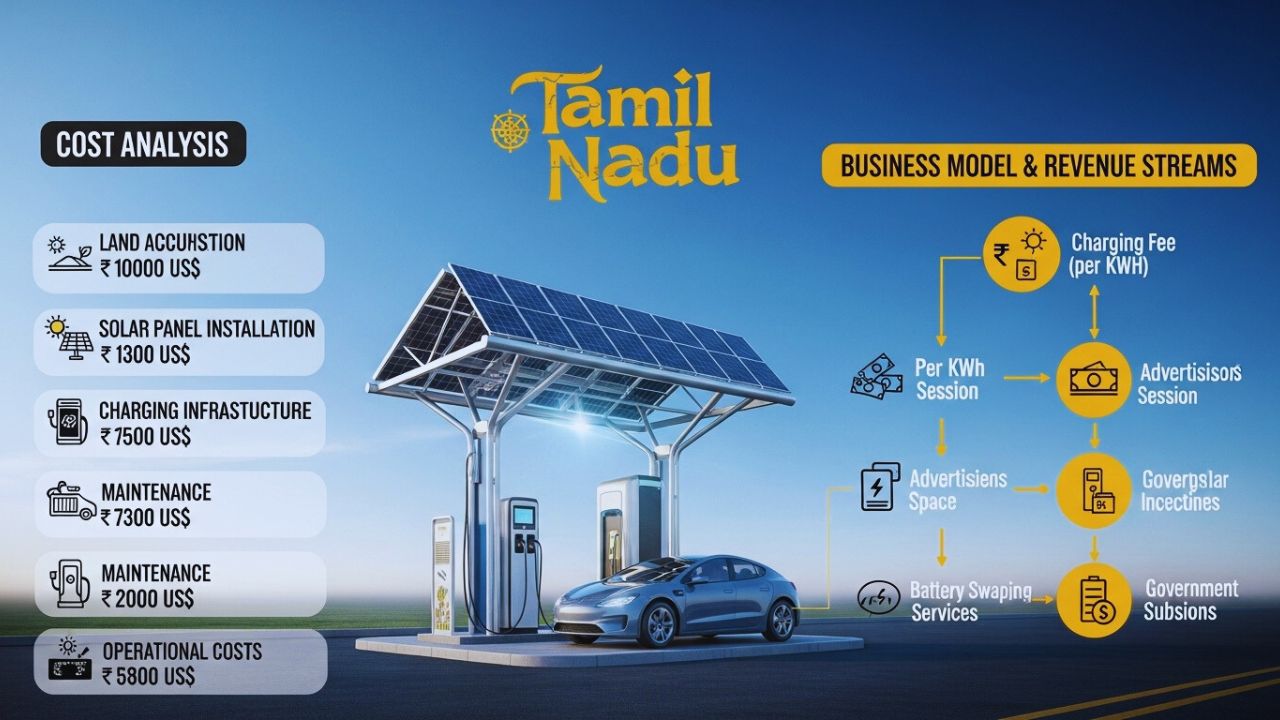
Solar EV Charging Station Cost: As Tamil Nadu accelerates its electric vehicle (EV) revolution, solar-powered EV charging stations are quickly becoming the centerpiece of sustainable mobility in the state. Combining two of India’s most impactful green transitions—solar rooftop adoption and EV growth—these hybrid stations provide a cleaner, cheaper, and future-ready answer to Tamil Nadu’s urban and rural charging needs.
Yet, the pathway to profitability and scale for charging station operators is complex, especially given changes in electricity tariffs, land costs, and evolving business models. This guide provides a comprehensive, up-to-date look at costs, incentives, revenue streams, and practical business models for establishing a solar EV charging station in Tamil Nadu in 2025. It’s targeted at entrepreneurs, fleet owners, real estate players, resident associations, and anyone seeking to participate in the charging eco-system of South India’s most dynamic mobility market.
Why Go Solar for EV Charging in Tamil Nadu?
- Solar is Cheaper: Solar reduces the draw from Tamil Nadu’s relatively high commercial and peak electricity tariffs, protecting revenue margins.
- Grid Resilience: Daytime solar generation matches peak charging demand, easing strain on the state’s network.
- Environmental Impact: Tamil Nadu’s manufacturing belts and cities benefit directly from carbon emissions reductions and air quality improvement.
- Incentives: Both central and Tamil Nadu government offer layered subsidies for renewable-powered charging, which can reduce payback time.
Read Also: Solar EV Roads: Charging Electric Cars While You Drive
Cost Breakdown: Solar EV Charging Station in Tamil Nadu (2025)
1. Capital Expenditure (CAPEX)
A. Equipment and Installation
| Item | Cost Range (INR) | Notes |
| Level 2 AC Charger (7–22kW) | 1,20,000–2,20,000 | Suits cars and 2/3-wheelers |
| DC Fast Charger (30–60kW) | 5,00,000–12,00,000 | Buses, SUVs, fleet charging |
| Solar PV System (10–50kW) | 4,00,000–24,00,000 | ₹45–65/watt for commercial scale |
| Inverter, BoS, Smart SW | 1,00,000–2,50,000 | Inverter, MPPT, energy management, cabling |
| Battery Bank/Storage (optional) | 3,00,000–10,00,000 | For night/peak smoothing |
| Land Lease (urban) | 6,00,000–12,00,000/year | Prime locations, parking, access |
| Civil Works, Branding | 2,00,000–4,00,000 | Canopy, signage, fencing, entry |
| Approvals, Compliance | 75,000–1,00,000 | Utility, DISCOM, environmental |
Typical launch cost for a two-charger solar/grid hybrid site with a 20 kW solar plant: ₹40–55 lakh in Chennai or Tier-2, less in less urban locations.
B. Ongoing Operational Costs (OPEX)
- O&M/Service: ₹1.5–2 lakh/year for basic maintenance, servicing.
- Staff/Security: ₹1–3 lakh/year, depending on hours and location.
- Insurance: ₹40,000–₹60,000/year.
- Land Lease, Property Tax: as per agreement.
- Marketing, Billing Platform Fees: ₹30,000–₹75,000/year.
Tamil Nadu’s EV Charging Tariffs: The 2025 Landscape
- Solar Hours (9 AM–4 PM): ₹6.50/kWh
- Peak Hours (6–9 AM, 6–10 PM): ₹9.75/kWh
- Night Charging (10 PM–6 AM): ₹8.10/kWh
- Fixed Charge for HT Connection: Rs. 304 per kVA per month (substantially higher since July 2025).
The implication: High fixed and variable charges make solar contribution critical for profitability, especially for high-utilization DC charging hubs.
Revenue & Business Model: Maximizing Profitability
Main contributing factors to station profitability in Tamil Nadu:
- Optimal solar vs. grid power use
- Strategic location for high utilization
- Government incentives on CAPEX
- Smart OPEX management
Key Revenue Streams
- Charging Fees: Most centers charge ₹12–20/kWh, sometimes higher for peak/fast charge slots.
- Subscriptions and Partnerships: Monthly packages for fleet companies, apartment associations.
- Green Credits/Carbon Revenue: Additional profit through MNRE or MoEFCC green credit claim.
- Branding/Ancillary Services: Retail, food courts, car washes at charging hubs.
Business Models
- Direct ownership (entrepreneur/franchise)
- Public-private partnership (PPP), e.g. city, TNSTC
- Aggregator/franchise tie-up with charge operators (Tata Power, ChargeZone, Jio-bp, etc.)
- Fleet hub (for taxis, delivery, e-bus/lorry depots)
Step-by-Step: Setting Up a Solar EV Charging Station in Tamil Nadu
- Market Study & Site Selection
- Close to highways, transport hubs, residential blocks, or offices.
- Accessible parking and solar exposure.
- Land Arrangement
- Lease agreement: City high-traffic sites are preferred but expensive.
- Load Calculation & Technology Mix
- Estimate demand by vehicle segment.
- Mix of slower AC and DC fast chargers for flexibility.
- Solar Design & Sizing
- At least 10–20 kW for daytime-only sites; 50 kW+ for highways/fleet.
- Include net metering and possible battery storage for backup.
- State and Central Compliance
- Apply for “Public EV Charging Station” registration with TANGEDCO, ARAI/BIS certification for equipment.
- Register with MNRE for solar setup; apply for subsidies/incentives.
- Installation & Software Integration
- Civil works, solar array, chargers, payment systems, remote monitoring.
- Launch & Operations
- Marketing, tie-ups, on-ground staff, maintenance contracts.
Government Incentives and Solar Subsidies
- Central MNRE Rooftop Solar CFA (up to 40%) for integrated solar EV charging.
- PM-eDrive and FAME-II: Grants up to 50–60% for fast chargers and select solar projects.
- Tamil Nadu State Policy: Additional capex subsidies, low GST (5%), electricity duty waivers, and parking/land incentives in select zones.
- Green Credit/Carbon Offset Revenue: Certify for tradable green credits under MoEFCC’s new scheme.
Profitability Example
Urban Solar+DGrid Fast Charging Station (2025, Chennai)
- Initial Outlay (20 kW solar + 2 DC fast chargers + land prep): ₹50 lakh
- Monthly Use: 5,000 kWh charged (60% solar, rest grid)
- Revenue at ₹15/kWh: ₹75,000/month
- Grid Power Cost: ~₹12,000 (for 2,000 kWh grid, solar is ₹6–₹7/kWh)
- OPEX (maintenance, staff, lease): ₹35,000–₹50,000/month
- Net Monthly Profit: ₹20,000–₹40,000
- Breakeven (with 40% solar subsidy): 2.5–3.5 years
Highway and fleet stations with higher demand can further shorten ROI periods.
Best Practices for Maximizing Returns
- Maximize daytime solar utilization via strategic scheduling (solar hours = lowest cost)
- Optimize layout for mixed use (cars, 2/3W)
- Regularly monitor tariffs and tailor user fees dynamically by time-of-day (ToD)
- Register site for available subsidies before commissioning
- Integrate smart-app booking/payment for repeat business and analytics
Challenges and Solutions
- Rising Grid Tariffs: Rely more on solar, consider battery integration
- High Land Costs: Seek PPPs, co-locate in busy retail or transport complexes
- Awareness and Utilization: Partner with EV aggregators, launch digital marketing in area
- Regulatory Changes: Stay updated with TNERC/TANGEDCO and MNRE guidelines
Read Also: Transparent Solar Glass: How India’s Skyscrapers Will Generate Power by 2025
FAQ
1. Do I need a license to start a solar EV charging station in Tamil Nadu?
No license is required, but you must register with TANGEDCO and comply with technical/ safety standards.
2. Can residential complexes set up stations for internal use?
Yes, and surplus solar energy can often be exported to the grid via net metering.
3. How much space is needed?
A small station needs around 500–700 sq ft; 1,500+ sq ft for larger/fleet hubs.
4. Is battery storage necessary?
Not mandatory, but suggested for high utilization, night charging, or fluctuating supply.
5. How do I apply for solar subsidy?
Through the MNRE’s national portal and TANGEDCO’s state nodal agency—with empanelled vendors and required documentation.
Conclusion
Solar-powered EV charging is at the heart of Tamil Nadu’s transition to sustainable e-mobility. With clear government incentives, rising demand, and cost advantages linked to solar adoption, now is the time for entrepreneurs, local businesses, and tech-driven investors to plug into this booming sector. Understanding the latest tariff structure, developer cost breakdowns, and business models ensures your station thrives both financially and environmentally in 2025 and beyond.
Related Posts

1 thought on “Solar EV Charging Station Cost & Business Model in Tamil Nadu”