In a rapidly evolving clean-energy market, the Solar Stewardship Initiative introduces a powerful new guide designed to boost transparency, accountability, and ethical practices across the global solar supply chain.
The newly released Buyers Guide aims to empower companies, investors, and public institutions with clear strategies that support responsible procurement while enhancing readiness for stricter regulatory requirements around forced labor, sustainability, and supply-chain verification.
The Solar Stewardship Initiative’s (SSI) first-ever Buyers Guide marks a pivotal step in global efforts to ensure the solar industry advances with responsibility, compliance, and ethical transparency at its core.
A New Benchmark for Responsible Solar Procurement
The publication of the 54-page SSI Buyers Guide represents a significant milestone for companies striving to operate responsibly in today’s complex solar manufacturing and procurement landscape. As the solar sector expands at an unprecedented pace, concerns about forced labor, environmental impact, and opaque supply-chain practices have intensified. This guide responds to those concerns by providing a structured and actionable framework for ethical procurement.
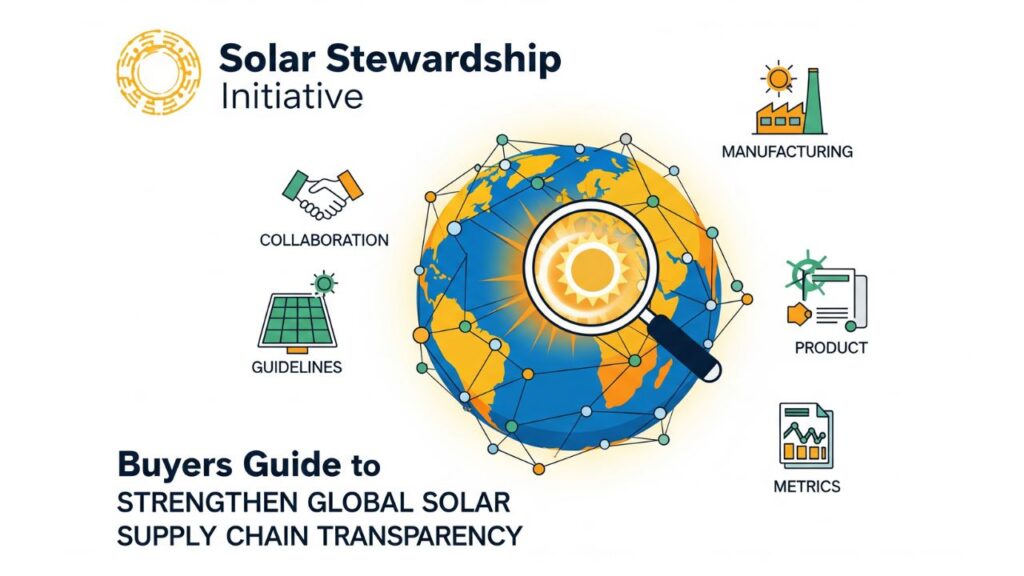
Structured in two distinct sections, the guide delivers value to both public stakeholders and SSI members:
- A public section offering practical guidance and clear recommendations adaptable to organizations of all sizes.
- A members-only appendix featuring advanced resources such as templates, due-diligence checklists, and contract clauses tailored for compliance-driven procurement teams.
This dual-design approach ensures the document is accessible to general buyers while still offering depth and rigor to companies deeply engaged in responsible supply-chain governance.
The SSI emphasized that collaboration with member companies played a crucial role in crafting the guide. By incorporating real-world challenges and industry-specific expertise, the Buyers Guide aligns closely with emerging regulatory pressures—especially those related to forced labour prohibitions, environmental transparency, and global due-diligence standards.
Read Also: India Solar Manufacturing Gap: Why It Matters for India’s Clean Energy Future
Reinforcing Transparency and Trust Across the Solar Supply Chain
At its core, the Solar Stewardship Initiative serves as an industry-led assurance system, committed to strengthening trust in manufacturing practices, factory integrity, and material traceability. Founded in 2022 by SolarPower Europe and Solar Energy UK, the initiative was established to address the growing demand for transparency and accountability across the photovoltaic (PV) value chain.
The newly released Buyers Guide reflects SSI’s broader mission: ensuring that solar companies can demonstrate responsible business conduct and comply with international expectations for environmental, social, and governance (ESG) performance.
The global solar industry’s rapid expansion has placed unprecedented pressure on supply chains. Complex international manufacturing networks have heightened concerns about:
- Labor exploitation and forced labor risks
- Material origin and traceability
- Environmental impacts linked to raw materials and production
- Corporate governance and ethical business conduct
With these challenges in mind, the Buyers Guide provides a unified approach for companies to navigate evolving legal requirements and adopt best-practice standards that align procurement with global ESG expectations.
Inside the SSI Evaluation Framework: A Holistic Approach to ESG Performance
A major strength of the SSI system lies in its rigorous evaluation framework, which assesses companies across multiple dimensions of sustainability and corporate responsibility. The framework is designed to ensure that companies not only commit to responsible practices but also demonstrate measurable progress.
According to the initiative, the SSI ESG Standard evaluates organizations across four essential pillars:
1. Governance and Business Ethics
This pillar examines how effectively a company upholds ethical business practices, manages internal controls, and maintains integrity in corporate decision-making. It includes 23 specific criteria, covering topics such as:
- Anti-corruption policies
- Ethical procurement guidelines
- Transparency and disclosure practices
- Internal oversight mechanisms
Strong governance is essential for ensuring supply-chain accountability and preventing unethical behavior across global operations.
2. Environmental Management
The second pillar—encompassing 21 criteria—evaluates a company’s environmental footprint and sustainability policies. Criteria include:
- Emissions and waste-management strategies
- Resource efficiency and water usage
- Pollution prevention and mitigation
- Climate-risk assessments
With the solar industry positioned as a leader in renewable energy, responsible environmental management remains critical to maintaining credibility in the clean-energy transition.
3. Human Rights and Labor Standards
This is the most extensive category within the SSI framework, containing 52 criteria dedicated to safeguarding worker rights and ensuring humane working conditions. Areas of assessment include:
- Fair wages and working hours
- Prohibitions on forced labor and child labor
- Worker-safety programs
- Freedom of association
- Grievance mechanisms and protections
Given recent global attention on labor concerns within solar supply chains, this pillar plays a crucial role in reinforcing ethical production standards.
4. Overall Corporate Responsibility
Each participating company must undergo evaluation of at least two operational sites within 12 months of joining SSI. Assessments must be conducted by accredited certification bodies, such as TÜV Rheinland, ensuring impartiality and credibility in the audit process.
This multilayered framework provides buyers, investors, and institutional stakeholders with clear, independently validated evidence of a company’s commitment to sustainable and ethical operations.
Growing Industry Participation and Certification Progress
The SSI registry now lists 14 certified operational sites, reflecting the increased engagement of global solar manufacturers in transparent and responsible supply-chain practices. Certified facilities belong to some of the industry’s most influential module producers, including:
- Astronergy
- Canadian Solar
- DMEGC Solar
- JA Solar
- Jinko Solar
- Risen Energy
- Trina Solar
Certification under the SSI ESG Standard signals a company’s commitment to meeting rigorous sustainability requirements across governance, environmental responsibility, and labor protections.
By adopting SSI’s framework, manufacturers can demonstrate their alignment with international regulations and expectations related to supply-chain transparency, responsible sourcing, and ESG accountability.
The certification process is particularly significant as governments worldwide introduce new regulations targeting forced labor, carbon footprints, and ethical procurement in renewable-energy sectors. For solar buyers and investors, SSI certification offers a level of confidence that the products they source comply with global legal and ethical standards.
A Guide Shaped by Industry Needs and Future Regulations
One of the key strengths of the SSI Buyers Guide is its forward-looking approach. As regulations continue to evolve—especially in the European Union, the United Kingdom. And North America—the solar industry faces increasing scrutiny over supply-chain practices.
The Buyers Guide is designed to help organizations prepare for emerging requirements such as:
- Due diligence legislation mandating deeper supply-chain visibility
- Forced labor bans targeting goods linked to human-rights violations
- Mandatory sustainability reporting
- Enhanced traceability regulations across PV modules and components
By integrating these regulatory trends into its guidance, SSI empowers organizations to adopt proactive compliance strategies rather than reacting to government enforcement at a later stage.
The guide encourages companies to shift from basic supplier engagement toward structured. And continuous ESG oversight, enabling stronger accountability at every step of the supply chain.
Read Also: Tailem Bend 3 Battery Project: Vena Energy Launches Major 408 MWh Storage Upgrade in South Australia
Why the SSI Buyers Guide Matters for the Future of Solar
The solar industry is poised for substantial global growth, driven by mounting climate goals and massive investments in renewable energy. But sustainable growth requires more than technological innovation—it demands transparent, ethical, and responsible sourcing.
The SSI Buyers Guide arrives at a critical moment, offering clarity in a landscape where supply-chain risks are high and global expectations are rising.
Some of the most important contributions of the guide include:
- Improving global supply-chain transparency through structured recommendations
- Supporting companies in mitigating forced-labor risks
- Strengthening industry credibility through certified ESG compliance
- Preparing buyers for future regulatory demands
- Promoting ethical manufacturing across the entire PV ecosystem
By bridging the gap between policy expectations and practical implementation, the guide empowers solar companies to build trust with customers, investors. And regulators—all while advancing the clean-energy transition responsibly.
As the industry continues to expand, initiatives like SSI will become essential to ensuring that solar energy remains not only a technological solution but also an ethical and sustainable one.
Related Posts



1 thought on “Solar Stewardship Initiative Launches Buyers Guide to Strengthen Global Solar Supply Chain Transparency”