
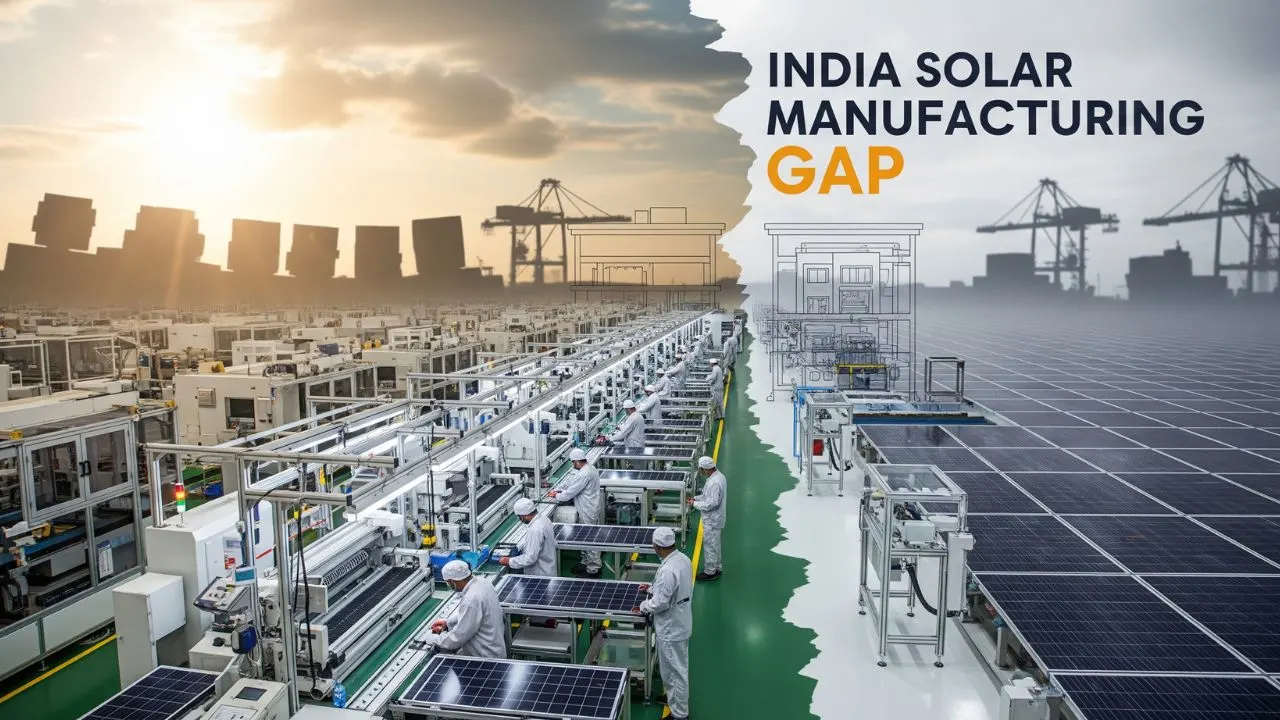
India solar manufacturing gap: India’s rapid rise as a global solar powerhouse is transforming its energy landscape, yet a widening manufacturing gap raises critical questions about long-term sustainability and energy sovereignty for the world’s fastest-growing large economy.
India’s clean-energy ambitions have never been higher. With record-breaking solar installations, national targets aligned with global climate goals, and government incentives accelerating adoption, the country is undergoing a monumental energy shift. But behind this success lies a less visible challenge — India’s heavy dependence on imported solar equipment, particularly in upstream manufacturing stages. This structural imbalance threatens to slow down the country’s momentum unless addressed urgently.
The Solar Boom: India’s Unprecedented Clean-Energy Expansion
India’s journey from a low-solar-capacity nation to a global renewable-energy leader has been remarkable. Over the past decade, the country has scaled rapidly, expanding solar installations in utility-scale parks, rooftop systems, and agricultural programs.
Explosive Growth Across the Solar Ecosystem
India’s solar capacity now stands at nearly 130 gigawatts, up from just a few gigawatts in the early 2010s. Since 2014, total renewable capacity has jumped from 81 GW to over 257 GW, making India the fourth-largest renewable energy producer in the world. This transformation has been driven by policy reforms, declining project costs, and a nationwide urgency to diversify away from fossil fuels.
Government commitments announced at COP26 have further escalated ambitions. India aims to achieve:
- 500 GW of non-fossil energy capacity by 2030
- Net-zero emissions by 2070
Solar remains the centerpiece of this strategy. Massive solar parks now compete globally in size and efficiency. Rooftop solar adoption is accelerating, especially in tier-2 and tier-3 cities. Agriculture-led schemes like PM-KUSUM empower farmers to produce and sell solar power, redefining rural energy economics.
Solar Accessibility Reaches New Milestones
One of the most striking achievements is how deeply solar energy has penetrated India’s social and economic fabric. Today:
- Solar parks operate across 13 states
- Rooftop solar powers millions of households
- Industries, malls, and IT parks adopt solar to reduce expenses
- Remote villages use solar micro-grids to eliminate energy poverty
The solar boom has not only reduced electricity costs but also fostered job growth, attracted foreign investment, and positioned India as a climate-action leader.
However, beneath this optimism lies a fundamental concern — a fragile supply chain heavily dependent on imported modules, wafers, and cells.
Read Also: Best Solar Panels and solar products for home 2025
The Manufacturing Weakness: India’s Underdeveloped Solar Industry
Despite its deployment success, India’s domestic manufacturing ecosystem remains critically underpowered. This disconnect between installation growth and manufacturing capability is now one of the biggest challenges facing the country’s clean-energy future.
Import Dependency Creates Strategic Vulnerabilities
India relies heavily on solar imports, primarily from China, for critical components such as:
- Polysilicon
- Wafers
- Solar cells
- Modules
- Inverters
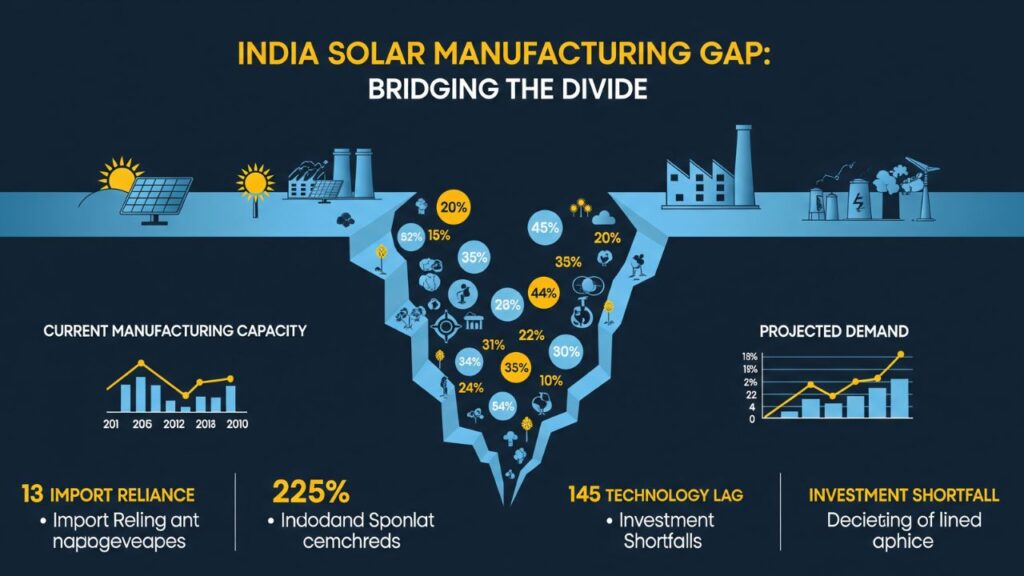
While India manufactures modules at scale, upstream activities — especially polysilicon and wafer production — are almost fully import-dependent. This puts India in a precarious position, especially when global supply chains tighten or prices fluctuate.
A recent industry analysis shows that Indian modules (Mono-PERC) are 103% costlier than Chinese modules, significantly impacting project costs and competitiveness.
Why India’s Manufacturing Lags Behind
Several factors contribute to India’s manufacturing gap:
- High cost of raw materials and low economies of scale
- Insufficient upstream infrastructure, such as polysilicon and wafer-fab units
- Technology gaps, including advanced cell technologies like TOPCon, HJT, and perovskite
- High capital expenditure requirements, deterring private investment
- Lack of consistent R&D funding and skilled labour availability
As a result, India’s solar installation success risks becoming overly dependent on foreign supply chains — a challenge that could undermine its long-term energy transition plans.
Why Closing the Manufacturing Gap Is Crucial for India
The urgency to bridge this gap goes beyond economics. Achieving true energy independence requires strong domestic manufacturing. Without it, India risks replacing its traditional crude-oil dependence with a new dependency on imported solar technologies.
Energy Sovereignty Through Industrial Strength
India’s clean-energy goals cannot be fully achieved without controlling the backbone of solar production. Domestic manufacturing will ensure:
- Stable pricing for solar infrastructure
- Protection against global supply disruptions
- Improved quality and performance standards
- Opportunities for large-scale job creation
A resilient solar manufacturing ecosystem strengthens national security by reducing exposure to geopolitical tensions or trade restrictions.
Global Competition Is Intensifying
Countries worldwide are aggressively expanding their solar manufacturing:
- The U.S. is reshoring solar production with IRA incentives
- The EU is investing in strategic green-industry partnerships
- China continues to dominate the upstream supply chain
For India to remain a competitive global player in renewable energy, it must accelerate both capacity and technology development.
Long-Term Sustainability Depends on Local Manufacturing
Solar is no longer just a project-deployment game. The next decade will be defined by:
- Technological innovation
- Supply-chain resilience
- Cost competitiveness
- Strategic control over raw materials
India must invest now to avoid falling behind as global markets evolve.
Government Push: Policy Measures Leading the Transformation
Recognizing the manufacturing gap, the Government of India has launched major initiatives to attract investment and build a strong domestic ecosystem.
Production-Linked Incentive (PLI) Scheme
The PLI scheme provides financial incentives for manufacturers who build integrated solar production units. The scheme has already attracted multi-billion-dollar investments and is expected to:
- Increase domestic module capacity
- Encourage polysilicon and wafer manufacturing
- Promote advanced cell technologies
Approved List of Models and Manufacturers (ALMM)
To ensure quality and reduce import dependence, ALMM restricts government-funded projects to certified domestic manufacturers. This policy boosts local companies and encourages technological upgrades.
Customs Duties on Imports
Duties on imported modules (40%) and cells (25%) aim to:
- Protect domestic industries from low-cost imports
- Create a level playing field
- Encourage long-term manufacturing investment
State-level incentives amplify national growth
States like Gujarat, Tamil Nadu, and Telangana are emerging as manufacturing hubs, offering:
- Subsidized land
- Power incentives
- Faster clearances
- Investment grants
These initiatives align with India’s larger goal of building a vertically integrated solar manufacturing supply chain.
The Road Ahead: What India Must Do to Achieve True Solar Independence
Achieving manufacturing excellence requires more than policy incentives. It demands strategic planning, capital investment, and technological innovation.
Here are key steps India must prioritize:
1. Build Upstream Capacity at Scale
India must strengthen production in:
- Polysilicon
- Ingot and wafer manufacturing
- High-efficiency solar cell technology
Without these core components, downstream industries cannot be fully competitive.
2. Invest in Research and Innovation
Innovation must focus on:
- Next-generation technologies (HJT, TOPCon, perovskite)
- Cost-reduction techniques
- High-efficiency production lines
R&D partnerships between universities, private companies, and government can accelerate breakthroughs.
3. Develop a Skilled Workforce
A strong manufacturing ecosystem requires:
- Training centers
- Industry-academic collaboration
- Specialized solar-manufacturing courses
Skilled labour will be crucial for scaling factories and adopting new technologies.
4. Create a Robust Solar Supply-Chain Network
India must reduce its dependence on imports of:
- Machinery
- Special gases
- Metals like silver and copper
- Critical minerals
A circular-economy approach, including recycling old modules, can further strengthen supply stability.
Read Also: Solar Farm Investment in 2025: A Complete Guide to Profiting from Clean Energy
5. Foster Global Partnerships and Exports
India has an opportunity to export:
- Solar modules
- Power electronics
- Renewable infrastructure solutions
Becoming a global manufacturing hub would align with India’s vision of being a leader in the clean-energy transition.
Conclusion: India’s Solar Future Depends on Manufacturing Strength
India’s solar revolution is one of the most inspiring energy transitions of the 21st century. With massive installations, falling project costs, and bold climate commitments, the country has positioned itself as a global clean-energy leader.
But to secure this progress for the long term, India must now turn its attention to the manufacturing backbone that sustains the solar sector.
Building a self-reliant, technologically advanced domestic supply chain will determine whether India can achieve:
- True energy independence
- Geopolitical stability
- Low-cost solar deployment
- A competitive global manufacturing identity
The path ahead is challenging but filled with unprecedented opportunity. If India succeeds, it will not only transform its own energy landscape but also contribute significantly to the world’s clean-energy future.
Related Posts


2 thoughts on “India Solar Manufacturing Gap: Why It Matters for India’s Clean Energy Future”