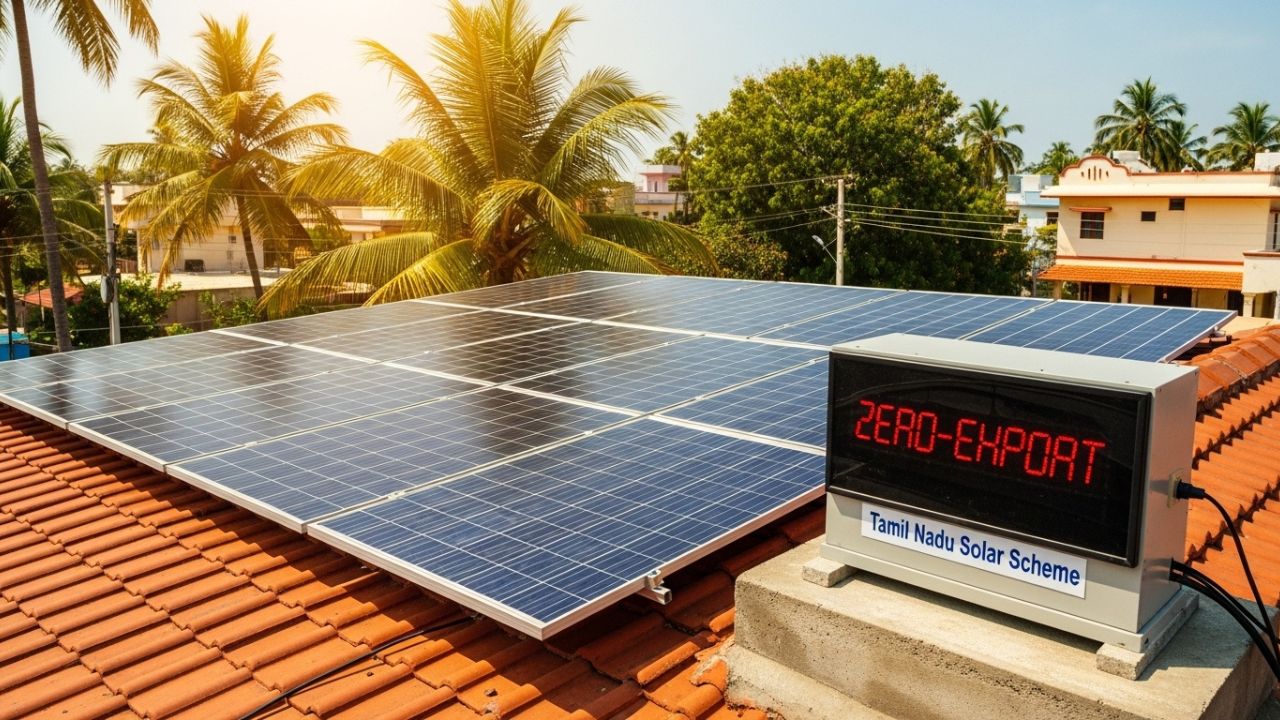
Zero-Export Rooftop Solar Scheme: In the drive towards sustainable energy, many businesses in Tamil Nadu are seeking not only lower power bills but also greater control over their electricity supply. One of the emerging options is a zero-export rooftop solar scheme, where a commercial rooftop solar system is configured to consume all generated solar energy on-site rather than exporting surplus back to the grid. When effectively designed and paired with suitable tariffs and incentives, such a scheme can lead to significant business savings.
This article explores how such a zero-export rooftop solar model works in Tamil Nadu, how businesses can benefit, what policy/regulatory environment exists, what savings to expect, how to evaluate whether it makes sense for your business, and what steps you need to implement it properly.
What is a Zero-Export Rooftop Solar Scheme?
A rooftop solar system under the zero-export model is one in which the solar PV generation is entirely consumed on-site, or is purposefully limited so that excess power is not exported to the grid (or very minimal export). In effect, the business becomes a prosumer (producer + consumer) whose solar production offsets their own grid imports as much as possible.
Key features of zero-export systems:
- Solar PV array installed on the rooftop (or canopy) of a business premise.
- System sized and configured to match the daytime load profile of the business, so most solar generation is used directly.
- Either no (or a very small) export to the grid, often achieved by system settings, inverter mode, or regulatory design.
- Reduced dependency on grid imports and thus lower energy costs.
- Depending on the tariff and policy, less favourable treatment in terms of remunerating exported units, but savings come from on-site consumption.
In Tamil Nadu, given the rising commercial electricity tariffs, the potential for savings is substantial. The zero-export model works especially well for businesses with significant daytime load (manufacturing, offices, commercial buildings, cold-storage, textile units, etc.).
Read Also: Commercial Rooftop Solar System Payback in India 2025: A Complete Guide for Businesses
Why Businesses in Tamil Nadu Should Consider This Model
Here are some reasons why a zero-export rooftop solar scheme makes compelling sense for a business in Tamil Nadu:
- High daytime consumption: Many businesses consume large amounts of electricity during daylight hours when solar generation is at peak. By matching solar output to daytime demand, the business maximises self-consumption and reduces grid purchase.
- Rising tariffs and peak charges: Commercial tariffs in Tamil Nadu continue to increase and often include peak demand or time-of-day surcharges. Solar generation reduces the volume of grid imports (and possibly peak demand) which directly reduces cost.
- Reduced grid dependency and resilience: A rooftop solar system, especially one paired with battery or load-shifting, gives a business more resilience against grid outages or tariff hikes.
- Regulatory advantages: Tamil Nadu has taken steps to promote rooftop solar via removal of some procedural barriers (for example, waiving feasibility reports for up to 10 kW rooftop installs) The New Indian Express+1. For commercial setups, reductions in rooftop network charges for MSMEs were implemented (e.g., 50 % reduction of network charges) Mercomindia.com+1.
- Business sustainability and branding: Beyond cost savings, installing rooftop solar sends a strong sustainability message, improving brand value and possibly helping with ESG (Environmental, Social, and Governance) reporting and supply-chain commitments.
The Policy & Regulatory Environment in Tamil Nadu
For businesses looking to adopt zero-export rooftop solar in Tamil Nadu, understanding the policy/regulatory environment is critical.
Rooftop Solar Incentives & Subsidies
While many subsidies are aimed at residential consumers, certain state-level incentives apply:
- The Tamil Nadu government’s Incentive for Domestic Rooftop Solar offers ₹ 20,000 per kW for grid-connected rooftop PV (domestic only) climatepolicydatabase.org+1.
- The national rooftop solar subsidy under the PM Surya Ghar: Muft Bijli Yojana (MNRE) offers central financial assistance (CFA) of ₹30,000 per kW up to 2 kW, and ₹18,000 per kW for systems above up to 3 kW etc. Green Pages India+1
These largely address residential systems rather than commercial ones.
Net-metering, Export & Zero-Export Options
For commercial rooftop solar, the business must check the tariff design of the local DISCOM (e.g., Tamil Nadu Generation and Distribution Corporation – TANGEDCO) and the permissible export / net-metering regime. While many rooftop systems are designed to export excess power, a zero-export system may utilise controls or settings to avoid export — this can be advantageous if:
- The feed-in/export rate is low, or
- You want to offset high grid import tariffs instead of relying on export credit.
Network / Wheeling / Open Access Charges
For larger rooftop systems (especially businesses), open access or rooftop export/import models may have additional charges (wheeling charges, network charges). Tamil Nadu reduced rooftop network charges for MSMEs by 50% recently Mercomindia.com+1. This enhances business savings potential.
Simplification of Process
In September 2024, Tamil Nadu waived the requirement of a separate feasibility report for installations up to 10 kW rooftop solar systems The New Indian Express. While many businesses will install above 10 kW, this signals regulatory intent to ease rooftop solar adoption.
How to Calculate Business Savings under a Zero-Export Model
For a business considering zero-export rooftop solar, here is a step-by‐step framework:
- Estimate daytime load: Determine how many units (kWh) your business consumes during the day (say 8 am-6 pm) when solar is available.
- Propose system size: Decide rooftop kW size such that solar generation can cover a large portion of daytime load (as much as feasible).
- Estimate solar generation: Use regional irradiance data (Tamil Nadu average ~4.5–5.5 kWh/kWp/day) to estimate annual generation:
Annual Generation (kWh)≈System Size (kW)×Yield (kWh/kW/year). \text{Annual Generation (kWh)} \approx \text{System Size (kW)} \times \text{Yield (kWh/kW/year)}.Annual Generation (kWh)≈System Size (kW)×Yield (kWh/kW/year).
For example: 50 kW × 1,500 kWh/kW/year ≈ 75,000 kWh/year. - Estimate import savings: Multiply the generation used on-site (instead of grid import) by your cost per unit from the grid.
- Estimate avoided charges: If your business has peak demand or time-of-day surcharges, solar may reduce these (estimate this separately).
- Estimate capital cost: Obtain quotes for rooftop solar installation (system + BOS + installation). Deduct any incentives/subsidies, though for commercial upstream subsidy may be limited.
- Compute payback:
Payback (years)=Capital CostAnnual Savings + Avoided Charges. \text{Payback (years)} = \frac{\text{Capital Cost}}{\text{Annual Savings + Avoided Charges}}.Payback (years)=Annual Savings + Avoided ChargesCapital Cost. - Consider maintenance & degradation: Assume minor annual O&M cost and panel degradation (~0.5–1% per annum).
- Present value / ROI: Over a 15-25 year horizon, solar typically delivers high ROI given rising tariffs.
Example: Textile Unit in Coimbatore (Zero-Export Model)
Scenario: A textile manufacturing unit has consistent daytime electricity usage of ~300 kWh/day (≈9,000 kWh/month) during production hours. Grid tariff is ₹9 per kWh. The rooftop is suitable for a 100 kW solar system.
- Estimated annual solar generation: 100 kW × 1,500 kWh/kW/year = 150,000 kWh/year.
- If daytime usage allows the business to use 120,000 kWh of solar (i.e., 80% of generation consumed on-site) then grid import reduction = 120,000 kWh × ₹9 = ₹10.8 lakh/year.
- Additional avoided peak demand or ToD charge reductions may add ₹1.0–₹1.5 lakh/year.
- Capital cost (assume ₹45,000/kW installed) = ₹100 kW × ₹45,000 = ₹45 lakh. (Costs may vary depending on scale, modules, inverter quality.)
- Payback = ₹45 lakh ÷ (₹10.8 lakh + ₹1.2 lakh) ≈ 3.6 years.
This shows that for a high-daytime-load business, a zero-export rooftop solar system can pay back in under 4 years — a very compelling business case.
Key Considerations & Practical Tips for Businesses
- Roof suitability and shading: Ensure rooftop has appropriate area, structural load-capacity and minimal shading during peak sun hours.
- Load profile analysis: Understand your daytime load well. If you have loads at night (e.g., factories with rotating shifts), you may need battery storage or reduce system size.
- Export control: If you design for zero export, ensure inverter/EMS settings or export limiting devices are in place — or configure the system to ensure surplus is minimal.
- Net-metering vs zero export: In some cases, exporting may be beneficial (if high feed-in rate). Evaluate export credit vs on-site consumption.
- Tariff structure: Commercial tariffs, peak demand charges, time-of-day surcharges matter. Savings will be higher if grid purchase cost per unit is high.
- Maintenance & servicing: Engage a reliable EPC and get performance guarantees; keep panels clean and monitor system performance.
- Subsidy / incentives: While many commercial installations may not qualify for large up-front subsidies, Tamil Nadu and central policies still offer process simplifications (waiver of feasibility up to 10 kW) and rooftop network-charge cuts for MSMEs.
- Financing: Consider solar loans or leases; savings can offset loan EMI.
- Future-proofing: If you anticipate night shifts or growth, consider adding battery or sizing larger but manage export via controls.
Frequently Asked Questions (FAQs)
Q1. What exactly does “zero-export” mean in practice?
A. It means the rooftop solar system is configured so that practically no power is exported to the grid; all generation is used on-site. This is achieved through system size matching, inverter settings or export-limiting controls.
Q2. Is zero-export always better than net-metering?
A. Not always. If your business has low daytime consumption relative to solar generation, or if export credit is high, net-metering may make more sense. But for businesses with high daytime demand and low value of export credit, zero-export can be more efficient.
Q3. Are subsidies available for commercial rooftop systems in Tamil Nadu?
A. Subsidies for residential systems are more common (e.g., domestic rooftop incentives). For commercial systems, while there may not be large upfront subsidies, Tamil Nadu has reduced network charges for rooftop solar for MSMEs and streamlined processes.
Q4. How big should my rooftop system be under a zero-export model?
A. Generally you size the system to approximate your daytime load so that most solar generation is self-consumed. Oversizing without matching load may create unwanted export unless managed.
Q5. What happens if my rooftop generation exceeds my daytime usage?
A. If you have a zero-export model, you might cap export using inverter/export-limiting settings, or incorporate battery storage to absorb surplus. Otherwise, surplus may go to the grid (if allowed) but may yield minimal benefit if export compensation is low.
Q6. How much can I save?
A. Savings depend on how much of your daytime load you can offset, and your current tariff. As shown in the example above, payback of 3–5 years is possible in the right situation.
Q7. Does zero-export mean I cannot ever export?
A. Not necessarily — “zero-export” is a design philosophy for minimal export. Some systems allow a small export buffer or use hybrid setups.
Conclusion
For businesses in Tamil Nadu looking to reduce electricity costs, enhance sustainability credentials and improve resilience, a zero-export rooftop solar scheme offers a compelling option. By aligning solar generation with daytime loads, reducing grid imports, and leveraging supportive regulatory changes (such as reduced network charges for MSMEs), businesses can achieve substantial savings, often with payback periods of just a few years.
However, success depends on proper load analysis, rooftop suitability, system design, export management, and understanding the tariff and incentive regime. While the term “zero-export” may sound restrictive, it simply means careful system sizing and setup to maximise on-site usage — and thereby maximise value for your business.
If your business has significant daytime load, adequate rooftop space, and is paying commercial electricity tariffs, this model deserves serious consideration. With the right EPC partner, financing structure and operational design, you can unlock meaningful business savings and position your enterprise for a clean energy future.
Related Posts