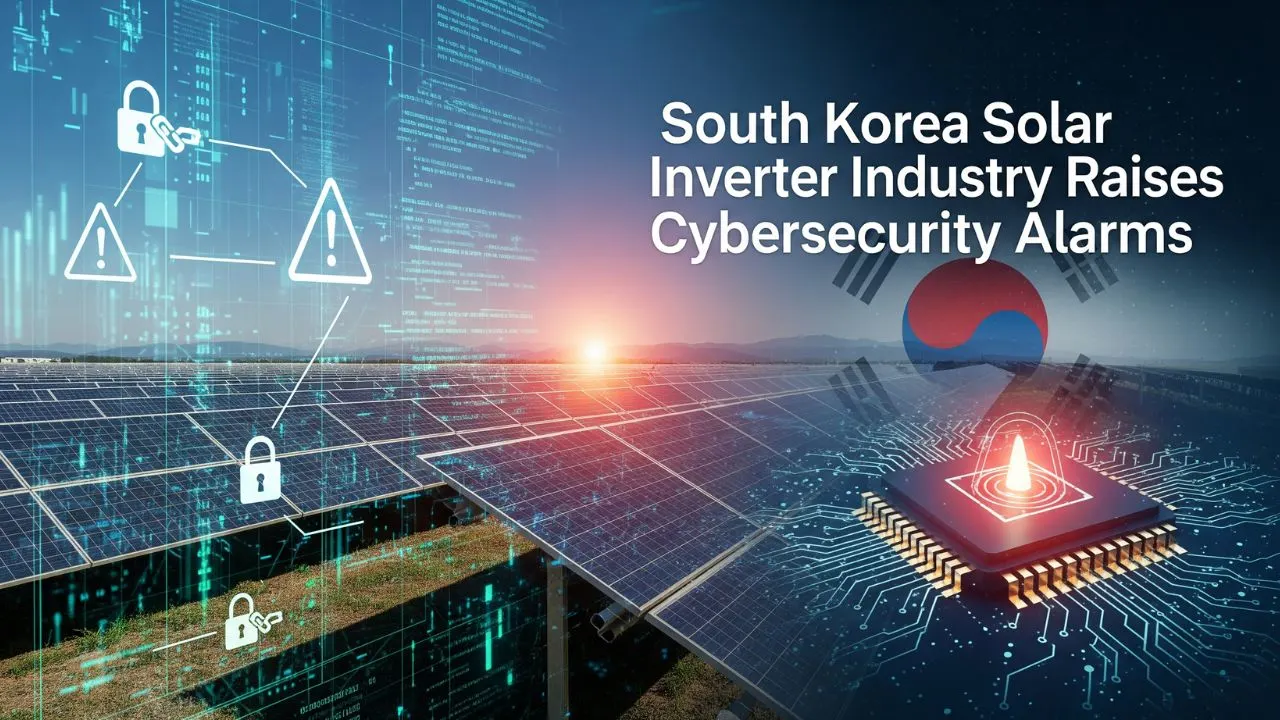
South Korea Solar Inverter Industry: A newly unified alliance of South Korean solar inverter makers is stepping forward as cyber threats, foreign imports, and energy-security challenges reshape one of the nation’s most critical clean-energy sectors.
In a market increasingly dominated by imported inverters — many equipped with unverified communication modules — South Korea’s domestic manufacturers are sounding the alarm. Their message is clear: the nation’s solar industry can no longer rely on unsecured foreign hardware as the grid grows more digitized, interconnected, and vulnerable to infiltration.
A Unified Industry Front: South Korea’s Inverter Manufacturers Form New Alliance
South Korea’s inverter sector has taken a decisive step by launching a new national industry council composed of seven prominent manufacturers: OCI Power, Dass Tech, Ecos, Dongyang E&P, DIK, Geumbi Electronics, and Inno Electric.
The group held its inaugural meeting on Nov. 18 at the Cheongju Osong Convention Center, marking the first coordinated industry effort to:
- Strengthen domestic manufacturing
- Safeguard local technical expertise
- Establish cybersecurity standards
- Develop a unified policy voice
- Counter increasing dependence on imports, particularly from China
For years, South Korea’s solar inverter makers have operated independently, leaving them with limited leverage in policy discussions and weak defenses against market saturation by low-cost imported products. With imports now making up more than 80% of annual inverter sales, the urgency for collaboration has reached a critical point.
The new alliance aims to reverse this trend by promoting domestic innovation, replacing unsecured foreign equipment, and protecting the national grid against escalating cyber threats.
Read Also: Solar Microgrid Tax Incentives 2025: New Funding Powering Schools & Public Infrastructure
Foreign Imports Trigger Cybersecurity Alarms
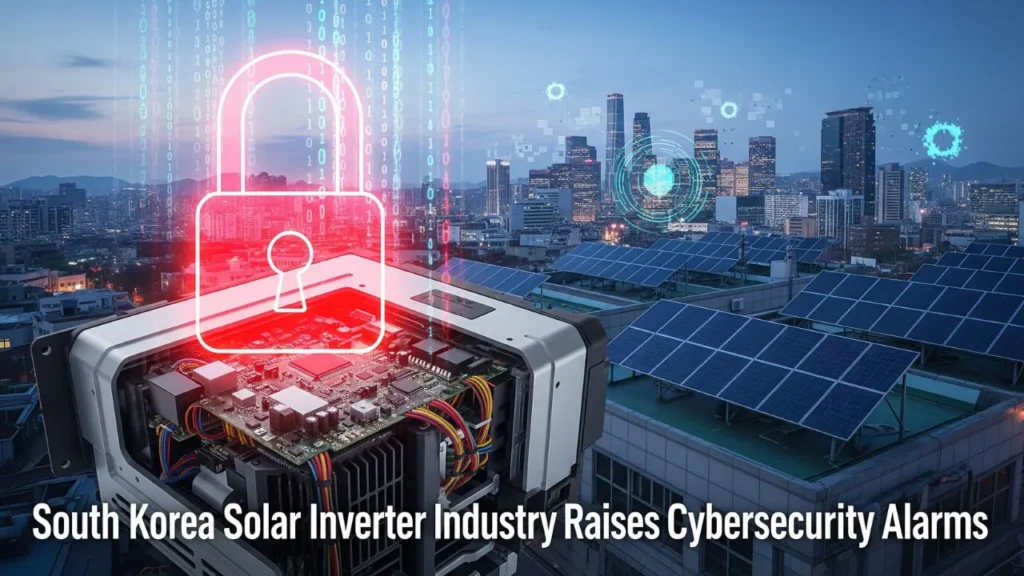
The rise of imported inverters — especially those produced under ODM arrangements in China — has intensified scrutiny across South Korea’s clean-energy sector. Local manufacturers and energy experts warn that many foreign-made inverters contain unapproved communication modules capable of:
- Unauthorized data transmission
- Remote manipulation
- Firewall bypass
- Real-time monitoring of grid conditions
These capabilities raise serious concerns about unauthorized access to the nation’s power infrastructure.
OCI Power, one of the leading council members, recently warned that inverters equipped with hidden communication features could be exploited to manipulate grid behavior, disrupt energy flows, or harvest sensitive data about national energy systems.
As South Korea advances toward a more digitally connected grid, the risk of cyber intrusion grows. Modern inverters are no longer simple power-conversion devices — they are networked endpoints connected to cloud platforms, mobile apps, and utility monitoring systems. This makes them potential gateways for cyberattacks.
Local manufacturers fear that without rapid action, South Korea’s dependence on foreign hardware could evolve into a strategic vulnerability, compromising both grid stability and national security.
Why the Inverter Sector Is Now a National Security Issue
South Korean officials are increasingly framing solar inverter security as a matter of energy sovereignty. The inverter is the “brain” of a solar power plant, responsible for controlling output, communicating with the grid, and responding to fluctuations in real time.
When these devices rely on foreign firmware or cloud services, the risks include:
1. Remote Shutdown Capability
Unsecured communication channels could allow hostile actors to disable or alter inverter behavior, potentially destabilizing local or regional grid segments.
2. Data Exposure
Inverters collect detailed operational data, including:
- Power generation patterns
- Network conditions
- System configuration data
- Grid performance metrics
If leaked, this data could reveal vulnerabilities in the national energy system.
3. Firmware Manipulation
Compromised firmware updates could introduce malicious code, enabling long-term, undetectable infiltration.
4. Large-Scale Grid Disruption
Coordinated cyberattacks targeting many inverters simultaneously could theoretically cause widespread grid instability.
With 80 GW of new solar capacity planned by 2030, the threat surface will only expand. The new council aims to proactively address these risks before they escalate into systemic weaknesses.
An Industry Under Pressure: How Imports Displaced Local Technology
South Korea’s inverter market is valued at up to KRW 1 trillion ($680.6 million) annually, but domestic manufacturers have long struggled against low-cost imports. Foreign-made inverters frequently undercut Korean products through:
- Subsidized pricing
- ODM production scaling
- Global distribution advantages
- Aggressive market expansion strategies
The result is a domestic industry that, until now, lacked a unified voice, making it difficult to compete or raise awareness about critical vulnerabilities.
While local companies maintain strong technological expertise, they face market conditions that heavily favor cheaper imports. This has left only a few niche segments under Korean control.
By forming a dedicated industry alliance, manufacturers now have a platform to advocate for:
- Protective regulatory measures
- Fair competition policies
- Domestic manufacturing incentives
- Strong cybersecurity standards
- Public awareness of inverter quality and safety issues
This coordinated effort marks a turning point in the fight to restore balance in a market overwhelmingly dominated by imports.
Government Targets Drive Demand for Secure, Domestic Inverters
South Korea’s long-term renewable energy strategy is creating massive new demand for inverters — and bringing the issue of cybersecurity to the forefront.
The 2050 Carbon Neutral Green Growth Committee aims to deploy 100 GW of renewable energy by 2030, including 80 GW of solar. With current installations at 27 GW, this requires over 10 GW of new solar capacity each year for the next five years.
Such growth will significantly expand the presence of connected inverters across the grid. Without strong domestic manufacturing, South Korea risks relying on foreign-built devices for one of its most critical infrastructure expansions in decades.
A secure, reliable supply chain is essential to meet national climate goals without compromising grid stability or cybersecurity.
Global Context: Europe Sounds Similar Alarms About Inverter Security
South Korea is not alone in confronting the risks of foreign-made, highly connected inverters. Across Europe, industry groups and regulators are now raising red flags about the cybersecurity vulnerabilities embedded in modern solar hardware.
SolarPower Europe’s 2025 Findings
A spring 2025 report from SolarPower Europe warned that:
- Networked inverters
- Cloud-based monitoring systems
- Remote control platforms
all increase exposure to cyber threats such as ransomware, remote shutdown, and data manipulation.
The report stressed that despite new EU cybersecurity rules, fragmented governance and weak installer practices leave large sections of Europe’s solar fleet exposed.
Czechia’s National Cybersecurity Agency Warning
In September, Czechia issued a national advisory stating that up to 99% of inverters used in small PV systems are Chinese-made, posing risks of:
- Firmware manipulation
- Unauthorized data transmission
- Potential grid disruption
The agency recommended reducing dependence on Chinese hardware and boosting domestic production — echoing concerns now surfacing in South Korea.
These international developments illustrate a global shift toward scrutinizing inverter security, positioning South Korea’s new industry alliance within a growing worldwide movement.
What the New Council Plans to Do
The newly formed South Korean industry council has outlined plans to:
1. Develop a Unified National Standard for Inverter Security
This includes communication protocols, encryption requirements, firmware management, and cloud security practices.
2. Strengthen Domestic Production Capabilities
The council aims to expand local manufacturing capacity to reduce dependence on foreign suppliers.
3. Propose Government-Level Policy Measures
To encourage adoption of domestic inverters, the group will advocate for:
- Incentives
- Certifications
- Procurement requirements
- Quality and security regulations
4. Establish a Rapid Response Framework
This system will help manufacturers respond collectively to cyber threats, vulnerabilities, or supply chain disruptions.
5. Promote Local Expertise and Job Creation
By ensuring inverter software, design, and cloud management remain controlled within South Korea.
The council’s strategy seeks to transform the country’s inverter sector from vulnerable and import-dependent to secure, resilient, and economically competitive.
Read Also: Solar Panel Recycling Tax Benefits: New Federal Incentives
Why This Moment Matters for South Korea’s Energy Future
The intersection of cybersecurity, energy independence, and renewable expansion creates a perfect storm of challenges — but also unprecedented opportunity.
South Korea’s inverter alliance arrives at a defining moment:
- Solar deployment is accelerating
- Grid digitization is increasing
- Global cyber threats are intensifying
- Dependence on foreign hardware is nearing unsustainable levels
By acting now, the nation can protect its infrastructure, foster domestic innovation, and ensure that its clean-energy transition rests on a foundation of secure, reliable technology.
Conclusion: A Turning Point for Korea’s Solar Inverter Industry
The formation of a unified council of South Korean inverter makers represents a landmark step toward securing the nation’s clean-energy future. With foreign imports dominating the market and cybersecurity risks escalating, the alliance provides the structure needed to defend domestic technology, restore supply chain control, and protect the national grid from emerging threats.
As South Korea races toward its 2030 renewable-energy targets, strengthening inverter security is no longer optional — it is essential. The new industry group brings the collective power, expertise, and urgency required to confront these challenges head-on and ensure a safe, resilient, and sovereign solar future.
Related Posts

2 thoughts on “South Korea Solar Inverter Industry Raises Cybersecurity Alarms”