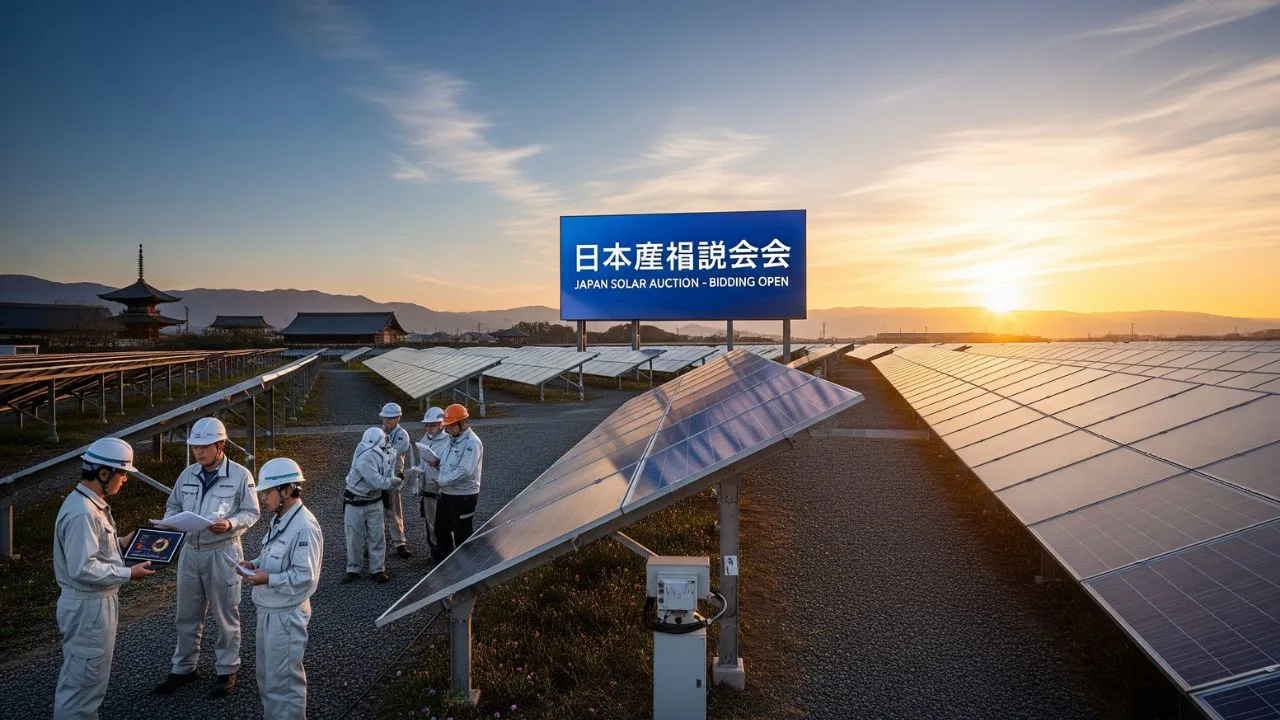
Japan solar auction: In a decisive move underscoring Japan’s ongoing renewable energy expansion, the nation’s 26th solar auction closed with remarkably competitive pricing and renewed investor interest across utility-scale PV projects.
The latest procurement round, overseen by Japan’s Green Investment Promotion Organization, reinforces the country’s commitment to scaling clean energy, but also reveals shifting market patterns compared to previous auction cycles. With 75.3 MW of solar capacity allocated, the auction demonstrated how developers are responding to evolving policies, price caps, and grid access challenges within Japan’s maturing solar landscape.
A Closer Look at the Results of Japan’s 26th Solar Auction
Japan’s newest auction results offer a deep insight into pricing trends and developer behavior in the utility-scale solar market. The Green Investment Promotion Organization, responsible for managing these competitive solar tenders, confirmed that 27 projects were selected, with capacities ranging from 300 kW to 21.7 MW, collectively amounting to 75.3 MW.
While the auction was initially expected to allocate 163 MW, the final awarded capacity fell significantly short. This shortfall highlights increasing project feasibility challenges, tighter policy requirements, and potential land or grid constraints that developers are grappling with across Japan.
One of the most notable outcomes was the lowest winning bid of JPY 4.97/kWh ($0.032/kWh), submitted for two smaller projects of 300 kW and 500 kW. This competitive price reflects strong cost optimization and improved efficiency in PV deployment.
On the other end of the spectrum, the highest accepted bid reached JPY 8.75/kWh, a price submitted for six projects between 1 MW and 2 MW in scale. This upper-limit bid also served as the auction ceiling, showing that several developers are still willing to bid near the price cap to secure market entry.
The average final price across all awarded projects landed at JPY 7.13/kWh, slightly above the results of earlier auctions but still evidence of sustained competitive pressure in the Japanese solar sector.
Read Also: Large-Scale Agrivoltaics Arrive in Norway with Record 46 MW Solar Project
Comparing the 26th Auction With Previous Rounds
To fully understand the significance of these results, it’s essential to compare them with pricing trends and capacity allocations from recent auctions.
25th Auction: Higher Capacity, Lower Prices
Japan’s 25th solar auction resulted in the allocation of 223.3 MW, significantly more than the 26th round’s 75.3 MW. The average price in that auction was JPY 6.58/kWh, which is noticeably lower than the JPY 7.13/kWh recorded in the most recent round.
This difference suggests changing market dynamics, including rising material costs, supply chain pressures, or shifts in developer strategies.
24th Auction: Exceptionally Low Bids and Strong Participation
In the 24th auction, the average final price stood at JPY 4.06/kWh, an all-time competitive milestone for Japan’s utility-scale PV tenders. The capacity allocated was 79 MW, slightly above the 26th round but still modest compared to earlier years.
What made both the 24th and 25th auctions unique was the presence of JPY 0.00/kWh bids, submitted for multiple projects between 300 kW and 2 MW. These bids likely came from developers who had already secured private PPAs (Power Purchase Agreements). And only participated in the auctions to obtain grid connection rights, not revenue guarantees.
This underscores how Japanese solar auctions are increasingly serving not just as pricing mechanisms. But also as gateways to grid access, an issue that remains a major bottleneck for solar expansion.
Historical Bidding Trends (2022–2025)
In the ten auction rounds conducted between March 2022 and March 2025, the lowest prices varied between JPY 5.06/kWh and JPY 8.85/kWh. This means that the JPY 4.97/kWh achieved in the latest auction is one of the most competitive bids recorded in the past several years.
Why the 26th Auction Allocated Less Capacity Than Expected
The 26th solar auction had a projected allocation of 163 MW, but the final awarded amount was just 75.3 MW— less than half of the target. Several key factors likely contributed to this shortfall.
1. Rising Costs and Market Uncertainty
Global increases in equipment prices, transportation costs, and labor shortages have placed pressure on developers, making it more difficult to bid aggressively.
2. Regulatory Compliance and Land Availability
Japan’s strict regulations, environmental requirements, and the scarcity of suitable land make project development more complex. Developers may be increasingly selective in terms of which projects they can realistically bring to auction.
3. Grid Access Limitations
Grid congestion remains a persistent challenge in Japan, particularly in regions where renewable energy penetration is high. Developers may avoid bidding if grid access cannot be guaranteed or if interconnection upgrades raise project costs significantly.
4. Competition from Private PPAs
As private PPAs gain traction, some developers secure attractive off-take agreements outside the auction framework. This reduces their reliance on government-run tender schemes.
Japan’s Long-Term Solar Policy and Auction Performance
To better contextualize the 26th auction, it is important to look at the bigger picture of Japan’s solar tender history and national renewable goals.
Strong Solar Allocation in Previous Years
In 2021, Japan allocated 675 MW of PV capacity across three different auctions—one of the strongest years in terms of solar deployment growth. Auctions before 2021 collectively allocated 942 MW, securing significant progress toward national renewable energy targets.
These figures demonstrate that while the 26th auction awarded a modest capacity, Japan’s broader auction-based strategy has historically delivered robust results.
A Maturing Market With Evolving Challenges
Japan’s solar market is transitioning from rapid expansion to a mature, efficiency-driven phase. Key trends include:
- More conservative bidding strategies as project risks increase
- Greater focus on securing grid access rather than tariff revenues
- Shift toward mid-sized and smaller projects, which often find it easier to navigate regulatory and land constraints
- Growing interest in hybrid systems, storage integration, and private PPAs
These factors shape the competitive landscape and influence auction performance year after year.
Read Also: Large-Scale Agrivoltaics Arrive in Norway with Record 46 MW Solar Project
Implications of the 26th Auction for Japan’s Renewable Energy Future
Despite a lower-than-expected allocation, the 26th solar auction remains a meaningful step in Japan’s energy transition.
A Sign of Stable but Competitive Pricing
The JPY 7.13/kWh average price suggests that solar power remains cost-competitive, even as developers face rising project development expenses.
Continued Commitment to Solar Growth
The government’s ongoing auction schedule confirms Japan’s commitment to expanding its renewable portfolio and achieving long-term decarbonization goals.
Market Adaptation Will Drive Future Efficiency
With stricter rules, evolving pricing trends, and grid constraints, developers will need to adopt innovative project designs, advanced technologies. And diversified financing strategies to remain competitive in upcoming auctions.
Conclusion
Japan’s 26th solar auction delivered a mix of competitive pricing, moderate capacity allocation, and valuable insights into the evolving nature of the country’s solar sector. The lowest bid of JPY 4.97/kWh ($0.032/kWh) highlights the technological and operational efficiencies gained by developers, while the significant gap between offered and allocated capacity underscores rising challenges in project feasibility and grid accessibility.
As Japan continues to refine its renewable energy policies, upcoming auctions will play a crucial role in shaping investment behaviour and accelerating the nation’s clean-energy transition.
Related Posts