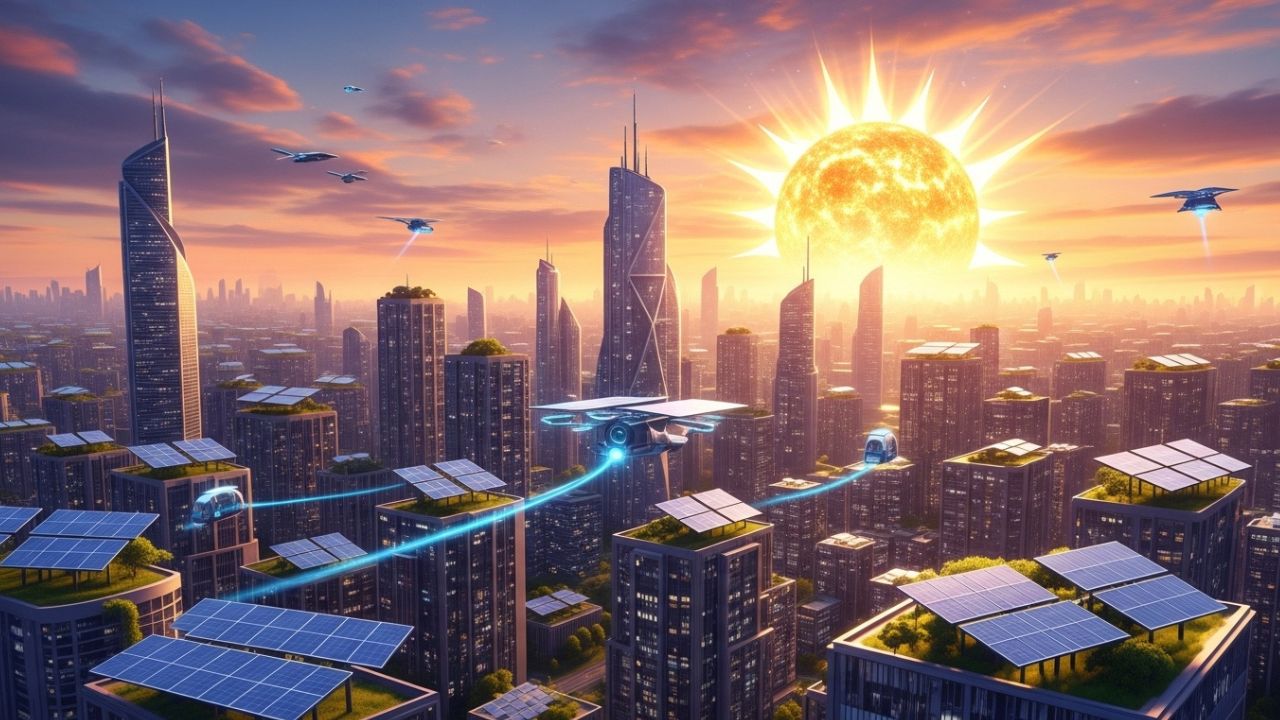
Smart Cities & Solar Missions: India’s cities are rapidly evolving — becoming smarter, cleaner, and more sustainable through the integration of renewable energy. With urban areas contributing to nearly 70% of total electricity demand, the push toward solar energy is redefining the blueprint for an eco-conscious India.
The Smart Cities Mission (SCM) and the National Solar Mission (NSM), both cornerstones of India’s green development agenda, are now working in sync to achieve self-sufficient, solar-powered urban ecosystems. Supported by the Ministry of Housing and Urban Affairs (MoHUA) and the Ministry of New and Renewable Energy (MNRE), cities across India are using technology, energy efficiency, and decentralized solar networks to become intelligent, energy-secure hubs.
This article explores how India’s smart city vision and solar missions are converging to create net-zero, climate-resilient, and environmentally sustainable cities by 2030.
Overview of India’s Smart Cities Mission
The Smart Cities Mission, launched in 2015, was India’s most ambitious urban modernization drive, covering 100 cities nationwide. Its goal: to make cities efficient in energy, waste, mobility, and infrastructure through the use of technology and sustainability-focused planning.
Key objectives include:
- Sustainability-first infrastructure using renewable energy.
- Smart mobility aided by electric vehicles and energy-efficient transport.
- Low-emission buildings compliant with green-building standards.
- Data-driven governance for resource optimization.
According to official government data, by 2025:
- Over 7,555 projects (94% completion rate) have been executed.
- The total project investment has exceeded ₹1.51 lakh crore, with renewable energy systems forming a critical part of completed developments.
Read Also: Solar EV Roads: Charging Electric Cars While You Drive
India’s Urban Energy Transformation
Historically, cities have been among the largest consumers of grid-based electricity, contributing to major carbon emissions. However, the integration of solar power under the Smart Cities Mission is transforming how urban power infrastructure operates.
The Renewable Energy Shift:
- India’s total installed solar capacity exceeded 92 GW by mid-2025.
- Smart cities collectively account for nearly 5 GW of distributed urban solar installations.
- Rooftop and floating solar systems are now integral to urban housing, metro stations, smart streetlights, and EV charging networks.
In addition, energy storage technologies and IoT-integrated energy grids are helping these cities manage variable renewable supply more effectively.
Integrating Solar Power Into Urban Infrastructure
The convergence of India’s Smart Cities framework with the National Solar Mission has enabled the deployment of solar systems across multiple layers of urban design.
1. Rooftop Solar for Urban Buildings
Under the PM Surya Ghar: Muft Bijli Yojana, residential and commercial properties in smart cities receive up to ₹78,000 subsidy per household for rooftop solar systems.
Example:
- State governments like Gujarat, Tamil Nadu, and Karnataka have made solar rooftops mandatory for new housing projects approved under Smart City plans.
This policy directly reduces household power costs, increases property values, and curbs grid dependency.
2. Solar Street Lighting and Smart Poles
Every smart city now features solar-integrated LED streetlights equipped with digital sensors, CCTV cameras, and Wi-Fi modules, powered entirely via decentralized solar grids.
- In Indore and Pune, over 50,000 smart poles operate on solar power.
- Bhubaneswar has replaced 42 key street corridors with solar-powered lighting systems, under the MNRE’s Solar City Mission, a subcomponent of the Smart Cities framework.
This not only reduces electricity bills for urban local bodies but also enhances safety and surveillance infrastructure.
3. Solar-Powered Public Transport
Several smart cities are using solar systems to operate metro networks and e-buses:
- Nagpur uses 14 MW of rooftop solar power for its metro stations.
- Kochi Metro sources 35% of its energy from solar setups.
- Delhi’s EV 2.0 Masterplan integrates solar EV charging stations at every metro interchange by 2026.
Smart transit hubs have become green energy clusters powering metros, parking lots, and passenger lounges sustainably.
4. Solar-Powered Water and Waste Systems
Urban water treatment plants and waste management facilities now operate on solar and hybrid grids.
- Surat Smart City runs its primary sewage treatment plant entirely on 10 MW solar power, saving ₹12 crore annually.
- Chandigarh has installed solar-powered waste compactors and sorting machines for smart garbage collection.
This integration represents a major leap in zero-waste and energy-positive municipal operations.
5. Floating and Canal-Top Solar Projects within Cities
Given limited rooftop space, states like Gujarat and Maharashtra have adopted floating solar panels on lakes, canals, and reservoirs.
- Ahmedabad’s Sabarmati Riverfront Solar Project generates 30 MW of clean power, reducing both water evaporation and heat island effects.
- Bhopal’s Smart Lake Solar Project powers civic utilities while enhancing aesthetic appeal.
Bhubaneswar: India’s Prototype Solar City
The capital of Odisha — Bhubaneswar — is leading India’s “Green Energy and Solar City” initiative under the Smart Cities Mission and MNRE’s Green City Program.
Key Highlights:
- Citywide renewable resource assessment for integrated implementation.
- Over 42 arterial roads fitted with solar-powered street lighting systems.
- Installation of “solar trees” at temples, colleges, and heritage areas.
- Deployment of solar kiosks providing purified drinking water.
- Development of solar-based EV charging stations in collaboration with Tata Power Central Odisha Distribution Ltd.
The Bhubaneswar Smart City Corporation and Odisha Renewable Energy Development Agency (OREDA) have made the city’s municipal energy model 60% renewable as of 2025.
Solar Energy for Smart Cities: Technological Innovations
Smart energy systems leverage AI, IoT, and digital twin technologies to optimize solar power generation, consumption, and storage.
Key Tech Applications:
- AI Predictive Analytics: Forecasts sunlight exposure, optimizing rooftop energy efficiency.
- Smart Grid Integration: Uses IoT sensors to automate load balancing.
- Battery Energy Storage Systems (BESS): Retains surplus solar power for night-time usage.
- Building-Integrated Photovoltaics (BIPV): Transforms glass façades of skyscrapers into solar panels.
- Digital Energy Dashboards: Enable citizens and administrators to monitor local solar output in real-time.
Cities like Chandigarh and Bengaluru have launched urban energy dashboards that display daily solar generation data accessible to the public.
The MNRE’s “Development of Solar Cities” Programme
Parallel to the Smart Cities Mission, the MNRE’s Solar City initiative (launched in 2014 and expanded in 2024 under the Green City Mission) defines a structured renewable energy mandate for urban zones.
Objectives:
- Reduce conventional energy demand by at least 10% in 5 years.
- Encourage community-level renewable integration programs.
- Promote decentralized generation and rooftop solar adoption.
Implemented Activities:
- Setting up solar parks, water heaters, and rooftop panels on public buildings.
- Development of solar zones for selective commercial and transport corridors.
- Incentives for citizens installing rooftop systems through municipal property tax rebates.
Indian cities such as Jaipur, Surat, Chandigarh, and Vishakhapatnam were among the first to adopt this plan, now expanded to newer urban zones like Bhubaneswar and Indore.
Economic Perspective: Green Growth and Job Creation
The integration of Smart Cities and Solar Missions is an economic catalyst, not just an environmental one.
According to MNRE’s 2025 Renewable Energy Report, India’s solar-linked urban programs have generated:
- Over 6 lakh green jobs nationwide, including installation technicians, data analysts, and energy managers.
- Around ₹8 lakh crore worth of cumulative investment opportunities across Smart Cities and allied energy projects.
- A projected reduction of 50 million tonnes of annual CO₂ emissions by 2030.
Moreover, smart cities integrating renewable microgrids with storage capabilities are expected to reduce fossil fuel imports by ₹1 trillion annually by the end of the decade.
Top Smart Cities Pioneering Solar Integration
| Smart City | Key Solar Milestones | Renewable Energy Share (2025) |
| Chandigarh | 30 MW rooftop solar on govt buildings; city declared “Model Solar City” | 85% |
| Indore | Solar streetlights and renewable waste-to-energy plants | 70% |
| Surat | Solar water treatment and 10 MW grid supply initiative | 65% |
| Pune | Metro and bus depots powered by solar energy | 55% |
| Bhubaneswar | Designated “Solar City” under MNRE Green City Mission | 60% |
| Varanasi | Solar ghats and hybrid rooftop installations | 40% |
These cities are shaping India’s renewable city model that balances clean energy, smart infrastructure, and urban efficiency.
Policy and Investment Drivers
- Municipal Bonds for Green Projects:
Smart cities like Pune and Indore are issuing bonds to finance their solar initiatives, backed by green loans from IFC and ADB. - Mandatory Green Building Codes:
- The Energy Conservation Building Code (ECBC) mandates rooftop solar integration for new commercial spaces.
- Residential housing projects under the RERA-Green Compliance Framework must use renewable energy for common utilities.
- Public-Private Partnerships (PPPs):
Collaboration models with companies like Tata Power, Adani Solar, and ReNew Energy have accelerated urban solar installations. - International Cooperation:
India’s participation in the International Solar Alliance (ISA) encourages global investment in solar-smart cities.
Challenges in Implementation
Despite rapid urban solarization, the mission faces multiple hurdles:
- Land and space constraints in densely populated cities.
- Inadequate finance models for small-scale rooftop projects.
- Delayed disbursement of subsidies under MNRE’s previous phases.
- Maintenance and monitoring issues after installation due to skill shortages.
The MNRE and MoHUA are addressing these through:
- Simplified solar subsidy portals.
- Training programs under Skill Council for Green Jobs (SCGJ).
- Urban renewable service contracts for post-installation management.
Future of Green Urban Development (2025–2030)
India’s roadmap for solar-smart urban growth is ambitious yet pragmatic. The government plans to:
- Increase the number of solar cities from 60 to 150 by 2030.
- Introduce net-zero building codes across all major metro regions.
- Launch Solar Microgrid Corridors under the National Infrastructure Pipeline (NIP).
- Integrate Green Hydrogen hubs to power institutional and industrial clusters.
As India aims for 500 GW of renewable capacity by 2030, its smart cities will be the technological spearheads that make the vision possible.
Read Also: Solar-Powered e-Learning Centres: Lighting Up Education in Rural India
FAQs
1. What is the link between the Smart Cities Mission and Solar Programs?
The Smart Cities Mission uses solar energy as a core sustainability pillar within its infrastructure modernization goals. MNRE’s solar programs provide technical and financial frameworks for urban solar adoption.
2. Which government bodies manage these missions?
- Smart Cities Mission: Ministry of Housing and Urban Affairs (MoHUA).
- Solar Missions: Ministry of New and Renewable Energy (MNRE).
3. What benefits do citizens receive from these initiatives?
Households can receive rooftop solar subsidies, reduced property taxes, uninterrupted power supply, and improved city air quality.
4. Are commercial buildings eligible for subsidies?
Yes. Commercial and institutional structures can claim subsidies under Phase II Rooftop Solar Programme and tax deductions for renewable investment.
5. What is the next phase of India’s smart city solar expansion?
The Green Cities 2.0 Plan (2026–2030) will focus on electric mobility, green hydrogen, and advanced solar microgrids.
Conclusion
The fusion of Smart Cities and Solar Missions is redefining India’s urban identity. Through initiatives like the PM Surya Ghar Yojana, Solar City Mission, and Green City Mission, the government is making renewable power a core component of city life.
From rooftops and roads to metros and markets, solar energy is becoming the heartbeat of India’s smart cities. As these developments expand, the vision of fully green, self-sustaining urban centers is no longer a distant ideal—it’s becoming the country’s new reality.
Related Posts
4 thoughts on “Smart Cities & Solar Missions: How India’s Urban Projects Are Going Fully Green”