Solar Powered Metro Stations: India’s metro rail revolution is not only transforming urban mobility, but also redefining how cities think about sustainability. As climate goals become more urgent and fuel costs continue to rise, metro corporations across India are embracing a cleaner, greener power source — solar energy. From Delhi Metro’s 50 MW solar capacity to Kochi Metro’s 55% solar reliance, the shift toward renewable energy is rapidly reshaping India’s public transportation infrastructure.
By integrating solar panels on rooftops, depots, and viaducts, India’s metro systems are setting global benchmarks in sustainable transit. The initiative doesn’t just cut emissions; it reduces operating costs, enhances energy independence, and helps achieve India’s national renewable energy target of 500 GW by 2030.
The Solar Revolution in India’s Metro Systems
The journey of solar integration into metro networks began in the early 2010s, when the Delhi Metro Rail Corporation (DMRC) started installing rooftop photovoltaic (PV) systems as part of its sustainability roadmap. Since then, solar power adoption has evolved from pilot projects to large-scale, grid-connected operations.
Currently, metros in Delhi, Kochi, Pune, Noida, Hyderabad, and Jaipur are advancing solar deployment through a combination of rooftop installations, captive solar plants, and power procurement from solar parks.
Delhi Metro: The Pioneer of Solar Transit
The Delhi Metro Rail Corporation (DMRC) remains the undisputed pioneer in using clean energy for public transport. With over 50 MW of total solar capacity operating across 93 stations and 15 depots, DMRC is the first metro in India to achieve more than 33% of its total energy from renewable sources.
Key Initiatives:
- Rooftop Solar Installations: Multiple stations, depots, and staff complexes are equipped with rooftop solar panels generating 40 million units (MUs) of electricity annually.
- Rewa Solar Park Partnership: Delhi Metro procures 350 MUs annually from the Rewa Ultra Mega Solar Park in Madhya Pradesh through a power purchase agreement (PPA).
- New Bid for Expansion: In October 2025, DMRC invited bids to develop a 500 MU captive solar power plant with Battery Energy Storage System (BESS) to reach 60% renewable energy dependence by 2026.
- Vertical Bi-Facial Solar Plants: India’s first 50 kW vertical solar power plant was commissioned at Okhla Vihar Station, while a 1 MW rooftop system was inaugurated at Khyber Pass Depot.
This combined setup aims to make Delhi Metro not just a mass transit system, but a climate-neutral mobility network.
Read Also: Portable Solar Kits: India’s New Lifeline in Disaster Relief Operations
Kochi Metro: Toward 100% Solar Energy by 2030
While Delhi Metro pioneered large-scale solar adoption, Kochi Metro is racing toward becoming India’s first fully solar-powered metro by 2030. The Kochi Metro Rail Ltd (KMRL) currently sources 49.9% of its power through renewable energy, primarily from solar generation.
Highlights:
- A 10.5 MW solar capacity already services metro operations.
- Construction is underway for new solar plants on 50 acres in Kasaragod and an additional 90 acres in Kuttanad, Kerala.
- The Kochi Water Metro, another sustainability project, runs battery-operated boats powered by renewable energy, connecting 10 islands across 78 km of waterways.
Through such multi-modal initiatives, KMRL aims to reach 100% energy neutrality by 2030, integrating solar power with hydrogen fuel technology and electric feeder buses.
The Broader Green Metro Movement
Apart from Delhi and Kochi, several other metro systems are embracing solar integration:
- Hyderabad Metro: Has rooftop solar at depots and aims for 15% renewable power integration by 2026.
- Chennai Metro: Uses solar power to operate lighting and escalators across key stations and plans a 20 MW solar capacity.
- Nagpur Metro: Designed as India’s first green metro, with 65% of its power needs met by solar generation through rooftop and ground-based systems.
- Pune Metro: Installed over 5 MW rooftop solar systems under its “Green Metro” project.
These cities collectively contribute to India’s Green Metro Vision 2030, a national initiative spearheaded by the Ministry of Housing and Urban Affairs to promote sustainable urban transport.
How Solar Power Transforms Metro Infrastructure Operations
1. Rooftop and Depot Installations
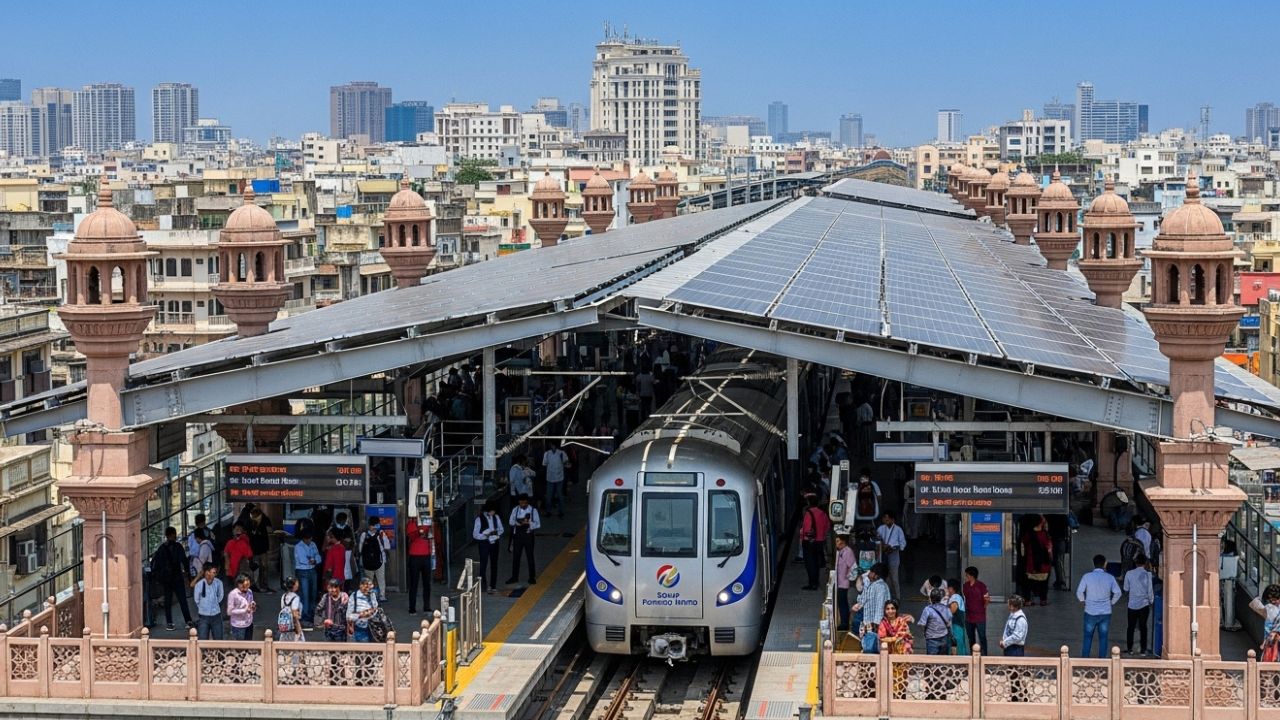
Solar panels installed on metro rooftops and depots utilize large, unused spaces efficiently. Delhi Metro alone has rooftop installations covering 93 stations, meeting nearly one-third of its daylight power demand.
2. Grid-Connected Captive Plants
To stabilize power supply, metros like DMRC are setting up grid-connected captive solar plants equipped with battery storage systems (BESS). These plants ensure steady energy even during cloudy conditions or grid failures.
3. Vertical and Viaduct-Based Solar Models
Innovative solar technology, like the vertical bi-facial panels used at Okhla Vihar station, capture sunlight from both sides — maximizing generation without occupying additional land. Elevated viaducts and station canopies also serve as viable surfaces for panel installation.
4. Smart Energy Management Systems
IoT-driven energy systems monitor real-time solar output, optimize energy use in trains and stations, and integrate with smart grids for load balancing.
Environmental and Economic Impact
1. Carbon Emission Reductions
Delhi Metro’s renewable energy efforts prevent roughly 66,000 tons of CO₂ emissions annually, equivalent to planting 1.1 million trees every year. Kochi Metro’s goal of full solar transition could cut Kerala’s urban transport emissions by 30–35%.
2. Lower Operational Costs
Solar power significantly reduces electricity costs in the long run. DMRC’s power purchase from Rewa Solar has led to annual savings of Rs. 60 crores, enabling reinvestment in expansion and modernization.
3. Energy Independence
By using local solar generation, metros decrease reliance on conventional grid supply. This ensures greater resilience and stability, especially in regions with fluctuating demand.
Technological Innovations in Solar Metro Systems
- Bi-Facial Solar Panels: Double-sided cells enhance energy yield by 10–20% compared to traditional panels.
- Battery Storage Integration: Systems like BESS allow smooth energy supply even during non-sunny hours.
- Energy Regeneration: Regenerative braking systems convert train kinetic energy into electricity, which pairs effectively with solar supply.
- Smart Grids: Automated power distribution helps in managing multi-source input, ensuring efficient load sharing between grid and solar energy.
Such cutting-edge technologies are reinforcing India’s position as a leader in green metro innovation.
Supporting Government Initiatives and Policies
Several national policy frameworks have accelerated renewable energy adoption in metro systems:
- National Solar Mission: Offers incentives for rooftop installations and captive solar plants.
- Urban Transport Policy (2025): Mandates new metros to include renewable power integration in feasibility studies.
- Green Metro Certification Program: Encourages metros to achieve “Green Transit” ratings through solar-based design and waste recycling systems.
- FAME-II Scheme: Supports electric feeder vehicles powered by solar-generated electricity around metro corridors.
These coordinated frameworks ensure that the Indian metro ecosystem evolves as a complete renewable energy model for urban mobility.
India’s Vision: Green Metro 2030
India’s Green Metro 2030 Vision aims to make every major metro operationally energy-neutral by combining solar, wind, and regenerative energy systems. This vision aligns with two broader national commitments:
- Achieving 500 GW of non-fossil fuel capacity by 2030.
- Reducing national carbon intensity by 45% under India’s updated NDC (Nationally Determined Contributions).
By adopting solar-first infrastructure, India’s metros contribute directly to its Viksit Bharat 2047 roadmap — enabling advanced, sustainable cities powered by clean mobility.
Real-World Examples of Sustainable Metro Practices
- Nagpur Metro: India’s “Solar Metro” uses rooftop plants to generate 14 MW, covering 65% of power needs while employing bio-diesel backup generators.
- Delhi Metro’s Khyber Pass Depot: Houses both rooftop solar and electric vehicle chargers for feeder e-buses, ensuring end-to-end renewable operations.
- Kochi Water Metro: Combines solar energy with electric propulsion in boats, bringing integrated green connectivity to Kerala’s waterways.
- Jaipur Metro: Incorporates regenerative braking and rooftop solar systems across its Phase 1 corridor.
Each of these projects showcases how Indian metros are embracing solar power not as an add-on but as a core operational pillar.
Challenges to Large-Scale Implementation
Despite the success stories, scaling solar infrastructure for metros has some challenges:
- Space Constraints: Limited rooftop and depot areas restrict large installations.
- Financing Hurdles: High upfront capital costs deter smaller metro systems.
- Energy Storage Costs: Battery storage systems remain expensive though prices are falling.
- Regulatory Alignment: State electricity policies often differ on open-access solar power usage.
Nevertheless, government tender models like Renewable Energy Service Company (RESCO) and Public-Private Partnerships (PPP) are helping metros mitigate these challenges effectively.
Read Also: Solar-Powered EV Highways: India’s Futuristic Road Concept for 2025
Frequently Asked Questions (FAQs)
1. Which Indian metro uses the most solar power today?
The Delhi Metro leads with over 50 MW solar capacity, meeting about one-third of its power needs through renewable sources.
2. Is Kochi Metro really going 100% solar?
Yes. Kochi Metro aims to achieve 100% solar energy reliance by 2030, backed by 140-acre solar projects in Kerala.
3. How does solar energy reduce metro operational costs?
By replacing conventional electricity purchases with solar-generated power, metros like DMRC save approximately Rs. 60 crores annually.
4. What is a vertical solar plant, and why is it important?
Vertical bi-facial solar plants, like the one at Okhla Vihar, capture sunlight from both sides, generating up to 15% more power without extra surface area.
5. What is India’s long-term goal for solar metros?
By 2030, every major Indian metro aims to source at least 60–100% of its energy from renewable, primarily solar, sources.
Conclusion
Solar power is illuminating a new path for India’s metro networks — one that merges modern engineering with environmental responsibility. From Delhi’s rooftop grids to Kochi’s energy-neutral dream, metros across India are becoming symbols of sustainable development.
As more metro systems adopt solar and integrate energy storage, these networks aren’t just reducing carbon emissions — they’re proving that large-scale urban infrastructure can thrive on clean energy. This synergy between renewable energy and urban transit positions India as a global benchmark in sustainable mobility — ensuring that every ride on a metro train moves the nation closer to a greener, brighter future.
Related Posts