
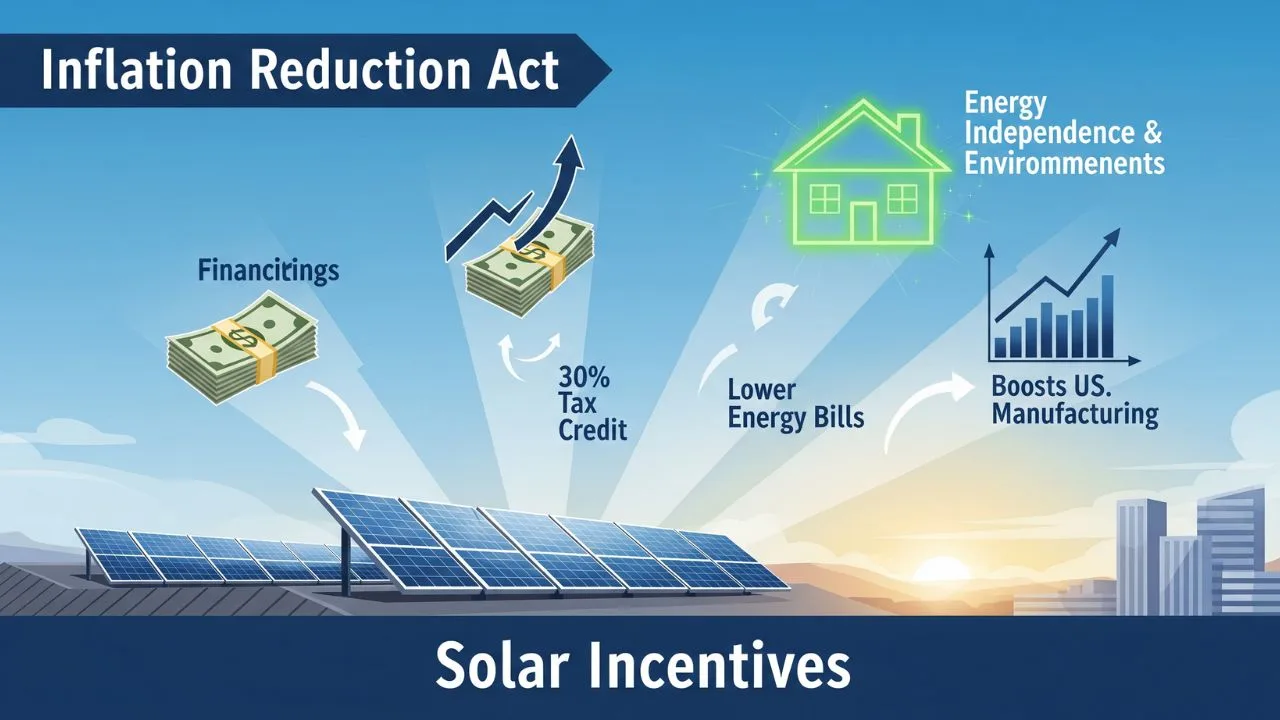
The Inflation Reduction Act is transforming solar adoption for millions of American homeowners, expanding credits, lowering upfront costs, and reshaping clean-energy affordability across the country in 2025.
The following article breaks down the latest updates shaping U.S. solar incentives, explaining how homeowners can maximize federal benefits, avoid common pitfalls, and make informed decisions before installing rooftop solar this year.
A New Era of Solar Savings Under the IRA in 2025
The Inflation Reduction Act (IRA) remains the most influential clean-energy policy in U.S. history, and 2025 marks one of its strongest years for residential solar incentives. Homeowners installing eligible solar systems continue to qualify for the 30% Residential Clean Energy Credit, one of the most generous federal tax benefits available today.
This credit applies to:
- Rooftop solar panel systems
- Solar batteries (standalone or paired with solar)
- Solar water heaters
- Labour, equipment, and installation costs
For many homeowners, this translates to $6,000 to $12,000 in instant tax savings, depending on project size and cost.
In 2025, the IRS has also improved guidance on documentation, making it easier for taxpayers to claim their credit during filing season. For households planning major energy upgrades, this is a critical time to take full advantage of IRA-backed incentives.
Read Also: Global Solar Tax Credits: Country-by-Country Incentive Guide
The 30% Residential Clean Energy Tax Credit: How It Really Works
The headline incentive—the 30% federal solar tax credit—is available through 2032. Homeowners can claim it as long as:
- The solar system is installed in a primary or secondary residence
- The taxpayer owns the system (leases do not qualify)
- The equipment meets energy and safety standards
One major benefit is that the credit is non-refundable but unlimited, meaning:
- If your tax bill is smaller than your credit, the unused amount can roll over for up to 5 years.
- There’s no cap on how much homeowners can claim.
For example:
A $25,000 solar + battery system earns a $7,500 tax credit. If the homeowner only owes $5,000 in federal taxes for 2025, the remaining $2,500 rolls over into 2026.
The IRS also now requires clearer receipts from installers, helping homeowners avoid delays or rejections when filing.
Standalone Battery Storage Now Fully Eligible in 2025
One of the biggest game-changers introduced by the IRA is the ability to claim the 30% credit on standalone residential battery storage systems, even without solar. This is vital as more Americans rely on:
- Backup power during outages
- Time-of-use energy management
- Grid-support programs
For 2025, any battery with capacity ≥ 3 kWh qualifies.
This means homeowners can upgrade or add a battery this year and still receive thousands in tax savings. The combination of solar and batteries remains the optimal setup for maximizing federal incentives and long-term energy independence.
Rebates, Grants & State Incentives Stack With the IRA
Beyond federal credits, homeowners can combine savings from:
- State solar tax credits
- Utility rebates
- Performance-based incentives (like net metering)
- Clean-energy grants
- Income-based energy programs
The IRA was designed to stack with most local incentives, which can reduce total costs by 40–60% in some states like California, New York, Maryland, and Massachusetts.
In 2025, the IRS clarified that rebates directly reducing upfront purchase price may reduce the tax credit amount, while post-installation rebates typically do not—a crucial detail for accurate tax planning.
Why 2025 Is a Strategic Year to Install Solar
Several market and policy factors make 2025 one of the strongest years for homeowners to adopt solar:
1. Equipment prices are stabilizing
After two years of supply-chain volatility, solar panel and battery prices are decreasing, improving return on investment.
2. Net metering changes are accelerating
States like California and Arizona have updated compensation rates for exported solar energy. Installing sooner allows homeowners to lock in better policies before further reductions.
3. IRA credits remain at their peak
The 30% rate stays stable through 2032, but experts predict high demand and manufacturing changes may increase installation costs in later years.
4. Battery adoption is surging
Homeowners are pairing storage with solar to enhance reliability, especially in outage-prone regions.
With these factors aligned, 2025 offers one of the best combinations of affordability, incentive strength, and policy stability for solar investments.
Important Eligibility Requirements Every Homeowner Must Understand
To avoid losing thousands in tax benefits, homeowners should closely follow these eligibility rules:
- System must be new (no used or refurbished components).
- Homeowner must own the system (loans qualify, leases do not).
- Primary or secondary U.S. residence only (no rentals unless the owner lives there part-time).
- Proper documentation must be maintained—invoices, permits, and installer certifications.
- Installation must be completed in 2025 to claim the credit during the 2025 tax filing season.
Improper filing or missing documents can cause delays, audits, or credit disqualification.
Read Also: New York Solar Tax Credits 2025: Expanded NY-Sun Incentives & High-Value Clean Energy Benefits
How to Claim the IRA Solar Tax Credit in 2025
Filing for the credit is straightforward if the system meets eligibility rules. Homeowners must:
- File IRS Form 5695 with their annual federal tax return.
- Provide installation costs, itemized receipts, and battery details if applicable.
- Include carryover amounts from previous tax years, if any.
- Keep detailed records for at least five years, in case of IRS verification.
Tax preparers and accountants can help ensure accuracy, especially for homeowners stacking multiple incentives.
Conclusion: Solar Incentives Will Continue to Shape U.S. Clean Energy Adoption
The IRA is pushing the U.S. toward one of the largest clean-energy expansions in history. With stronger credits, battery eligibility, and simplified filing rules, 2025 is a pivotal year for homeowners to embrace solar technology at the lowest net cost in a decade.
Whether the goal is reducing utility bills, gaining energy independence, or increasing home value, the IRA empowers American households to make sustainable transitions with confidence and financial advantage.
Related Posts


6 thoughts on “The Inflation Reduction Act (IRA) Solar Incentives: What Homeowners Must Know in 2025”