

photovoltaic plant in Cartagena: In a bold move accelerating Spain’s clean-energy transition, a new 4.4 MW solar plant in Cartagena promises to power 540 electric vehicle charging points across four major regions, marking a defining moment for sustainable mobility.
The project, led by renewable energy operator Eranovum, represents a significant milestone for Spain’s solar-powered EV infrastructure, combining large-scale photovoltaic energy generation with fast-growing electric mobility needs.
A New Solar Benchmark in Murcia
Eranovum is advancing construction on La Guía, a state-of-the-art 4.40 MW photovoltaic plant located in Cartagena (Murcia). This innovative energy facility is designed exclusively to generate clean electricity for EV charging infrastructure, making it the company’s first plant dedicated fully to electric mobility.
Spread across 5 hectares, the installation comprises 6,244 high-efficiency solar panels, each with a capacity of 710 Wp, supplied by Chinese manufacturer Tongwei. These modules—model 710W-TWMHF-132 cell—are mounted on fixed 2V bipost 20º structures, grouped into 232 tables for optimal performance and stability across the terrain.
To convert the solar energy into usable power, the plant incorporates 14 cutting-edge Sungrow SG350HX inverters, each rated at 352 kVA, ensuring the system can deliver consistent, high-quality energy to the EV network it is designed to support.
A Solar Facility Built for High Performance
Strong Capacity and Energy Output
Eranovum expects La Guía to generate an impressive 7,800 MWh of renewable electricity annually, an amount specifically calculated to supply its growing network of EV chargers.
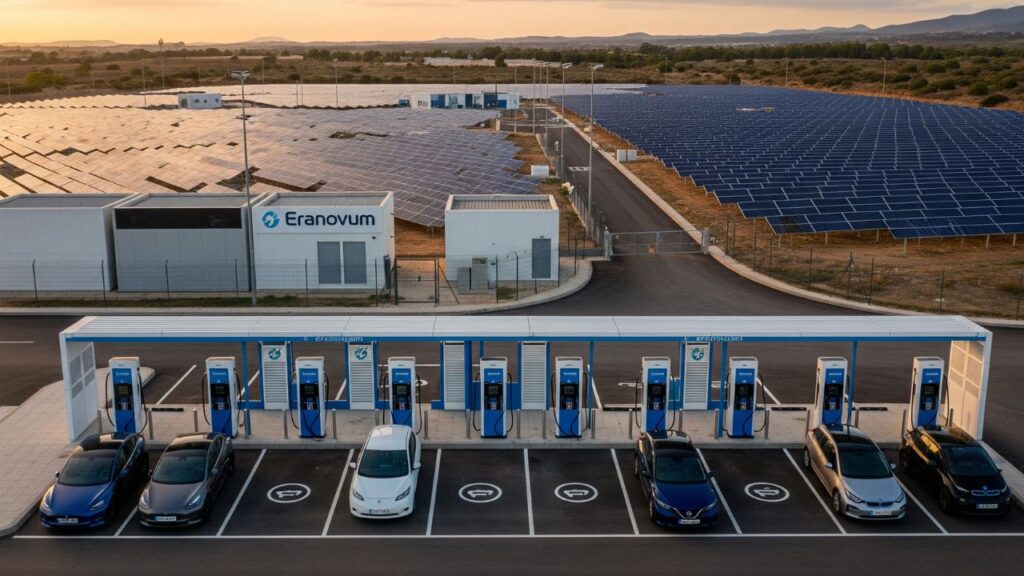
This energy production is equivalent to:
- Powering 540 distributed EV charging points across four regions
- Offsetting thousands of tonnes of CO₂ emissions per year
- Supporting the ongoing electrification of private and commercial transport
The charging points supported by the plant are located across the Valencian Community, Catalonia, Murcia, and Castilla-La Mancha, forming a strategic corridor for clean mobility in eastern and central Spain.
Read Also: Tailem Bend 3 Battery Project: Vena Energy Launches Major 408 MWh Storage Upgrade in South Australia
Designed for Scalability and Future Needs
One of the most forward-thinking aspects of the La Guía project is its built-in capability for future battery energy storage. While not yet installed, the infrastructure allows seamless integration of large-scale storage systems, ensuring:
- Enhanced grid stability
- Improved energy dispatch during peak charging hours
- Greater efficiency in renewable energy utilization
This foresight positions the project as a long-term, resilient solution for Spain’s evolving transportation and energy landscape.
Eranovum’s First Dedicated EV Solar Plant
A Milestone for Clean Mobility
Although Eranovum already operates renewable assets and EV charging infrastructure independently, La Guía marks the company’s first hybrid model facility dedicated entirely to producing solar energy for its own charging network.
This hybrid concept—direct integration of solar generation with mobility infrastructure—is increasingly viewed as a model for sustainable transport systems across Europe.
Replicable Model for Future Expansion
Eranovum has stated that La Guía is only the beginning. The company intends to replicate this model in future solar-EV hybrid facilities, leveraging the success and learnings from this pilot installation.
According to their timeline, the next plant of similar characteristics could begin construction in the first half of 2026, marking the start of a broader rollout.
This approach positions Eranovum as a pioneering player in the convergence of two rapidly growing industries:
- Renewable energy production
- Electric vehicle charging infrastructure
How This Project Strengthens Spain’s Renewable Mobility Vision
Accelerating the EV Transition
Spain has been pushing forward with aggressive targets for EV adoption, yet charging accessibility and clean electricity supply remain core challenges. By coupling solar energy with charging infrastructure, projects like La Guía offer multiple benefits:
- 100% renewable-powered EV charging, reducing reliance on fossil-fuel energy
- Increased public confidence in the availability of green charging options
- Energy supply independence, especially during peak hours
This helps ensure that the rapid increase in EVs aligns with Spain’s decarbonization commitments.
Supporting Regional Development
The 540 charging points supplied by La Guía are not clustered in a single region but strategically spread across:
- Valencian Community
- Catalonia
- Murcia
- Castilla-La Mancha
This wide deployment:
- Enhances regional connectivity
- Enables long-distance EV travel
- Supports tourism and commercial transport routes
- Reduces pressure on Spain’s existing electrical grid
Enhancing Grid Stability and Resilience
With its future-ready battery storage capability, La Guía could eventually contribute to:
- Peak shaving
- Grid reinforcement
- Energy arbitrage during demand fluctuations
As EV usage rises, so too will the need for intelligent, resilient energy systems. La Guía positions itself as a valuable component of that future.
Technological Innovation at the Core
High-Efficiency Panels from Tongwei
The 710W Tongwei modules installed at La Guía represent some of the highest-capacity solar panels currently on the market. Their design prioritizes:
- High efficiency under varying weather conditions
- Lower degradation rates
- Strong temperature performance
These factors help ensure consistent output across the lifespan of the plant.
Sungrow Inverters Enhance System Reliability
The inclusion of 14 Sungrow SG350HX inverters boosts the system’s performance with advanced features such as:
- High conversion efficiency
- Robust safety systems
- Strong grid compatibility
- Remote monitoring and operational diagnostics
Together, these technologies allow Eranovum to maintain operational excellence and maximize plant uptime.
A Strategic Step Toward Energy Independence
Contribution to National Renewable Energy Goals
Spain aims to achieve a fully decarbonized energy system by 2050, with interim milestones driving more than half of its electricity generation to come from renewable sources by 2030.
Projects like La Guía directly support these targets by:
- Increasing solar energy penetration
- Reducing reliance on imported fuels
- Electrifying transportation with zero-carbon power
Strengthening the EV Charging Ecosystem
By powering 540 charging stations, the plant:
- Helps alleviate growing demand on the national grid
- Ensures the supply of clean, predictable, and affordable energy
- Reduces the environmental impact of EV charging
This integrated approach sets a new standard for future EV infrastructure planning.
Long-Term Vision and Sustainability
Replicable, Scalable, and Impact-Driven
Eranovum’s hybrid model represents a scalable blueprint that can be applied not only across Spain but across Europe. As demand for both renewable energy and EV charging grows, hybrid solar-charging facilities may become essential components of national mobility systems.
Environmental Benefits
The La Guía plant’s annual output of 7,800 MWh could help avoid:
- Significant CO₂ emissions
- Fossil-fuel dependency in the mobility sector
- Congestion on conventional electrical grids
By injecting clean energy directly into the EV network, it ensures that electric mobility remains truly sustainable—not merely electric.
Looking Ahead: Construction and Deployment Timeline
Eranovum confirmed that:
- The La Guía plant is currently under construction
- Full operational capability will support the company’s existing EV charging network
- Plans to replicate the model are already under evaluation
- The next plant could begin construction in early 2026
This signals a structured, long-term commitment to expanding renewable mobility solutions.
As EV adoption accelerates and renewable energy becomes more mainstream, hybrid systems like La Guía could become the backbone of Spain’s clean transportation movement.
Related Posts

5 thoughts on “4.4 MW photovoltaic plant in Cartagena to Power 540 EV Charging Points | Eranovum Launches First Mobility-Focused PV Facility”