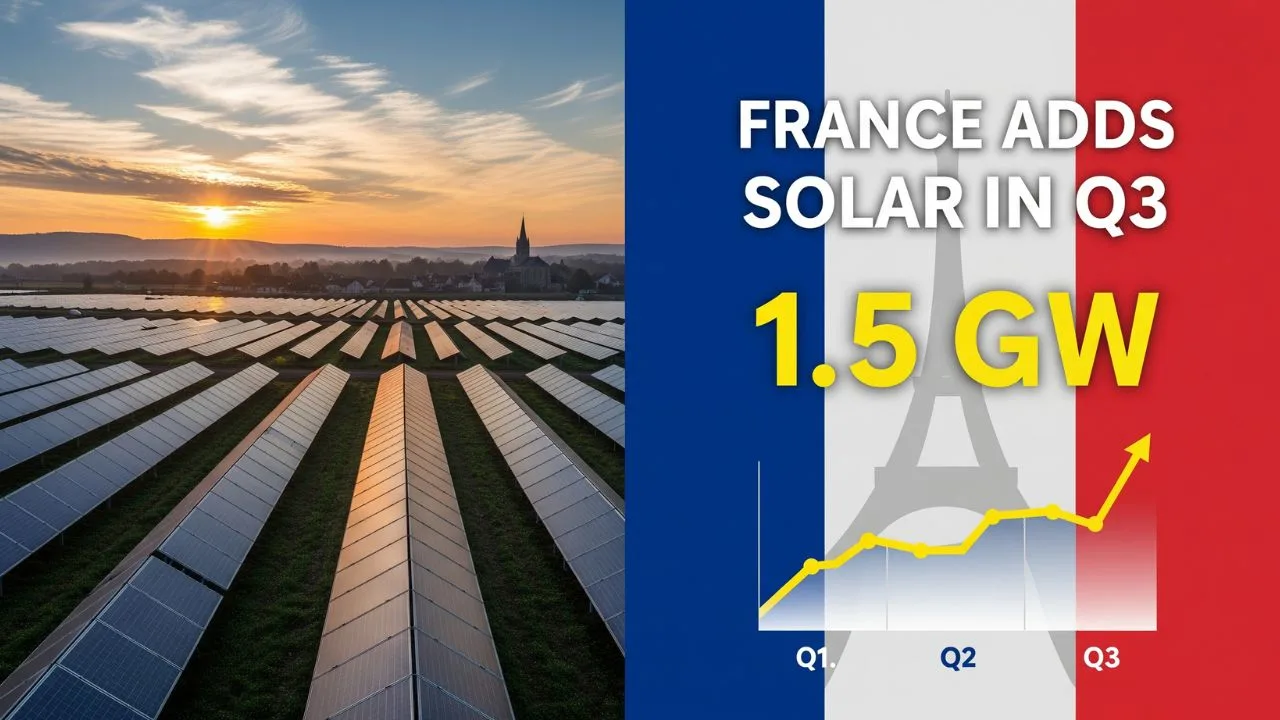
France Adds 1.5 GW Solar in Q3: France’s clean-energy transition is accelerating at a pace the country has rarely witnessed. New data from the Ministry of Ecological Transition reveals that France added an impressive 1.5 GW of new solar PV capacity in the third quarter alone, pushing its nationwide solar footprint to 29.7 GW by the end of September.
For a nation aiming to reshape its energy landscape and reduce fossil-fuel reliance, the latest numbers signal a turning point—one driven by strong regional participation, expanding project pipelines, and a cultural shift toward self-consumption.
A Record-Breaking Nine Months for French Solar
The first nine months of the year have been nothing short of remarkable.
From January to September, France connected 4,445 MW of new solar installations to its grid. To put the progress in perspective:

- 2025 (Jan–Sep): 4,445 MW
- 2024 (Jan–Sep): 3,735 MW
- 2023 (Jan–Sep): 2,408 MW
This represents a nearly 20% jump over the previous year and an 84% surge compared to 2023.
The solar momentum is clearly building year after year as government incentives, simplified permitting pathways, and regional commitments fuel new projects of all scales.
Read Also: South Korea Solar Inverter Industry Raises Cybersecurity Alarms
Third Quarter Performance: Another Strong Leap Forward
In Q3 alone, France added 1,533 MW of solar capacity.
This figure surpasses the 1,463 MW added during Q3 2024, reflecting consistent quarterly growth.
The Q3 spike is significant because summer months often provide the most ideal conditions for installation and grid integration. Many large-scale projects, especially those in industrial zones and agricultural fields, tend to complete their commissioning during this period.
France Approaches the 30 GW Milestone
With 29.7 GW of total installed capacity as of September, France is now on the verge of crossing a symbolic threshold: 30 gigawatts of nationwide solar energy capacity.
This milestone puts the country among the European leaders for PV adoption, trailing behind Germany and Spain but closing the gap steadily.
The growth is also crucial for meeting the EU’s overarching renewable energy targets for 2030, which require accelerated solar deployment year after year.
Large Projects Deliver Big Capacity, Small Projects Dominate in Numbers
One of the most interesting trends in France’s solar expansion is the sharp contrast between the size of installations and their overall impact on capacity.
Large-Scale Installations:
- Systems above 500 kW accounted for nearly one-third of the total added capacity.
- However, these represent only 0.2% of new grid connections.
This means a tiny fraction of projects—mainly solar farms, industrial rooftops, and utility-scale arrays—are delivering a massive chunk of the nation’s solar growth.
Small Self-Generation Systems:
- Installations below 9 kW made up 86% of all new solar units installed.
- Yet, they contributed only 13% of new capacity.
These small systems are typically rooftop arrays installed by households, small businesses, and farm owners. While individually modest, they reflect a growing grassroots movement of citizens participating in France’s renewable energy transition.
Regional Powerhouses Leading the Solar Charge
Three regions continue to dominate France’s solar expansion, together delivering 46% of newly connected capacity:
1. Nouvelle-Aquitaine
Known for its vast landscapes and favorable sunlight conditions, this region has become a hub for both agricultural PV installations and large solar farms.
2. Occitanie
A long-time renewable energy champion, Occitanie has supported solar integration through regional policy frameworks and innovation programs focused on sustainability.
3. Auvergne-Rhône-Alpes
With growing industrial installations and community solar initiatives, this region plays a critical role in accelerating nationwide capacity.
These regions collectively also hold 51% of France’s total installed PV capacity, reinforcing their position as the backbone of the nation’s solar revolution.
Solar Pipeline Sees a Major Lift — Now at 36.9 GW
France’s future solar landscape looks even brighter. The national solar pipeline—projects in various stages of development—has grown 15% since Q4 2024, reaching:
- 36.9 GW of total pipeline projects
- 8.4 GW with signed grid connection agreements
This surge signals strong investor confidence and a robust licensing environment, especially as France pushes to streamline renewable project approvals under national climate strategies.
A well-filled pipeline also ensures France will continue adding significant capacity in the coming years, even if installation timelines experience temporary slowdowns.
Self-Consumption Hits New Highs in Q3 2025
Self-consumption, a growing trend in Europe, is gaining strong popularity in France. More households and businesses are choosing to generate and consume their own solar energy, reducing grid dependence and cutting electricity costs.
Key Self-Consumption Highlights (Q3 2025):
- 1,173 GWh of self-consumed solar electricity
→ 10% of all PV electricity produced this quarter - 255 GWh came from fully self-consumed systems
→ 22% of all self-consumed energy - Systems dedicated to full self-consumption represent:
→ 13% of metropolitan France’s self-consumption capacity
→ 8% of total installed solar capacity
The rise in self-consumption aligns with the national goal of empowering consumers while easing pressure on the grid during peak hours.
What’s Driving France’s Solar Surge?
1. Strong Government Policies
France’s long-term energy strategy prioritizes renewables, with subsidies, feed-in tariffs, tax incentives, and simplified administrative procedures playing key roles.
2. Rising Energy Prices
Higher electricity costs, especially after global energy market fluctuations, are pushing both households and industries toward solar adoption.
3. Corporate Sustainability Goals
French companies are increasingly committing to zero-carbon strategies, leading to large-scale rooftop installations and solar investments.
4. Technological Advancements
More efficient panels, improved storage technology, and the rise of agrivoltaics are expanding the possibilities for solar deployment.
5. Support for Community and Local Energy Projects
France has encouraged local communities and cooperatives to develop their own PV projects, democratizing access to clean energy.
Read Also: Solar Panel Recycling Tax Benefits: New Federal Incentives
What This Means for France’s Energy Future
With nearly 30 GW already installed and a massive pipeline in progress, France is positioning itself as a key European player in solar innovation.
The current trajectory suggests the country will:
- Continue breaking annual solar installation records
- Expand industrial and agricultural solar projects
- Strengthen grid stability through distributed energy systems
- Scale up hybrid solutions combining solar and storage
The shift toward self-consumption also hints at a decentralized energy future where consumers play an active role in the grid.
France’s Solar Growth in 2025: A Turning Point
Q3 2025 may well be remembered as a pivotal period for France’s renewable energy movement.
The combination of:
- Record installations,
- Fast-growing pipelines,
- Regional leadership, and
- Rising self-consumption
illustrates a country deeply committed to reshaping its energy foundation.
As France prepares to cross the 30 GW threshold, one thing is clear:
The nation’s solar transformation is not slowing down—it’s accelerating.
Related Posts
2 thoughts on “France Adds 1.5 GW Solar in Q3, Nears 30 GW Total PV Capacity in 2025”