Switching to solar energy is one of the smartest financial and environmental decisions a homeowner can make. However, the biggest hurdle for many is the upfront cost. The average cost of a residential solar system in the U.S. ranges between $15,000 and $30,000, depending on size, location, and equipment.
The good news is that residential solar has become more accessible than ever thanks to a wide range of financing options. This guide provides a comprehensive, data-driven overview of loans, leases, and Power Purchase Agreements (PPAs), helping you choose the best path to energy savings and independence.
Why Solar Financing Matters More Than Ever
Solar financing is the key that unlocks the benefits of clean energy for most homeowners. It transforms a significant capital expense into a manageable monthly cost, often lower than your current electricity bill.
Here is why financing is critical in 2026:
- Accessibility: It allows homeowners to install solar with little to no money down.
- Immediate Savings: You can start saving on your electricity bill from day one.
- Protection from Rate Hikes: Solar locks in a large portion of your energy costs, shielding you from rising utility rates (which have increased by an average of 4-5% annually in many states).
- Strategic Investment: With the 30% federal Investment Tax Credit (ITC), solar is not just an expense but a high-return investment.
The 2026 Solar Financing Landscape: A Quick Overview
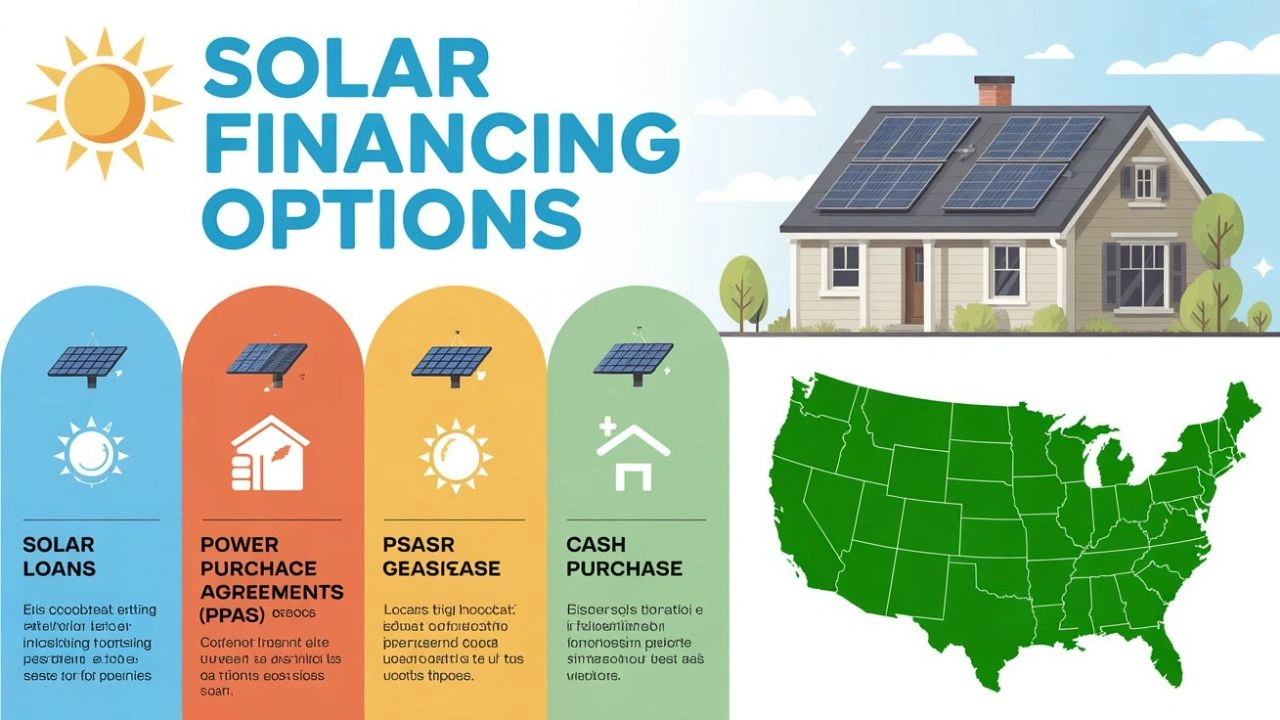
There are four primary ways to finance a solar system, each with distinct advantages and trade-offs:
| Feature | Cash Purchase | Solar Loan | Solar Lease | Power Purchase Agreement (PPA) |
|---|---|---|---|---|
| Ownership | Yes | Yes | No | No |
| Upfront Cost | High (Full system cost) | Low to None | None | None |
| Monthly Payment | None | Fixed loan payment | Fixed lease payment | Variable (per kWh rate) |
| Tax Benefits (ITC) | Yes | Yes | No (Goes to owner) | No (Goes to owner) |
| Long-Term Savings | Highest | High | Moderate | Moderate |
| Maintenance | Homeowner’s Responsibility | Homeowner’s Responsibility | Included | Included |
| Best For | Homeowners with savings, seeking max ROI. | Homeowners who want ownership and tax benefits without large upfront cost. | Homeowners wanting hassle-free solar with no ownership responsibilities. | Homeowners wanting immediate savings without the commitment of a loan. |
Option 1: Cash Purchase – Maximum Long-Term Savings
Paying for solar upfront in cash is the simplest and most profitable option. It provides the highest return on investment (ROI) and the fastest payback.
- Key Benefits: Immediate ownership, full eligibility for the 30% ITC, no interest or monthly payments, and maximum lifetime savings.
- Drawbacks: Requires significant upfront capital.
- Payback Period: Typically 4 to 6 years. After that, your electricity is essentially free for the remaining 20-25 years of the system’s life.
Expert Insight: The average cash purchase yields a 20-30% internal rate of return (IRR), making it one of the best low-risk investments available to a homeowner.
Read Also:Solar Panel Installation Cost USA 2026
Option 2: Solar Loans – Affordable Ownership
Solar loans are the most popular financing method, allowing you to own the system and benefit from the tax credit while spreading the cost over time.
Types of Solar Loans:
- Secured Loans (Home Equity): Use your home as collateral, offering the lowest interest rates (often 5-8% in 2026).
- Unsecured Loans: No collateral required, but rates are typically higher (7-12%).
- Solar-Specific Loans: Offered by specialized lenders like Mosaic or SunPower, designed specifically for solar with flexible terms (5-25 years).
How a Solar Loan Works:
- You borrow the system’s cost, minus any down payment.
- You repay the loan with a fixed monthly payment.
- You claim the 30% ITC on your taxes. You can choose to pay this credit toward the principal (reducing your loan) or keep it.
- Average 2026 Rates: Expect rates between 5% and 10% APR, depending on credit score and loan type. A good credit score (700+) unlocks the best rates.
The Financial Picture
Example Scenario: A $20,000 system with a 30% ITC.
- Total Cost: $20,000
- Tax Credit: $6,000
- Net Cost: $14,000
If financed with a 10-year loan at 6% APR:
- Monthly Payment: ~$155
- Monthly Electricity Savings: ~$150-$200
- Result: Your monthly payment is offset by your savings, meaning you are cash-flow positive from day one.
Option 3: Solar Lease – Hassle-Free, No Ownership
A solar lease allows you to use the solar system without owning it. You pay a fixed monthly fee to the solar company, which owns and maintains the system.
- Key Benefits: Zero upfront cost, predictable monthly payment, and all maintenance and repairs are handled by the provider.
- Drawbacks: You don’t own the system, you are not eligible for the ITC, and long-term savings are lower than purchasing. Lease payments often have a 2.9% annual escalation clause, meaning your payment increases over time.
Pro Tip: A lease can be a good option if you have no tax liability to use the ITC and prefer a hands-off approach. However, it is generally the least financially rewarding option over the system’s lifespan.
Option 4: Power Purchase Agreement (PPA) – Pay Per kWh
A PPA is similar to a lease, but instead of a fixed monthly payment, you pay for the electricity the system produces at a predetermined rate (usually lower than the utility rate).
- Key Benefits: Zero upfront cost, immediate savings based on your usage, and performance risk is carried by the solar provider.
- Drawbacks: No ownership, no tax benefits, variable payments based on production, and long-term contracts (20-25 years) that can complicate home sales.
Expert Insight: The key difference is payment structure. A lease is a fixed asset payment; a PPA is a variable payment based on energy output.
Federal and State Incentives: Reducing Your Cost
Financing becomes significantly more attractive when combined with government incentives.
Federal Investment Tax Credit (ITC)
- What It Is: A 30% tax credit on the total system cost for systems placed in service through 2032.
- Crucial Detail: This is a credit, not a deduction. It reduces your tax liability dollar-for-dollar. You must have sufficient tax liability to claim it. This credit is only available to those who own the system (cash or loan).
- Impact: On a $25,000 system, the ITC saves you $7,500.
State and Local Incentives
Beyond the ITC, many states offer additional benefits:
- Net Metering: Allows you to sell excess solar electricity back to the grid at retail or near-retail rates, significantly increasing your savings.
- Tax Exemptions: Some states offer property tax or sales tax exemptions for solar installations.
- State Tax Credits: Some states offer their own tax credits.
- Solar Renewable Energy Credits (SRECs): In some states, you can earn and sell SRECs for additional income.
Read Also:No Gas, No Electricity: The Solar Stove Changing Home Cooking
Navigating the Solar Loan Process
- Check Your Credit Score: A higher score (700+) gets you the best rates.
- Compare Lenders: Get quotes from multiple lenders, not just the installer’s preferred partner.
- Understand Dealer Fees: Some loans with “low interest rates” have high upfront dealer fees (5-10%). Compare the APR (Annual Percentage Rate), which includes these fees.
- Use the ITC Wisely: You can use your $6,000 tax credit to make a lump-sum payment on the principal of your loan, reducing your balance and future monthly payments.
Choosing the Right Option: A Decision Matrix
| Your Priority | Recommended Option |
|---|---|
| Maximum lifetime savings and fastest payback | Cash Purchase |
| Balance of ownership, savings, and low upfront cost | Solar Loan |
| Zero upfront cost, fixed payment, and no maintenance | Solar Lease |
| Zero upfront cost and pay based on energy used | PPA |
| You have no federal tax liability | Lease or PPA (since you can’t use the ITC) |
The Bottom Line
Residential solar financing has made clean energy accessible to millions. By understanding the nuances of loans, leases, and PPAs, you can choose the path that best aligns with your financial goals and energy needs.
With the 30% ITC, net metering, and falling equipment costs, the economics of solar are compelling. The key is to get multiple quotes, understand the financing terms, and calculate your total cost and savings over the 25-year life of the system. A properly financed solar system is a powerful investment that pays dividends for decades.
Author: Solar Facts India Team
This analysis is based on current market data, federal policies, and industry best practices as of August 2026. It is for informational purposes only and does not constitute professional financial, legal, or investment advice. Please consult qualified advisors for your specific situation. For our full disclaimer and contact information, please visit our About and Disclaimer pages.
Related Posts


3 thoughts on “Residential Solar Financing Options USA 2026: A Complete Guide to Loans, Leases, and PPAs”