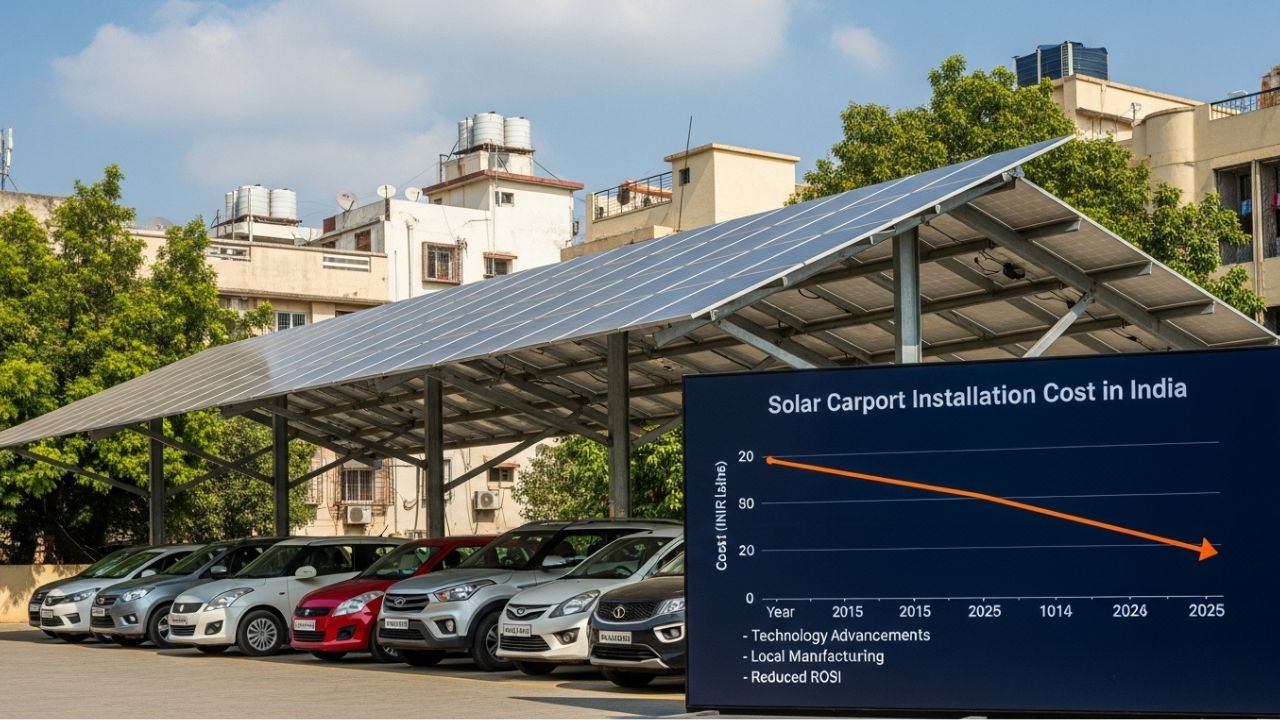
solar carport installation cost India: The rise of electric vehicles (EVs) in India has created an urgent need for efficient and sustainable charging solutions. As businesses, ride-hailing services, logistics companies, and corporate fleets adopt EVs, they face the challenge of charging infrastructure that is cost-effective, reliable, and scalable. One innovative solution is the solar carport—a parking structure equipped with solar panels that generates electricity directly on-site.
Solar carports are more than just renewable energy solutions; they offer dual benefits: shaded parking and on-site solar power for EV charging, reducing dependency on the grid. For fleet operators, this model is particularly trans-formative because energy costs and downtime directly affect profitability.
This article delves deep into solar carport installation costs in India, their ROI, benefits, technological considerations, and best practices. We’ll also explore examples, FAQs, and actionable insights for fleet managers considering solar-powered parking structures.
What is a Solar Carport?
A solar carport is a parking facility where the roof is equipped with photovoltaic (PV) panels. These structures typically include:
- Solar Panels: Generate DC electricity from sunlight.
- Solar Inverters: Convert DC to AC electricity for charging EVs or feeding into the grid.
- Mounting Structures: Durable frameworks supporting the panels over parking spaces.
- Optional Battery Storage: Enables charging at night or during peak demand.
- EV Chargers: Integrated charging points for fleet or public vehicles.
Solar carports can be single-level or multi-level, depending on available land, parking density, and energy needs. For corporate fleets, single-level carports with high-efficiency panels often suffice, while larger fleet operators may consider tiered or multi-story structures.
Read Also: Commercial Rooftop Solar System Payback in India 2025: A Complete Guide for Businesses
Why Solar Carports Are a Game-Changer for Fleet Charging
1. Cost Reduction
Fleet operators spend substantial amounts on electricity for EV charging. Solar carports reduce reliance on the grid, providing self-generated electricity at lower cost per kWh. Over time, these savings significantly impact operating budgets.
2. Scalable Infrastructure
Solar carports can be built incrementally. For example, a logistics company can start with 50 EV parking slots and expand as fleet size grows.
3. Dual-Purpose Investment
Unlike traditional solar rooftops, carports offer shaded parking—protecting vehicles from heat, rain, and UV damage—while simultaneously producing energy.
4. Grid Independence
For commercial fleets in regions with unstable electricity supply, solar carports ensure uninterrupted charging, particularly when paired with battery storage.
5. Sustainability and Compliance
With ESG (Environmental, Social, and Governance) norms gaining importance, solar carports demonstrate corporate commitment to carbon neutrality and green operations.
Components of a Solar Carport and Their Cost Drivers
The total installation cost of a solar carport depends on several factors:
1. Solar Panels
- High-efficiency monocrystalline panels are preferred for limited roof space.
- Cost ranges: ₹25–35 per watt installed for commercial-grade modules.
- For a 100 kW system, panel costs can range ₹25–35 lakh.
2. Inverters
- Convert DC electricity from solar panels to AC for fleet chargers.
- String inverters or central inverters can be used.
- Typical cost: ₹5–8 lakh per 100 kW installed.
3. Mounting Structures
- Custom-designed carport frames are essential to withstand wind, rain, and vibration.
- Materials: galvanised steel or aluminum.
- Cost: ₹10–15 lakh for 100 kW, depending on height and size.
4. EV Charging Infrastructure
- AC or DC fast chargers integrated into the solar system.
- Cost per fast charger: ₹1–2 lakh for AC, ₹5–10 lakh for DC fast chargers.
- Fleet charging infrastructure depends on fleet size and simultaneous charging requirements.
5. Optional Battery Storage
- Lithium-ion or advanced lead-acid batteries allow off-peak or night-time charging.
- Adds ₹8–12 lakh per 100 kWh capacity but increases ROI for 24-hour charging operations.
6. Civil Works and Electrical Integration
- Includes trenching, cabling, and safety installations.
- Typically adds 10–15% of project cost.
Solar Carport Installation Cost in India: Typical Estimates
For a mid-sized commercial fleet, consider a 100 kW solar carport with 50 EV parking bays. Here’s a rough breakdown:
| Component | Cost (₹) |
| Solar Panels (100 kW) | 30,00,000 |
| Inverters | 6,00,000 |
| Mounting Structures | 12,00,000 |
| EV Charging Points (10 chargers) | 15,00,000 |
| Electrical & Civil Works | 5,00,000 |
| Optional Battery Storage | 10,00,000 |
| Total Installed Cost | 78,00,000 |
Note: Prices vary by manufacturer, location, and EPC contractor.
For larger fleets (500 kW systems), economies of scale can reduce the per-kW cost to ₹35–38k per kW.
Estimating ROI for Solar Carports
To calculate ROI, we consider:
- Annual energy generation
- Electricity cost savings
- Maintenance cost
- Subsidies and incentives
Step 1: Annual Energy Generation
Assuming Tiruppur or Pune-like solar insolation: 4.5–5.5 kWh/m²/day, a 100 kW system generates ~1,80,000–2,00,000 kWh/year.
Electricity Cost Savings
- Grid electricity cost: ₹8–10 per kWh
- Annual savings = 2,00,000 kWh × ₹9 ≈ ₹18 lakh/year
O&M Costs
- Routine cleaning and maintenance: ~1% of CAPEX = ₹78,000/year
Net Savings
- Net annual savings = ₹18 lakh − ₹0.78 lakh ≈ ₹17.22 lakh/year
Simple Payback
- Payback = ₹78,00,000 ÷ ₹17.22 lakh ≈ 4.5 years
After 25 years of panel life, total savings ≈ ₹4.3 crore, delivering an ROI of 450%.
Government Subsidies and Incentives
1. Ministry of New and Renewable Energy (MNRE)
- Offers capital subsidies of 30–40% for commercial solar rooftop projects under certain conditions.
2. State-Level Incentives
- Many states (Tamil Nadu, Maharashtra, Karnataka) provide stamp duty exemptions, net metering, and concessional loans for commercial solar.
3. Accelerated Depreciation
- Businesses can claim up to 40% depreciation in the first year, reducing taxable income and improving financial returns.
Technological Considerations
1. Choosing the Right Inverter
- String inverters are cost-effective but less efficient for high-capacity setups.
- Central inverters handle large arrays efficiently and offer easier monitoring.
2. Battery Integration
- Useful for 24/7 fleet operations.
- Provides peak-shaving, reduces grid dependency, and enables cost arbitrage during peak electricity rates.
3. EV Charger Type
- AC chargers: slower but cheaper
- DC fast chargers: higher cost but essential for quick fleet turnaround
4. System Monitoring
- Smart inverters and cloud-based monitoring platforms enable predictive maintenance and maximise energy generation.
Best Practices for Fleet Operators
- Align Solar Size with Fleet Load
Estimate peak charging requirements to avoid underutilized solar assets. - Leverage Net Metering or Zero Export Policies
Maximize self-consumption to achieve better ROI. - Perform a Detailed Cost-Benefit Analysis
Include panel degradation (~0.5–0.7%/year) and inverter replacement cycles. - Select Reputable EPC Contractors
Choose companies with experience in commercial solar carport installations. - Plan for Future Expansion
Modular design allows incremental capacity addition as fleet size grows.
Case Example: 200 kW Solar Carport for a Logistics Fleet
Scenario:
- Fleet Size: 100 EVs
- System Size: 200 kW
- Panels: 540 monocrystalline modules
- EV Chargers: 20 AC fast chargers
- Installed Cost: ₹1.5 crore
- Annual Energy Generation: 4,00,000 kWh
- Grid Tariff: ₹9/kWh
ROI Calculation:
- Annual Savings = 4,00,000 × ₹9 = ₹36 lakh
- O&M = ₹1.5 lakh
- Net Savings = ₹34.5 lakh
- Payback = ₹1.5 crore ÷ ₹34.5 lakh ≈ 4.3 years
This demonstrates scalability and high ROI for mid-sized commercial fleets.
Read Also: Commercial Rooftop Solar System Payback in India 2025: A Complete Guide for Businesses
Challenges and Mitigation Strategies
| Challenge | Mitigation |
| High upfront cost | Use subsidies, loans, and tax incentives |
| Limited roof space | Consider multi-story carports or ground-mounted canopies |
| Grid instability | Integrate batteries for backup |
| Dust and pollution | Regular panel cleaning |
| EV fleet growth | Modular design for incremental expansion |
Future Outlook
India’s EV market is expected to grow 5–7x by 2030, increasing demand for fleet charging infrastructure. Solar carports offer:
- Cost-effective and green charging
- Reduced grid dependency
- ESG and corporate sustainability benefits
- Scalability for expanding fleets
With falling PV costs, improved inverter efficiency, and battery innovations, solar carports are set to become the standard solution for fleet operators across India.
Frequently Asked Questions (FAQs)
Q1: What is the average cost of a solar carport in India?
A: For a 100 kW commercial setup, costs range from ₹70 lakh to ₹80 lakh, including panels, inverters, mounting, EV chargers, and civil works.
Q2: How long does it take to recover the investment?
A: Typical payback period is 4–5 years, depending on energy consumption, subsidies, and grid tariffs.
Q3: Can solar carports charge EVs at night?
A: Only if battery storage is integrated; otherwise, they rely on daytime solar generation or grid power.
Q4: Are subsidies available for commercial fleets?
A: Yes, MNRE and state-level schemes provide capital subsidies, accelerated depreciation, and other incentives.
Q5: Do solar carports require maintenance?
A: Yes, periodic cleaning, inverter checks, and monitoring are essential to maintain optimal performance.
Conclusion
Solar carports are a revolutionary solution for fleet charging in India. They combine renewable energy generation, vehicle protection, and operational cost savings into a single, scalable infrastructure.
For fleet operators, investing in a solar carport:
- Reduces electricity costs
- Ensures reliable EV charging
- Enhances corporate sustainability
- Offers impressive ROI with 4–5 year payback
As India transitions toward a greener transportation ecosystem, solar carports will play a pivotal role in making EV fleets profitable, sustainable, and future-ready.
Related Posts