Solar EV Charging Station Cost: As India races toward a green mobility future, Andhra Pradesh emerges as a key player in deploying electric vehicle (EV) infrastructure powered significantly by solar energy. The state’s commitment to sustainable energy has catalyzed a growing market for solar-powered EV charging stations, combining environmental benefits with excellent commercial potential. Entrepreneurs, housing societies, fleet operators, and municipalities now have exciting opportunities to invest in renewable-based charging infrastructure that slashes operation costs and contributes to India’s clean energy pledges.
This article provides a thorough and expert overview of the cost structure, business models, government policies, and revenue streams related to establishing and running a solar EV charging station in Andhra Pradesh in 2025. It also highlights unique state-specific incentives, commercial viability examples, and practical advice for aspiring entrepreneurs.
Andhra Pradesh’s EV & Solar Market: A Growing Landscape
EV Adoption Trends in Andhra Pradesh
Following the launch of the Andhra Pradesh Electric Vehicle and Energy Storage Policy (2020) and ongoing incentives, the state has rapidly increased EV registrations:
- Two-wheelers and three-wheelers dominate early adoption, with electric buses and cars growing steadily.
- With public and private fleet expansions in cities like Vijayawada, Visakhapatnam, and Amaravati, demand for reliable, fast, green charging infrastructure is at an all-time high.
- The government targets 30% reduction in conventional fuel use in transport by 2030 via electrification.
Solar Power Penetration
Andhra Pradesh benefits from abundant sunlight, making it ideal for solar integration:
- The state has become one of India’s leading solar producers, with an installed capacity exceeding 5 GW by 2025.
- Rooftop solar adoption in residential and commercial sectors supported by active state nodal agencies like APERC and APCFSS is on an upswing.
- Integration of solar with EV charging aligns well with Andhra Pradesh’s Green Energy Corridor and decentralized energy goals.
Read Also: Smart Homes Meet Solar: Cost and Benefits for Indian Homeowners
Cost Structure for Solar EV Charging Stations in Andhra Pradesh (2025)
Capital Expenditure (CAPEX)
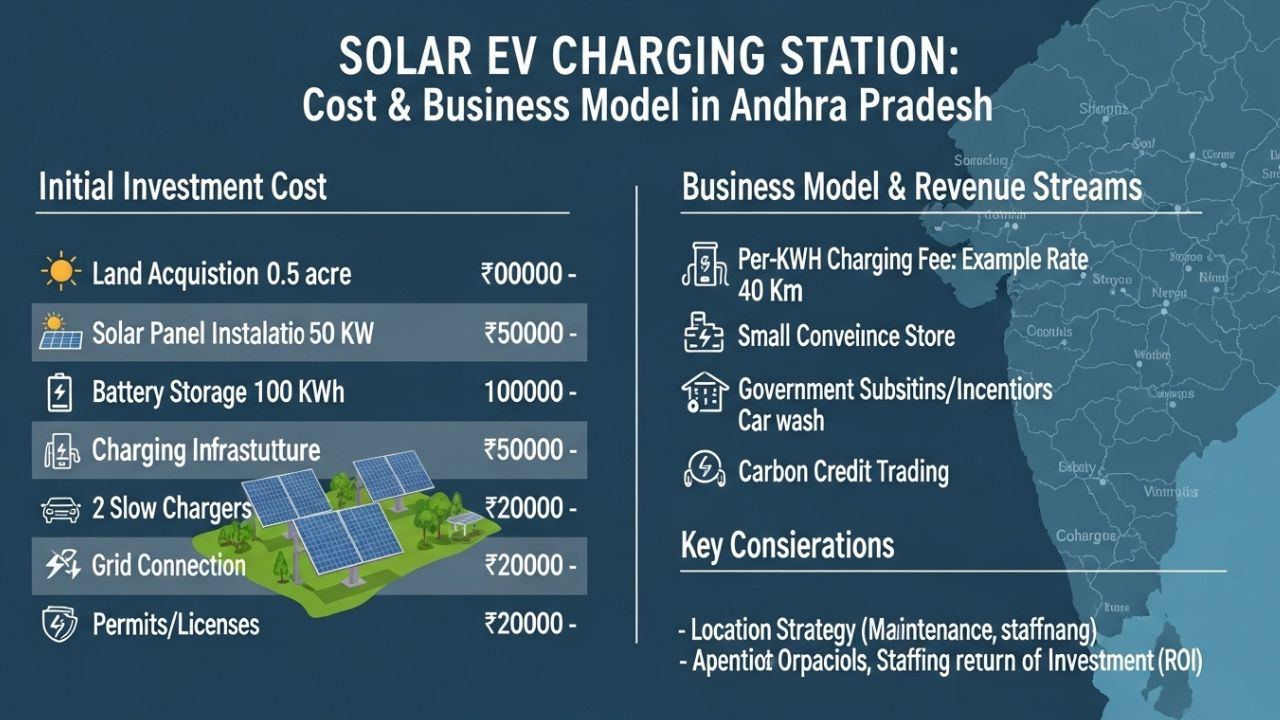
Costs vary widely depending on station size, charger types, and solar plant capacity. Typical ranges (Sep 2025) are:
| Item | Estimated Cost (INR) | Details |
| Level 2 AC Charger (7–22 kW) | ₹1,00,000 – ₹2,00,000 | Public, residential charging |
| DC Fast Charger (30 – 60 kW) | ₹6,00,000 – ₹12,00,000 | Highway or commercial hubs |
| Solar Panels (per kW) | ₹50,000 – ₹65,000 | Price varies by volume and supplier |
| Inverter & Balance of System (BoS) | ₹1,50,000 – ₹3,00,000 | MPPT controllers and grid interface |
| Battery Energy Storage System (Optional) | ₹2,50,000 – ₹8,00,000 | For load smoothing and night backup |
| Civil Works and Land Preparation | ₹2,00,000 – ₹5,00,000 | Fencing, shelters, cabling |
A small public solar EV charging station with:
- 2 DC fast chargers
- 20 kW solar array
- Associated electrical works
may cost around ₹40–60 lakh initially, including land rental, civil works, and equipment.
Operational Expenses (OPEX)
Running costs are vital for profitability:
- Maintenance contracts: ₹1.5–3 lakh/year
- Electricity cost for grid-top-up: ₹1–2 lakh (depending on solar fraction)
- Staffing: ₹1–2 lakh/year
- Security, insurance, software tools: ₹50,000/year
- Land rent/taxes: Variable by location
Business Models for Solar EV Charging in Andhra Pradesh
1. Direct Ownership and Operation
- Best suited for entrepreneurs or companies with capital and operational capabilities.
- Profits come from per-kWh charges, subscription-based plans for fleet operators, and solar energy export.
- Requires upfront capital but offers maximum control and high returns.
2. Franchise/Dealer Model
- Tie-ups with national or statewide EV charging aggregator platforms (e.g., Tata Power’s EZCharge or Ather Grid).
- Lower capital investment; profit-sharing with larger network operators.
- Facilitates faster launch and wider customer reach.
3. Public-Private Partnerships (PPP)
- Collaboration with Andhra Pradesh State Government or urban local bodies.
- Government may provide land or subsidies; private players manage infrastructure.
- Participating in government tenders reduces financial risks.
4. Cooperative or Group Net Metered Stations
- Residential complexes or housing societies establish shared solar EV stations.
- Benefits from Group Net Metering Policies allowing sharing of solar generations and costs.
- Enables cost-efficient installations with government subsidies.
Government Incentives and Subsidies in Andhra Pradesh
Central and State-Level Support
- MNRE Rooftop Solar Subsidy: Up to 40% subsidy for initial 3 kW and 20% for additional capacity, applicable for the solar array portion.
- AP State Renewable Energy Agency (APCFSS): Offers additional top-ups and fast-track clearances for solar installations linked to charging stations.
- PM-eDrive Scheme: Grants funding support for EV chargers, especially fast chargers in public/private sectors.
- Electricity Duty waivers & net metering rebates: Provided by Andhra Pradesh government to encourage green power export from charging stations.
Subsidy amounts significantly reduce net capex, dropping typical solar plant costs by ₹15-20 lakh on a mid-sized station.
Revenue Potential and ROI in Andhra Pradesh
- Average charge price: ₹10–12 per kWh for fast charging.
- Typical station usage: 300–500 charging sessions/month, average 20 kWh per session.
- Monthly Revenue: ₹6–12 lakh for busy commuter hubs.
Example Profitability Calculation
| Parameters | Value |
| Initial Investment | ₹50 lakh (solar + chargers) |
| Monthly Income (Charging) | ₹7.5 lakh |
| Monthly Expenses (OPEX) | ₹3 lakh |
| Monthly Net Profit | ₹4.5 lakh |
| Payback Period | Approx. 12 months |
High-traffic metropolitan and highway sites yield faster paybacks. Lower scale or rural setups require strategic subsidy integration and business diversification.
Practical Considerations for Tamil Nadu Entrepreneurs
- Ensure MNRE approval and empanelled vendor selection for subsidy compliance.
- Location matters: high visibility, good grid connectivity, and proximity to parking or amenities are crucial.
- Incorporate smart digital billing and mobile app integration for seamless user experience.
- Regularly liaise with APERC and TANGEDCO for updated policy changes and tariff structures.
- Build partnerships with EV manufacturers and fleet operators to ensure steady customer flow and subscription revenues.
Future Outlook: Evolving Trends in Andhra Pradesh’s EV Solar Charging
- Expansion of shared solar EV charging stations in housing complexes under Group Net Metering.
- Increasing integration with battery storage solutions to offer 24/7 solar charging reliability.
- Enhanced government grants for solar-powered smart urban corridors within Amaravati and Visakhapatnam Smart City domains.
- Growing opportunities in rural electrification where solar EV stations reduce grid dependency.
- Adoption of digital twinning for managing energy flow and forecasting in smart charging networks.
Read Also: Solar-Powered e-Learning Centres: Lighting Up Education in Rural India
FAQs
1. What is the typical cost of installing a solar EV charging station in Andhra Pradesh?
It ranges from ₹40 lakh for a small 20 kW solar array with 2 fast chargers to over ₹1 crore for a large highway hub.
2. Are government subsidies available?
Yes. MNRE offers subsidies on the solar component; the state typically adds additional incentives and electricity duty waivers.
3. Can I start a solar EV charging business with low capital?
You can use franchise or partnership models to minimize upfront costs while benefiting from established networks.
4. Is battery storage important?
Battery storage boosts station uptime and is recommended in areas with unstable grids, though it raises initial costs.
5. How are charges to EV owners decided?
Stations set per-kWh or per-session tariffs, often regulated by APERC and aligned with commercial electricity tariffs.
Conclusion
Establishing solar-powered EV charging stations in Andhra Pradesh is a promising and sustainable business proposition in 2025. Supported by strong government subsidies, a maturing EV market, and Tamil Nadu’s abundant solar resources, the opportunity provides competitive returns through innovative business models.
With increasing EV penetration and shifts to green energy, solar EV charging hubs will play a pivotal role in accelerating clean mobility. By understanding costs, incentives, and operational strategies detailed herein, entrepreneurs and investors can confidently enter and succeed in this fast-growing sector.
Related Posts