Your afternoon solar panels are creating a bizarre problem that’s reshaping our entire electrical grid. Here’s the surprising truth about what happens when the sun goes down.
If you have rooftop solar panels, you’re part of one of modern energy’s greatest success stories—and one of its most perplexing challenges. There’s a strange phenomenon quietly transforming power grids across sunny states, and it has everything to do with what happens when millions of solar systems simultaneously stop working at sunset.
It’s called the “Duck Curve,” and understanding it might save you money while revealing why the future of clean energy looks different than anyone expected.
What Exactly Is the Duck Curve?
Imagine your city’s power grid as a giant bathtub. For decades, utility companies carefully filled this tub throughout the day, with demand slowly rising in the morning, peaking in the late afternoon when everyone got home, then tapering off at night.
Enter solar panels—millions of tiny faucets pouring free, clean energy into the tub all day long.
Here’s the problem: At noon on a sunny day, those faucets are gushing. The tub fills so quickly that traditional power plants (the main faucet) must throttle way back. But around 5 PM, people arrive home, turn on appliances, and—crucially—the sun sets. Those millions of solar faucets turn off almost simultaneously.
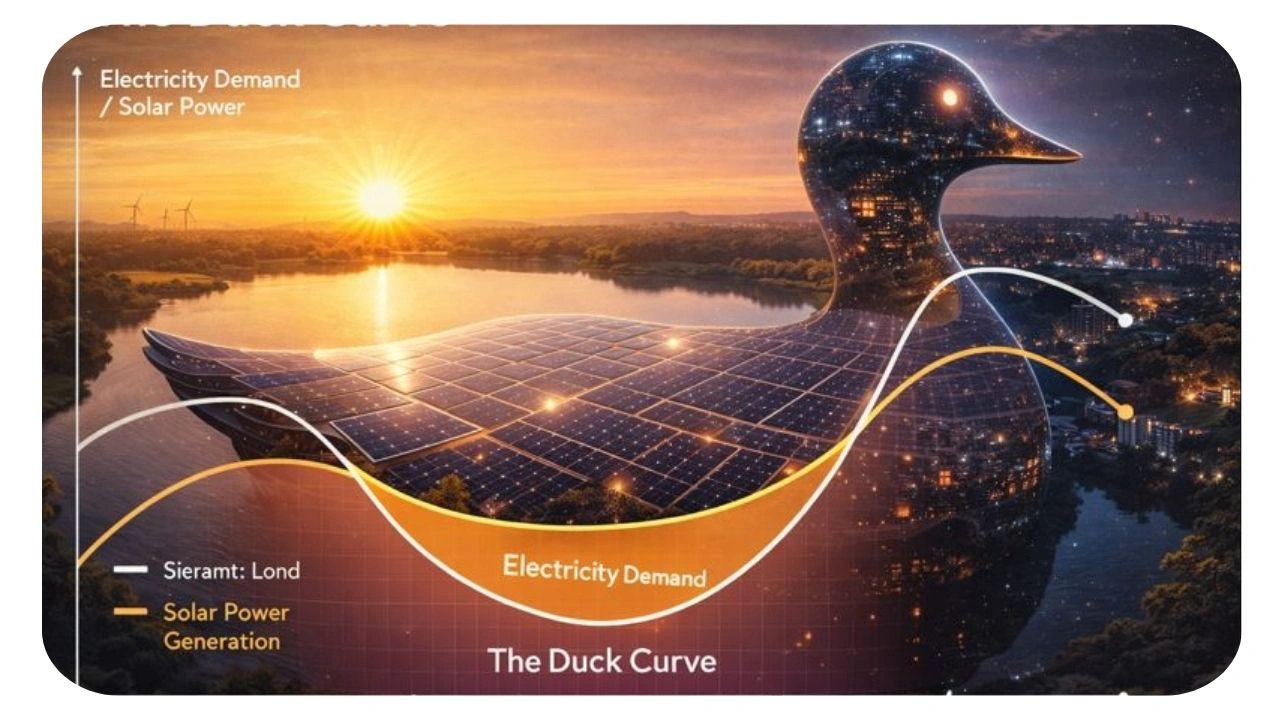
The result? Grid operators must scramble to ramp traditional power plants from low to extremely high output in just a few hours. When charted, this creates a shape that, with some imagination, looks like a duck:
- The belly: The deep midday dip in net demand (thanks to solar)
- The neck: The rapid ramp-up as solar fades and evening demand hits
- The head: The evening peak demand
Each year, as more solar comes online, the duck’s belly gets deeper and its neck steeper—creating what grid operators call “the world’s most dangerous chart.”
Visual: How the duck curve forms throughout a typical sunny day
Why This “Good Problem” Actually Matters
You might be thinking: “Too much solar? That sounds like a great problem to have!” And in many ways, it is—it represents incredible progress. But this success creates real challenges:
- The Evening Scramble: Traditional power plants (especially natural gas “peaker plants”) aren’t designed to ramp up this quickly. It’s stressful for equipment and expensive to operate this way.
- The Solar Squander: During those super-sunny midday hours, some grids are producing so much solar electricity that they actually have to pay neighboring states to take it or, in extreme cases, curtail (turn off) solar production. Yes—sometimes there’s literally too much of a good thing.
- The New Economics: This reshapes the financial model of solar. When everyone produces power at noon, noon power becomes less valuable. When everyone needs power at 7 PM, 7 PM power becomes premium.
Read Also: PM Surya Ghar Muft Bijli Yojana: How Rooftop Solar Can Cut Your Electricity Bill to Zero
Your Bill Is Already Changing Because of This
If you live in California, Arizona, Hawaii, or other solar-heavy regions, you’ve probably already seen the most direct consumer impact: Time-of-Use (TOU) electricity rates.
Under traditional billing, electricity cost the same whenever you used it. Under TOU (which many utilities are shifting to), you pay:
- Super off-peak: Lowest rates (often late night/early morning)
- Off-peak: Low rates (midday when solar floods the grid)
- On-peak: Highest rates (evenings, typically 4-9 PM, when solar drops)
The bottom line: Your habits now matter more than ever. Running your dishwasher at noon instead of 7 PM could save you 30-50% on that load’s energy cost. Charging your EV immediately when you get home? That’s now the most expensive time.
The Real Sunset Challenge: What Happens at 6 PM?
Let’s walk through a typical sunset in a solar-powered neighborhood:
5:30 PM: Solar panels are still producing, but output is dropping as the sun angles lower.
6:00 PM: People arrive home. Lights go on. Ovens preheat. TVs start. Air conditioners might kick back on.
6:30 PM: Solar output is minimal. The grid now needs to replace all the solar that was just generating plus meet the increased evening demand.
7:00 PM: Peak demand hits. Natural gas “peaker” plants—the most expensive and least efficient—fire up.
This transition period is getting narrower and more extreme every year. In California, the required ramp-up has increased by over 60% in just six years—the equivalent of needing to bring online the output of 15 large power plants in three hours.
The Solutions Already Taking Shape
The good news? We’re not just identifying problems—we’re building fascinating solutions:
1. The Home Battery Revolution
Home batteries like the Tesla Powerwall are evolving from backup devices to daily money-saving tools. Owners can store their cheap midday solar and use it during expensive peak hours. Some utilities even pay battery owners to share their stored power during critical periods through “virtual power plants.”
2. Smart Homes That Read the Grid
New technologies let your home automatically adjust to grid needs:
- Smart electric panels (like SPAN) can prioritize circuits
- Smart water heaters can heat water at noon (using solar) instead of evening
- Smart EV chargers can delay charging until off-peak hours
3. The Big, Beautiful Grid Upgrades
On a massive scale, engineers are working on:
- Pumped hydro storage: Using solar power to pump water uphill during the day, then releasing it through turbines at night
- Long-distance transmission: Moving midday desert solar to regions where it’s still needed later
- Next-gen solutions: Green hydrogen and advanced grid-scale batteries
Read Also: Photovoltaic Systems in Hotels: Milleproroghe 2025 Opportunity for Italy’s Hospitality Sector
What You Can Do Today
Whether you have solar or not, your habits matter in the age of the duck curve:
If you have solar panels:
- Shift your energy use: Do laundry, run the dishwasher, or charge devices midday
- Consider a home battery: For both resilience and potential savings through TOU arbitrage
- Explore smart home tech: Automate your energy shifting
If you don’t have solar:
- Understand your rate plan: Check if you’re on TOU and learn your peak hours
- Be peak-aware: Simple shifts can lower your bill and help the grid
- Support grid modernization: Local policies matter for building a flexible energy system
The Bigger Picture: A Temporary Growing Pain
The duck curve isn’t a failure of solar—it’s a temporary symptom of success. Our grid was designed for a one-way flow of electricity from big plants to homes. We’re now transitioning to a two-way, dynamic network where every home can be both consumer and producer.
As one grid engineer told me: “We spent a century building the perfect highway for gasoline cars. Now we need to transform it overnight for electric, self-driving vehicles—while keeping all the traffic moving.”
The solutions emerging—from home batteries to AI-managed grids—aren’t just fixing the duck curve. They’re building a more resilient, efficient, and democratic energy system for everyone.
The sun will set today, and the duck curve will form again. But with every battery installed, every smart appliance connected, and every shifted load, we’re slowly reshaping that curve—and building a grid that can truly run on sunshine, even after dark.
Related Posts